
Esta obra está bajo una Licencia Creative Commons Atribución-NoComercial 4.0 Internacional.
Recepción: 22 Enero 2025
Aprobación: 27 Marzo 2025
Publicación: 02 Julio 2025
DOI: https://doi.org/10.36517/contextus.2025.94842
Abstract:
Background: Premium vehicles’ purchase peculiarities are, often, characterized due varied factors about functionality, including symbolism of status, prestige and social differentiation. To investigate these aspects, the current research was based on Ajzen's (1991) Theory of Planned Behavior (TPB), which identifies three central constructs: attitude toward the behavior, subjective norms, and perceived behavioral control.
Purpose: The aim was to understand the determinant factors of purchasing luxury vehicles, based on TPB constructs.
Method: Data collection was developed through semi-structured interviews with premium vehicle consumers. The interviews were qualitatively analyzed using content analysis technique, through QDA Miner software, to identify central themes according TPB constructs.
Results: This research evidenced that attitudes toward behaviors are largely positive, influenced by social status and emotional benefits such as the sense of personal achievement. Subjective rules varied, being more relevant for professionals in contexts where public image is valued. Perceived behavioral control was mainly influenced by financial conditions and opportunities. Factors such as vehicle comfort and safety also contributed to strengthening the purchase intention.
Conclusions: In the context of luxury vehicle purchases, consumers are strongly influenced by self-image and social prestige, while financial control plays a relevant role in purchase intention.
Keywords: consumer behavior, marketing, social status, vehicle, financial control.
Resumo:
Contextualização: A compra de veículos premium é frequentemente motivada por fatores que vão além da funcionalidade, envolvendo simbolismos de status, prestígio e diferenciação social. Para investigar esses aspectos, esta pesquisa se baseou na Teoria do Comportamento Planejado (TCP) de Ajzen (1991), que identifica três construtos centrais: atitude em relação ao comportamento, normas subjetivas e controle comportamental percebido.
Objetivo: O objetivo foi compreender os fatores determinantes para compra de veículos de luxo com base nos construtos da TCP.
Método: A coleta de dados foi realizada por meio de entrevistas semiestruturadas com consumidores de veículos premium. As entrevistas foram analisadas qualitativamente, utilizando-se a técnica de análise de conteúdo, com suporte do software QDA Miner, para identificar os temas centrais de acordo com os construtos da TCP.
Resultados: Os resultados mostraram que a atitude em relação ao comportamento é amplamente positiva, influenciada pelo status social e pelos benefícios emocionais, como a sensação de conquista pessoal. As normas subjetivas apresentaram variação, sendo mais relevante para profissionais em contextos em que a imagem pública é valorizada. Já o controle comportamental percebido foi influenciado principalmente pela condição financeira e pelas oportunidades de financiamento. Fatores como o conforto e a segurança dos veículos também contribuíram para fortalecer a intenção de compra.
Conclusões: No contexto de compra de veículos de luxo, os consumidores são fortemente influenciados pela autoimagem e pelo prestígio social, enquanto o controle. Financeiro desempenha um papel crucial na concretização da intenção de compra.
Palavras-chave: comportamento do consumidor, marketing, status social, veículo premium, controle financeiro.
Resumen:
Contextualización: La compra de vehículos premium suele estar motivada por factores que van más allá de la funcionalidad, involucrando simbolismos de estatus, prestigio y diferenciación social. Para investigar estos aspectos, la presente investigación se basó en la Teoría del Comportamiento Planeado (TCP) de Ajzen (1991), que identifica tres constructos centrales: la actitud hacia el comportamiento, las normas subjetivas y el control conductual percibido.
Objetivo: Este trabajo buscó comprender los factores determinantes para la compra de vehículos de lujo, basándose en los constructos de la TCP.
Método: La colección de datos se realizó mediante entrevistas semiestructuradas a partir de consumidores de vehículos premium. Las entrevistas se analizaron cualitativamente, utilizando la técnica de análisis de contenido, con el apoyo del software QDA Miner, para identificar los temas centrales de acuerdo con los constructos de la TCP.
Resultados: Este trabajo puso en evidencia que la actitud hacia el comportamiento es ampliamente positiva, influenciada por el estatus social y los beneficios emocionales, como la sensación de logro personal. Las normas subjetivas presentaron variaciones, siendo más relevantes para profesionales, en contextos donde se valora la imagen pública. El control conductual percibido estuvo influenciado principalmente por la condición financiera y las oportunidades de financiamiento. Factores como la comodidad y la seguridad de los vehículos también contribuyeron al fortalecimiento de la intención de compra.
Conclusiones: En el contexto de la compra de vehículos de lujo, los consumidores están fuertemente influenciados por la autoimagen y el prestigio social, mientras que el control financiero desempeña un papel crucial para concretar la intención de compra.
Palabras clave: comportamento del consumidor, marketing, estatus social, vehículo premium, control financeiro.
1 INTRODUCTION
Nowadays, organizations and individuals experience continuous transformations influenced by the market speed, complexity and high competitiveness, driven by technological advances and behavioral changes (Rahma et al., 2024). In this context, companies face constant pressure to review their strategies, cultures, processes and customer relationships seeking not only to maintain their market relevance, but to avoid losing consumers. Thus, adopting practices like aimed customer retention and improving sales results, whether financial or operational, becomes essential to ensure organizational sustainability (Plens, 2003).
Barakati et al. (2024) highlight that the luxury automotive sector represents the pinnacle of engineering sophistication, design innovation and status symbolism. As a prominent component of the global luxury market, this sector not only reflects significant technological enhancements and impeccable craftsmanship, but also captures different cultural narratives surrounding prestige and success. As this is a highly competitive market with high added value, understanding consumer needs, desires and experiences becomes crucial for brands sustainability and growth in this segment (Kotler, Keller & Chernev, 2024).
These authors emphasize that knowing the needs, desires and experiences from any target audience, companies are enabled to meet their customers' expectations and, consequently, increase their sales. Furthermore, failures in recognizing customer needs can result in loss of resources, time and investments (Kotler, Keller & Chernev, 2024).
It is important to highlight that premium consumer market has received attention in recent years (Neo, Ong & Tu, 2008; Tatt, 2010; Zhang & Kim, 2013; Bertoli, Busacca & Imperato, 2020; Chaudhary & Kumar, 2021). Zhang and Kim (2013), for example, found that premium areas’ consumer behavior can often be based on the principles of the Theory of Planned Behavior (TPB) (Ajzen, 1991).
In the view of several authors, TPB provides a robust framework to better understand some psychological processes supporting consumer behavior, particularly their purchase intentions (Jain, Khan & Mishra, 2017; Canguende-Valentim & Vale, 2022; Li et al., 2022; Hien, Thong & Yen, 2024). For Ajzen (1991), an individual's behavior is determined by their intention to perform it, which is influenced by their attitudes, subjective norms and their perceived behavioral control over the behavior. Attitudes refer to positive or negative evaluations influencing an individual's predisposition to act. Subjective norms involve social expectations’ perception and pressures on behavior, shaped by beliefs about what significant others expect. Perceived behavioral control concerns the perception about the ease or difficulty to perform a behavior, based on the assessment of resources, skills, and obstacles. The author also highlights that these three factors directly influence the individual's intentions to perform or not perform a certain behavior, which can ultimately become the behavior itself.
For example, consumers’ attitudes towards luxury cars are significantly shaped by how these cars are perceived in terms of quality, durability and the luxury experience they offer (De-Silva et al., 2019; De-Silva, Khatibi & Azam, 2020). These perceptions are rooted in the consumer’s social context, where subjective norms – defined by friends, family and media influences – guide their purchasing decisions. In many parts of the world, owning a luxury car is not just a matter of mobility, but a statement of social and economic arrival (Silva, Costa & Castro, 2024).
Furthermore, perceived behavioral control, which encompasses consumer beliefs about the ease of purchasing luxury cars, affects intentions. This can be influenced by financial factors such as affordability and availability of financing options, as well as non-financial factors such as the perceived reliability of the car and the quality of after-sales services (Barakati et al., 2024).
Hence, understanding the characteristics and factors that influence the audience consumption, such as their preferences, allows companies to create advertising campaigns that resonate with consumer aspirations and improve communication processes in the sales sector. Diniz (2012) adds that customers in the luxury car market may have different profiles, making it essential to understand these variations and to adequately determine which factors are involved in their purchases. This understanding can help sales professionals; to act more effectively, boosting sales and improving attractiveness strategies.
In this context, the objective of this research was to understand the determining factors for the purchase of premium vehicles, based on the TCP. To this end, premium vehicles were considered to be cars produced by imported brands, such as: Audi, BMW, Mercedes-Benz, Volvo, Jaguar and even larger companies such as Porsche, Ferrari and Lamborghini.
2 THEORETICAL FRAMEWORK
2.1 Theory of Planned Behavior (TPB) and the consumption of premium vehicles
The Theory of Planned Behavior (TPB) was developed by Ajzen (1991) as an evolution of the Theory of Reasoned Action (TRA) (Fishbein & Ajzen, 1975; Ajzen & Fishbein, 1980). While TRA emphasized the role of intentions and attitudes in predicting behaviors, TPB incorporated the construct of perceived behavioral control recognizing that, in many situations, every person may face external barriers or internal limitations affecting their ability to act on their intentions (Ajzen, 1991; Sheeran, Trafimow, & Armitage, 2010; La-Barbera & Ajzen, 2020; Canguende-Valentim & Vale, 2022). Figure 1 presents both models.

Figure 1
Model of TRA evolution to TPB.
Source: Prepared based on Fishbein and Ajzen (1975), Ajzen and Fishbein (1980) and Ajzen (1991).
For Ajzen (1991), human behavior is determined, directly or indirectly, by three main components: attitudes towards behavior, subjective norms and perceived behavioral control. Together, these elements influence both the formation and the intention to perform an action, considered the immediate antecedent of behavior. Ajzen (2006) adds that intention is the main behavior’s predictor, as it reflects the person's motivational effort to act in a specific way. Ajzen (1991) argues that the three fundamental constructs – attitudes, subjective norms and PBC – result from different sets of beliefs, classified respectively as behavioral, normative and control.
Regarding the construct “attitudes”, Ajzen (1991) refers to it as the positive or negative evaluations that a person makes regarding a specific behavior. These evaluations come from behavioral beliefs, which link behavior to expected results (Ajzen, 1991). In the context of purchasing premium vehicles, consumer attitudes are often influenced by beliefs of superior quality engines, technological sophistication and social prestige linked to brands (De-Silva et al., 2019; De-Silva et al., 2020). Studies indicate that consumers of luxury goods tend to value symbolic attributes, such as exclusivity and status, as much as or more than functional ones (Devanathan, 2023; Ma & Coelho, 2024; Park, Le &. Hong, 2024). In this context, the decision to purchase a luxury vehicle is not only an act of consumption, but a form of self-expression and social communication.
In this sense, looking forward to superior quality in luxury vehicles can be reflected in several aspects of the product, such as finishing materials, exterior and interior design and, mainly, durability. Fallini and Rezzano (2021) informed that consumers' perception of value is strongly anchored in the reliability and functional purchased goods’ excellence. Thus, when associating product quality with positive reviews, premium cars consumers interpret these attributes as signs of high standard and, consequently, build favorable beliefs about the brand. The choice of any luxury vehicle, therefore, goes beyond the mere act of locomotion and becomes a crucial element of social distinction (Kapferer & Valette-Florence, 2021).
In addition to quality, technological sophistication has assumed a prominent place in shaping attitudes toward premium vehicles. The development of new features, such as semi-autonomous driving systems, artificial intelligence control panels and advanced connectivity features, intensifies the perception of innovation and exclusivity (Barakati et al., 2024). In this scenario, technology not only satisfies functional needs but also becomes a status symbol (Al-Issa & Thanasi, 2024). Consumers opting for such innovations, reinforce their modernity and progressive ideals, enabling the consolidation of their self-image in front of social reference groups (Belleghem, 2016; Lopes et al., 2024; Rahi et al., 2025).
Brand prestige, therefore, emerges as a determining factor for consumers who seek, in luxury vehicles, the confluence between differentiated performance and social recognition (Milheiro et al., 2024). According to the authors, the prestige of a brand is associated with the perception of value, rarity and superior quality that conveys to the market. This prestige, on the other hand, is supported by a communication and branding strategy that continually highlights elements of refined design, historical tradition and association with aspirational elements (Kapferer & Valette-Florence, 2021). In this context, premium brands do not just sell products: they offer their consumers a set of values that make them part of a select group, nurturing pride and belonging feelings.
“Subjective norms,” in turn, highlight the relevance of social dynamics in shaping purchase intentions and are formed from normative beliefs (Ajzen, 1991). Premium vehicles often occupy a prominent position in cultures where conspicuous consumption is seen as an indicator of success (Devanathan, 2023; Aleem, Loureiro & Bilro, 2024). The influence of reference groups, such as friends and family, can reinforce purchase intention by creating a sense of social validation (Ajzen, 1991). Canguende-Valentim and Vale (2022) highlighted that in markets where luxury goods consumption is highly valued, subjective norms play a relevant role, especially among consumers who see the acquisition of a premium vehicle as a personal and social achievement.
From this perspective, it is important to note that such social and cultural pressures do not act in isolation, but are articulated with symbolic and emotional aspects, reinforcing adherence to prestige and distinction values. Bourdieu (1984) indicates that social “distinction” can be constructed from consumption practices signaling, to other individuals, the position occupied by the subject in the social hierarchy, and purchasing a luxury good, such as a premium car, becomes a legitimization element of a certain symbolic capital. In this sense the consumer behavior, when strongly influenced by the subjective norms of their social group, reveals the seek for belonging and recognition. Devanathan (2023) adds that conspicuous consumption occurs in an environment of symbolic and referential interactions, in which social validation and the successful identity projection appear as determining forces for purchasing intentions.
PBC reveals the complexity of purchasing decisions and is formed by control beliefs (Ajzen, 1991). Even if the intention to purchase a premium car is high, consumers may face practical barriers that will make it difficult to complete the purchase. Factors such as financing conditions, car maintenance costs and taxes can be barriers to buying them (Greene et al., 2019; Kim & Lee, 2019; Di & Su, 2024; Silva, Costa & Castro, 2024).
In the context of these barriers, it is essential to emphasize that PBC encompasses both objective and subjective aspects (Ajzen, 1991). From the objective point of view, the consumer evaluates financial resources and the real conditions to access to the product, such as credit policies, tax incentives and technical assistance availability (Kapferer & Tabatoni, 2011). The subjective dimension, on the other hand, involves the confidence that consumers place in their own abilities to manage these resources, dealing with possible difficulties (Ashfaq et al., 2018). According to Solomon (2016), the perception of ability to overcome these obstacles can increase the willingness to bear higher initial costs, especially when the consumer sees long-term value of the product, whether in terms of durability, satisfaction or symbolic benefits.
Furthermore, culture and social environment exert considerable influence on how consumers interpret and manage barriers to purchasing premium vehicles. In markets, where luxury products acquisition is part of a conspicuous consumption pattern, the perception of control may be greater, as there is an expectation that the individual will seek alternatives enabling the access to prestigious goods (Canguende-Valentim & Vale, 2022). Furthermore, in more austere environments, the cost-benefit analysis tends to be rigorous, reducing the purchase likelihood if barriers are considered excessive (Sun et al., 2024). These peculiarities show that the accomplishment of any intention to acquire a luxury vehicle does not depend only on financial or logistical issues, but on symbolic and cultural factors reinforcing, or minimizing, the importance of investing in high value-added goods.
It is important to highlight that the interaction between constructs (attitudes, subjective norms and PBC) may be even stronger in the studied market. This is because purchasing decisions are, often, motivated by the combination of emotional, rational and social factors (Chernov & Gura, 2024). This motivation is also highlighted by Verplanken and Wood (2006) and Wang (2022) when they state that behaviors with high emotional involvement, personal and third-party evaluations can be decisive for making purchases.
3 METHODOLOGY
To understand the determining factors for the purchase of premium vehicles, this research adopted a qualitative, exploratory and applied approach. The qualitative nature of the research allowed an consumers' perceptions and motivations analysis, providing a better understanding of the factors influencing their purchasing decisions. Creswell and Creswell (2021) highlight that qualitative research allows researchers to understand the subjective meanings and experiences of participants, as an essential component to capture the complexities that influence consumers behavior, especially in specific markets such as premium vehicles, where value motivations and perceptions can vary between individuals.
This is an exploratory approach, as the study sought to investigate a little-understood phenomenon and identify new perspectives, since the factors determining the luxury cars purchase in Brazil remain little explored. In this sense, Creswell and Creswell (2021) emphasize this approach, researchers engage in an investigation exploring the problem, identify relevant variables and establish a basis for future and more structured studies. It is worth to remember that, even though TPB has been widely discussed in recent years, the present research chose to use it to understand the factors that may influence consumers in the purchase of luxury cars, and to identify the beliefs (behavioral, normative, and control) preceding the TPB constructs.
Regarding data collection, semi-structured interviews were used, a technique that allows flexibility in obtaining information and in-depth exploration of the topics covered (Creswell & Creswell, 2021). The interviews were conducted personally with premium vehicle consumers, and all of them were recorded and transcribed. The interview questions were developed based on Fishbein and Ajzen's (2010) guidelines for research using TPB methodology, aiming to capture premium vehicle consumers aspects such as motivations, value perceptions, social and cultural influences and purchasing experiences. According to the guidelines, the authors point out the relevance of a qualitative data survey with people who fit the profile to be researched, in order to identify variables and categories, and only then develop the creation, pre-testing, and application of the surveys.
The Appendix presents the interview script.It is important to remember that the research was not submitted to the Research Ethics Committee (CEP) because it falls under Exception I of Resolution 510, of April 7th, 2016, of the National Health Council (CNS) (Brazil, 2016).
Since this is a qualitative study, no sample size was initially defined, considering saturation as the measurement for sample definition. Olsen (2015) states that saturation is a technique used in qualitative research to determine the point at which the collection of new data no longer generates relevant or additional information for understanding the phenomenon studied. Thus, the sample was considered sufficient when the responses began to repeat themselves and no new categories or significant themes emerged, ensuring the depth and richness of the qualitative analysis. Figure 2 presents in summary form the entire methodological process of the research.

Figure 2
Methodological steps taken to develop the research.
Source: Own elaboration.
It is worth noting that the participant selection process was based on the customer portfolio of a dealership in São Paulo state, responsible for premium vehicles sale. Therefore, in order for the participant to be considered for the research, he/she must have purchased a premium vehicle in the last five (5) years and agreed to participate in the research. The interviews were conducted between April and June 2024, and all of them were recorded and later transcribed for the analytical process.
The analysis of the collected data followed the content analysis method, according to Bardin (2011). In this context, participants’ responses were categorized and interpreted, identifying recurring patterns and themes. Bardin (2011) emphasizes that analytical categories may emerge throughout the analytical process or be predefined. Text mining techniques were also used to improve qualitative analysis through QDA Miner software, aimed by the WordStat module. In this process, the software's word exclusion dictionary (pronouns, articles, prepositions, etc.) was applied, as well as manual exclusion of words considered outside research scope. In addition, stemming was used. Nascimento and Menandro (2006) conceptualize stemming analysis as a technique that reduces the word to its root.
In the analysis itself, the word frequency analysis was initially performed, identifying the participants’ most used terms. Therefore, TF-IDF (Term Frequency-Inverse Document Frequency) index was applied to highlight the most relevant words, considering terms’ relative importance in each document, as highlighted by Faustino-Dias, Spanhol and Mariani (2022) and Faustino-Dias, Spanhol and Marques (2024). Faustino-Dias, Spanhol and Marques (2024) explained that TF-IDF combines local term frequency (TF) with the penalty of its global occurrence (IDF), resulting in the degree of relevance of each word. It is noteworthy that the entire analysis was based on research participants' narratives.
4 ANALYSIS AND DISCUSSION OF RESULTS
4.1 General characteristics of the sample
The sample consisted of 26 participants who agreed to participate in the interviews. Firstly, the sociodemographic characteristics of the participants were sought and understood, registering their age, occupation, education and field of study. Table 1 shows sociodemographic characteristics of the sample, as well as the coding adopted for content analysis. For education, the levels were considered as completed, i.e., completed secondary school, completed higher education, completed postgraduate studies, etc., with postgraduate studies referring to training at a lato sensu level.
Sociodemographic characteristics of the sample

Source: Own elaboration.Note: Participants who did not complete high school; do not have a specific area of training (higher education), for this reason the form was not completed.
As can be seen, there is a predominance of male participants, with only two female participants (E16 and E25). These findings are aligned with the results of Vigneron and Johnson (1999), Holmqvist (2015) and Lee et al. (2015) suggesting that men tend to value attributes associated with status and power, often represented by luxury goods.
Ages range from 23 to 53 years, allowing for the understanding of different approaches related to motivations and desires for consumption. It is also important to note that most participants possess higher education or postgraduate degrees (lato sensu), suggesting high educational level in the sample, with only E13, E18, E23 and E26 participants having only completed high school.
Regarding the participants' areas of training, it is possible to see a great diversity, ranging from administration, engineering, law, dentistry, medicine, advertising, accounting, architecture, and even marketing. However, the most common area of training among the participants is administration. About occupation, there is a significant variety of professions. Many participants are involved in business, are consultants and directors, which suggests that the participants hold leadership or decision-making positions. Professions such as lawyer, doctor, and dentist are also represented, indicating the presence of independent professionals in the sample.
4.2 Content analysis and text mining
After identifying the sociodemographic characteristics of the sample, the content analysis itself began. The transcribed interviews were loaded into QDA Miner software to facilitate qualitative data processing and organization. It should be noted that the first section focused on understanding the characteristics of the participants, while the present section is responsible for presenting narratives, as well as the appropriate characterization according to theoretical TPB constructs.
In the first analysis, a word cloud representing the participants’ narratives was developed (Figure 3). As can be seen in Figure 3, it reveals that the five most frequent words are “car” (F = 100), “luxury” (F = 76), “influence” (F = 48), “safety” (F = 45) and “comfort” (F = 37). These words reflect central aspects for understanding the factors that influence the intention to purchase luxury vehicles in TPB context (Ajzen, 1991), since they concern the characteristics related to PBC and the participants’ attitudes towards the product.
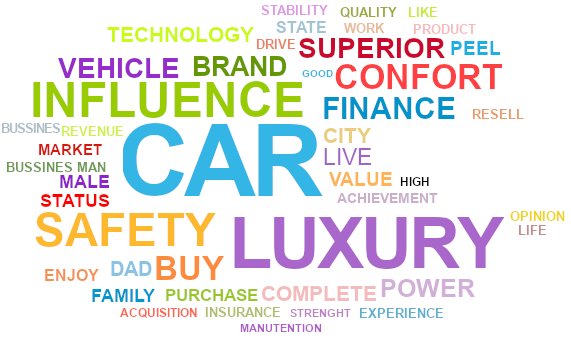
Figure 3
Word cloud containing the most frequent words from participants' narratives.
Source: Own elaboration.
The word “car”, for example, appears as the most frequent term, as expected, given the research focused on luxury vehicles purchase. In this context, a car is not just a way of transportation, but a symbol of status, success and personal achievement. Several interviewees highlighted that luxury cars are the reflection of their personal and financial achievement. E04, for example, stated that it means “winning in life, a car shows how much you ‘can’, it indicates respect when you arrive at places” (Interview excerpt – E04). This view is corroborated by the literature on the consumption of luxury goods, pointing to automobiles as the main goods used to express social differentiation (Wiedmann, Hennigs & Siebels, 2009).
The word “luxury”, on the other hand, appears centrally in the research reinforcing the aspirational nature of purchasing vehicles in this category. Luxury, in addition to indicate quality and exclusivity, carries with it the idea of social status and success (Wiedmann, Hennigs & Siebels, 2009; Lee et al., 2015; Ma & Coelho, 2024; Park, Le &. Hong, 2024). In several reports, interviewees linked luxury with comfort, security and exclusivity, as in the E09’s speech mentioning that “status is the main benefit” (Interview excerpt – E09). Luxury, in this case, is not seen only as something aesthetic, but as an emotional and social need, reflecting the desire for distinction in relation to others, which is aligned with the results of Chernov and Gura (2024).
Social influence is also a central factor in purchasing intentions (Ajzen, 1991). The word “influence” highlights the role that friends, family and the social circle influence the decision to purchase a luxury car (Canguende-Valentim &. Vale, 2022). In the words of E01, he reports that he was influenced by his friends: “friends with the same car as mine also influenced me” (Interview Excerpt – E01). This social pressure, although subtle in some cases can be decisive, especially in contexts where the social group qualifies the possession of high-value goods (Canguende-Valentim & Vale, 2022; Devanathan, 2023; Aleem, Loureiro & Bilro, 2024).
“Safety” in turn, is often mentioned as one of the main benefits of owning a luxury car (Shaw & Pease, 2010). This word refers both to the physical security provided by high-quality vehicles and to the emotional security linked to the vehicle’s prestige and reliability. E08 states that “comfort, safety and personal pleasure drive the purchase” (Interview excerpt – E08), which for him are reasons to acquire a luxury car. Safety is, therefore, a component that reinforces both the positive attitude towards the purchase and the perceived control, as consumers feel safer investing in something that brings them peace of mind on several levels.
Finally, “comfort” appears as another aspect valued by the interviewees, being directly associated with the experience of owning a luxury car. Some of the participants indicated the comfort as a differential that justifies the high investment (Choudhury, Mishra & Mohanty, 2018; Furtado et al., 2022). An example of this is the statement by E16 who highlighted: “[...] this type of car generates a lot of comfort and safety; it is all armored and such" (Excerpt from interview with E16). It is important to perceive that comfort is closely linked to the positive attitude towards purchasing behavior, since it increases the perception of quality of life and well-being provided by the luxury vehicle.
Furthermore, words analysis considered as most relevant in the participants' narratives was executed. For this purpose, a statistical calculation performed by the TF-IDF index was considered. In this analysis, only words with TF-IDF equal to or greater than 9.0 were considered. The results are presented in Table 2.
Must be noted that the TF-IDF index presents the most relevant words in the set of narratives analyzed, and obtaining this result is not linked to the words’ frequency. Hence, it is important to highlight that the indexes observed in the present study are considered low when compared to the studies by Faustino-Dias et al. (2022) and Faustino-Dias et al. (2024). This is because, in their studies, the authors analyzed a large volume of documents. On the other hand, in a more recent study, Faustino-Dias, Guterres and Marques (2025) obtained results similar to those observed here.
Most relevant words in participants’ narratives from TF-IDF

Source: Own elaboration.
As observed in the present research, the words with the highest TF-IDF values are “vehicle” (18.1) and “luxury” (16.5), suggesting that these terms have high relevance in the participants’ discourse, reflecting the relevance of luxury cars in the context of the current research. The word “vehicle” is the most prominent word, indicating that interviewees frequently refer to the concept of automobile in their responses, while “luxury” reinforces the aspirational character associated with their acquisition. The centrality of these words corroborates the symbolic and functional relevance attributed to luxury vehicles (Chernov & Gura, 2024).
Other terms such as “brand” (11.0), “financial” (10.7), and “comfort” (10.0) also appear with high frequency, indicating that participants consider varied factors; such as the car brand, the financial conditions involved and the comfort provided by the vehicle, as important aspects for purchasing decision. It is important to perceive that car’s brand plays crucial role in building identity differentiating in the luxury market, while financial aspect reveals pragmatic concerns aligned with the cost-benefit consumers’ perception (Stokburger-Sauer, Ratneshwar & Sen, 2012; Rodrigues et al., 2023). Comfort, in turn, reinforces those hedonic attributes, such as quality and well-being, are fundamental components of luxury consumption experience (Hennigs et al., 2013).
The brand, particularly, is relevant at the formation of value and in guiding consumer’s decisions in luxury markets, as it adds prestige, exclusivity and symbolic identification to the product or service offered (Díaz-Bustamante, Carcelén & Puelles, 2016; Debenedetti, Philippe & Dion, 2025; Walser-Luchesi, Furst & Rabeson, 2025). In this context, brand equity takes a central role, as it involves both tangible aspects, such as perceived quality and corporate reputation, and intangible dimensions, such as associated tradition and cultural heritage (Kapferer & Valette-Florence, 2021; Nazarani & Suparna, 2021).
The strength of a luxury brand is built through the consistency of its narrative over time, articulating elements such as history, lifestyle and sophistication, in order to establish deep emotional and cultural ties with the target audience (Kapferer & Valette-Florence, 2021). In addition, the reliability conveyed by any brand works as a sign of guarantee and authenticity, fostering the customer’s loyalty and justifying higher prices when compared to generic or lower value-added products (Debenedetti, Philippe & Dion, 2025). In this context, the brand becomes a strategic asset, exerting significant influence on value’s perception, competitive differentiation and the maintenance of long-term relationships with consumers in highly distinctive and selective markets (Kotler, Keller & Chernev, 2024).
Words such as “technology” (9.3) and “market” (9.0) highlight that market value innovation and the perception also influence consumer preferences when purchasing luxury cars. This is because the integration of advanced technologies in premium vehicles, not only increases their functional appeal but also signals modernity and exclusivity to consumers (Kamran et al., 2022; Garikapati & Shetiya, 2024). Furthermore, the word “market” reflects the pressures perceived by participants, as well as the developments in the automobile market experienced in recent years (Iqbal et al., 2022).
Finally, the narratives are presented by subsection, considering TPB constructs. Hence, the discussions for every construct (attitudes, subjective norms, perceived behavioral control and intention) are presented below.
4.2.1 Attitudes towards behavior
The attitude towards behavior within TCP is defined by the positive or negative evaluation that every person has about performing a certain action (Ajzen, 1991). In the context of buying luxury cars, the interviewees' statements revealed that this behavior is generally seen in a positive way. E04 stated that using a luxury car is the “feeling of victory, succeeding in life, the car shows how much you 'can', it commands respect when you arrive at places” (Excerpt from Interview with E04). This indicates that owning a luxury car is perceived as a way of validating success and social position, which strengthens the positive attitude towards the purchase.
Previous studies, such as those by Barakati et al. (2024) and Silva, Costa and Castro (2024), corroborate this perception as they found that the association between luxury cars and a sense of achievement can boost the formation of positive attitudes, especially when the product is seen as a symbol of social ascension. From a managerial perspective, brands can enhance this emotional connection by emphasizing narratives of overcoming and prestige in their campaigns, reinforcing that the acquisition of a luxury vehicle represents both personal and professional achievements. In this context, Andrade (2021) adds that one of the essential tools for this enhancement is the use of storytelling to bring potential consumers closer to the brand, especially on social media.
This positive attitude is strongly related to the symbolism of status and prestige that the luxury car represents. E09 mentioned that “status is the main benefit, especially in my profession, where advertising is prohibited and it is not possible to clearly demonstrate other forms of distinction” (Excerpt from interview with E09). Here, the luxury car is not just something good, but a tool that differentiates a person in a social and professional context, offering a form of distinction that could not be obtained by other social environments (Wiedmann, Hennigs & Siebels, 2009). This symbolism could be considered as one of the main determining factors in the positive attitude towards purchasing a luxury vehicle.
Comparing Wang (2022) and Chernov and Gura (2024) findings with those in the current research, it is observed that the prestige of luxury goods acts as a passport to more exclusive circles, consolidating the perception of social and professional superiority. In fact, this implies the need to create branding strategies that highlight the product as an element of social differentiation, investing in selective communication channels and exclusive experiences to reinforce the idea of distinction (Debenedetti, Philippe & Dion, 2025).
In addition to the symbolic aspect, emotional components are also relevant in the formation of positive attitudes. For E10, it is a “unique feeling of well-being, in addition to adding value” (Interview excerpt – E10). This report exemplifies the emotional connection that every person might have with a luxury car, seen not only as a way of transportation, but as an object providing happiness and satisfaction. This is aligned with literature related to luxury consumption, which points out that the emotional value of something a person has is, often, more relevant than its functional value (Verplanken & Wood, 2006; Wang, 2022; Chernov & Gura, 2024).
In this regard, studies indicate that the emotional dimension in luxury consumption results in a greater willingness to pay high prices, as there is a strong affective component in product evaluation (Neo, Png & Tu, 2008; Ashfaq et al., 2018; Wang, 2022; Silva, Costa & Castro, 2024). In this sense, companies can develop sensory marketing actions, providing immersive test drives, private events and sharing content that awakens the customer's emotional involvement, reinforcing the hedonic value that a luxury car provides.
The positive attitude is also reinforced by functional factors such as safety and comfort. E08, as already mentioned, highlights that luxury cars provide “comfort, safety and personal pleasure” (Interview Excerpt – E08), important characteristics when purchasing a luxury car. This reflects the view that the luxury car does not only offer status, but also concrete benefits in terms of performance and quality (Iqbal et al., 2022; Kamran et al., 2022; Garikapati & Shetiya, 2024). The combination of these factors may create a strongly positive attitude towards consumers’ purchasing behavior, as they see a luxury car as a perfect combination of functionality and prestige.
The combination of functional and symbolic elements increases the attractiveness of the product, as it allows the consumer to justify the high expense both through technical superiority and social recognition (Schade et al., 2016; Debenedetti, Philippe & Dion, 2025; Walser-Luchesi, Furst & Rabeson, 2025). In managerial terms, strengthening this duality may involve highlighting safety certifications, cutting-edge technology and the durability of a vehicle in advertising campaigns, while maintaining the appeal of exclusivity and sophistication.
Finally, positive attitudes towards luxury car purchases can also be seen as a reflection of the interviewees’ personality and background. E09 mentioned his point of view on luxury vehicles as shaped by his “personality” rather than by his upbringing. This point highlights that attitudes can be shaped not only by external influences, but also by internal factors (Ajzen, 1991; Ma & Coelho, 2024; Park, Le &. Hong, 2024), such as personal ambition and desire for distinction. Thus, attitudes towards the purchase of luxury cars are multidimensional, encompassing emotional, functional and symbolic peculiarities, which together strengthen the behavioral intention.
4.2.2 Subjective norms regarding behavior
Subjective norms refer to the customer's perception about the social pressure to perform, or not, a certain behavior (Ajzen, 1991). About the interviews applied in this research, many of them mentioned that the opinion of other people, such as friends and family, are important but are not always decisive for purchasing a luxury car. E18, for example, stated: “they see it as something cool, a good thing, but I didn’t have any opinions” (Interview Excerpt – E18).
The results found here indicate that, although the interviewees recognize the influence of reference groups, there is a perception of independence in the purchase decision, highlighting the relevance of personal conviction. This finding corroborates studies pointing to the coexistence between the desire for social approval and consumer autonomy in choosing luxury goods (Bian & Forsythe, 2012). Critically, however, it might be important to mention that the strength of these norms can vary according to different cultural and socioeconomic contexts (Bian & Forsythe, 2012; Kapferer & Valette-Florence, 2021). Thus, although E18 reports less dependence on others’ opinions, it is possible that, in more collective cultures, the social group pressure is more relevant, requiring a contextualized analysis.
In the sample itself, it is possible to observe different perceptions, demonstrating that social pressure from the environment influences purchasing decisions, that is, the subjective norm exerts greater influence. In the same context, E22 reported that his circle of friends influenced his purchasing decision when mentioning: “friends who have the same car as mine also influenced me at the time, because I’m always with them” (Interview Excerpt – E22). In this example, the purchasing decision is shaped by living in a group that values luxury cars, suggesting that in certain social contexts, purchasing behavior can be reinforced by a desire for conformity and belonging (Canguende-Valentim & Vale, 2022; Devanathan, 2023; Aleem, Loureiro & Bilro, 2024). Ajzen (1991) highlights that implicit social pressure makes the customer want to share the same consumption patterns as their peers.
This empirical evidence contributes to understanding deeply how peer influence can be especially decisive when there is a cohesive group sharing similar consumption behaviors (Chan, Berger & Van-Boven, 2012). From a managerial perspective, this result allows criticism of many marketing approaches, specially of those that ignore the central role of the “brand community” or friendship networks in the persuasion process (Sarkis, Al-Maalouf & Lakiss, 2024). Comparatively, previous studies indicate that social display of luxury items gain greater emphasis in groups where collective status is valued (Wong & Ahuvia, 1998; Petrescu et al., 2024; Skulsuthavong & Wang, 2025), highlighting cultural differences that, provably, modulate the subjective norms’ intensity.
Furthermore, subjective norms can be influenced by professional expectations. E25 reported that, by exchanging his popular car for a luxury one, he started to sell more and gained greater credibility with customers. This change in perception regarding his profession demonstrates that, in certain fields, the status conferred by a luxury car can be a way to increase customer trust and, therefore, professional success (Meier & Mutz, 2020; Pan, 2021; Soza-Parra & Cats, 2024). Thus, subjective norms not only reflect direct social pressure, but also implicit professional expectations in certain markets.
In this sense, the results point to contributions for the management of brands and professionals who depend on customer validation in highly competitive markets. Owning a luxury car can represent a “sign” of competence and prosperity, leveraging the trust of potential consumers (Philippe, Debenedetti & Chaney, 2022). However, it is important to critically question whether this practice can induce inequalities or foster unrealistic expectations in certain sectors, potentially distorting the perception of real professional capacity or quality (Veblen, 2018). Thus, managers must balance the adoption of status symbols with organizational policies that emphasize the real value of the service or product offered, avoiding the overvaluation of ostentatious goods.
The literature suggests that, although subjective norms are an important predictor of behavioral intention, their impact may vary depending on the individual’s autonomy in relation to their social groups (Armitage & Conner, 2001; Canguende-Valentim & Vale, 2022). In the case of luxury car purchases, it seems that, for many interviewees, external pressures are minimized by strong personal conviction regarding the behavior. E23 says that “I am 100% aware of what I want in terms of cars” (Interview excerpt – E23). Personal conviction and decision-making autonomy reduce the impact of subjective norms, making them less relevant. This narrative highlights the importance of considering the interaction between personal predisposition and the persuasive power of subjective norms. In terms of comparisons, recent research corroborates the idea that consumers with high self-efficacy or a strong sense of individual identity tend to resist group pressures more when it comes to luxury brands (Kapferer & Valette-Florence, 2021). On the other hand, it is essential to criticize the potential selection bias of interviewees, as those who already have high purchasing power may feel less pressured by the opinions of others, in contrast to consumers with intermediate income, who may depend more on the social recognition provided by luxury goods.
4.2.3 Perceived behavioral control over behavior
Perceived behavioral control over behavior refers to the ease or difficulty that a person believes in performing any desired behavior (Ajzen, 1991). In the case of purchasing luxury cars, the control perceived by the interviewees is strongly linked to financial condition and the ability to maintain the vehicle. Regarding this, E13 said: “without a good monthly income, I could not have or maintain the cars I have had to date” (Interview excerpt – E13).
The relevance of financial aspects in the acquisition of luxury products has been emphasized by several studies, which point to the need for prior economic stability as a determining factor in perceived behavioral control (Kapferer & Tabatoni, 2011; Ashfaq et al., 2018; Canguende-Valentim & Vale, 2022; Barakati et al., 2024; Cappeli, Banks & Gardner, 2024). In particular, large expenditures require greater awareness of risks and a greater ability to plan the costs of maintaining and preserving the asset (Ko, Costello & Taylor, 2019). For the luxury market, the exclusivity offered by the products must be supported by clarity about financial factors involved, since high-income consumers want to both signal their status and avoid negative surprises in the mean and long term (Shukla & Purani, 2012). In this way, a careful analysis of purchasing power and available sources of income reinforces the feeling of control, encouraging the intention to purchase.
In addition to the individual financial issue, management research in the field of luxury marketing highlights that perceived behavioral control can be reinforced or reduced by the way how brands communicate their values and financing possibilities to their consumers (Atwal & Williams, 2009; Kapferer & Tabatoni, 2011). In this context, the more transparent and accessible the information about maintenance costs, warranty plans and exclusive assistance benefits, the greater the level of control perceived by consumers tends to be. From a management perspective, this suggests the need for communication strategies that emphasize not only the prestigious characteristics of the vehicle, but also the financial predictability involved in its acquisition.
In addition, adequate financial planning is also a factor that increases perceived control. E07 commented that, for him, the purchase of a luxury car is only possible in cases where there is good planning. This planning involves considering not only the vehicle’s price, but also its costs such as insurance, maintenance and taxes. Thus, perceived control over luxury car purchasing depends on the person's ability to predict and manage these costs over time, which can influence, facilitate or hinder the purchase intention.
From a comparative perspective, results from studies in other high-value goods segments reinforce the role of perceived control as a catalyst between purchase intention and completion (Kim et al., 2013; Zhang & Huang, 2024). In premium markets, the ability to manage perceived costs and risks is the key element for decision-making (Ko, Costello & Taylor, 2019). In this context, the adoption of loyalty programs and after-sales services, such as fixed-price revision plans, is a management practice that can strengthen the buyer's sense of security regarding the sustainability of the investment (Kapferer & Valette-Florence, 2021).
The narratives of E07 and E13 related to financial management and planning demonstrate that this concern has been increasing for making purchases, especially for large-value purchases (Birkenmaier & Fu, 2019; Nuñez-Letamendia, Yeo, Lim & Yii, 2023; Sánchez-Ruiz & Silva, 2024). Also, considering that people have been consuming more and more impulsively, such considerations highlight the concern of consumers in this market to remain financially stable, as discussed by Creevy and Furnham (2019) Cappelli, Banks and Gardner (2024).
Another important aspect of perceived control is the possibility of financing. Several interviewees in the present work mentioned that access to favorable financing conditions makes it easier to purchase a luxury car. E05 stated: “ease of financing and interest rates” are factors that positively influence his decision. This reflects the role of credit options in increasing perceived control, since these options allow the customer to acquire any good without compromising his/her immediate financial well-being (Barakati et al., 2024).
From a critical perspective, however, easy credit conditions might lead to a “false sense of control,” in which consumers underestimate the medium- and long-term financial impacts (Xavier, Ferreira & Bizarrias, 2019). In terms of managerial implications, it is essential that companies provide clear information about interest rates, terms and additional costs in order to avoid over-indebtedness among their target audience. In contrast, when financial institutions and automobile makers come together to offer transparent and customized payment terms, consumers’ sense of trust and control tends to be reinforced, resulting in greater loyalty (Xavier, Ferreira & Bizarrias, 2019).
On the other hand, perceived control is also influenced by barriers, such as the high price of certain car models and the difficulty of maintenance of the vehicle in the long term. As an example, E15 mentioned: “the price of the luxury car and the conditions to pay for it and maintain it” are priority factors in the purchase decision, since they can act as a facilitating or interfering factor. It is important to note that in the luxury market, such as premium vehicles, high prices are elements used to guarantee consumer exclusivity (Choudhury, Mishra, & Mohanty, 2018; Devanathan, 2023; Barakati et al., 2024; Park, Le & Hong, 2024). Thus, the greater the perceived control, the greater the likelihood that the purchase intention will actually be realized.
4.2.4 Behavioral intention
Behavioral intention, in the TPB, is the main predictor of behavior, directly influenced by the attitude towards the behavior, subjective norms and perceived behavioral control (Ajzen, 1991). In the case of purchasing luxury cars, the interviewees’ intentions were generally clear and positive, reinforced by the combination of favorable attitudes, perceived control over the purchase and, in some cases, social pressures. E09 mentioned that “he/she always wanted to have a luxury car”; emphasizing: “it is a personal achievement”.
In this regard, Ko, Costello, and Taylor (2019) stated that the strengthening of purchase intention for luxury vehicles is also related to the mechanisms on how companies, in luxury cars, communicate about the symbolism and functional values of their products. The association between the vehicle and the consumer's personal achievement, as well as the status experience that the good provides, tends to intensify the purchase intention, as it signals the achievement of life goals and social advancement. In this context, branding strategies that emphasize prestige and exclusivity can generate greater emotional involvement, resulting in more robust and lasting purchase intentions.
However, purchase intention can be modulated by external factors, such as financial situation or new life priorities. E15 reflected on the difficulty of maintaining purchase intention in the face of family commitments, stating that “I still have other priorities before realizing this dream, such as educating my children”. This type of external interference suggests that, although the intention is clear, the behavior implementation may depend on other circumstances changing the person’s priorities, which is consistent with the TPB assumptions.
Despite the fact that the purchase intentions are susceptible to changes in the circumstances, research indicates that consumers who are willing to invest in luxury goods tend to resume this behavior when their personal or market conditions become more favorable (Wiedmann, Hennigs & Siebels, 2009; Hennigs et al., 2013). In this sense, the development of long-term relationship strategies that maintain active the desire to purchase, even when external factors postpone this process, are important. Loyalty programs, exclusive events and ongoing contact with the brand can nurture the intention until the necessary resources or the consumer's priorities are aligned again with the purchase of a luxury car.
Furthermore, the intention to purchase luxury cars appears to be particularly strong when the customer perceives that the behavior is a reflection of his/ her personal success and social status. E25 said: “I understand that my point of view about luxury products was more influenced by my personality than by my education”. This indicates that the intention to purchase a luxury car is intrinsically linked to self-image and perception of success (Meier & Mutz, 2020; Pan, 2021; Soza-Parra & Cats, 2024), which strengthens the intention and increases the likelihood that the behavior will be developed.
Another factor reinforcing the intention to behave is the adequate financial planning. E15 mentioned that he “wouldn’t go to crazy financial lengths to buy a luxury car. I buy what I can afford and what is within my budget.” This type of planning, combined with a clear perception of financial control, increases the likelihood that the intention to purchase will be realized in a responsible manner, without compromising the customer’s financial health (Birkenmaier & Fu, 2019; Nuñez-Letamendia, Yeo, Lim & Yii, 2023; Sánchez-Ruiz & Silva, 2024). This corroborates the TPB principles, which postulates that behavioral intention is stronger when the individual perceives that he or she has control over the action (Ajzen, 1991).
5 FINAL CONSIDERATIONS
The objective of this research was to understand the determining factors for the purchase of premium vehicles, using Ajzen's TCP (1991) as a basis. Based on interviewees’ narratives, it was possible to explore the central constructs of TCP, and how these factors can influence the intention to purchase a luxury car. The qualitative analysis allowed us to identify emotional, functional and social aspects that reinforce purchase decisions, offering different insights related to internal and external motivators guiding the high-end consumers’ behavior.
The main results indicate that the attitude towards the behavior is largely positive, being reinforced by the symbolism of status, prestige and personal achievement linked with the ownership of premium vehicles. In addition, functional elements such as safety, comfort and technology were decisive in justifying the choice of these vehicles. Subjective norms proved to be relevant, especially in contexts in which social and professional pressures influence decisions, although some interviewees reported greater personal autonomy in their choices. Perceived control, on the other hand, was strongly influenced by financial stability and available financing conditions, proving to be the most important factor to accomplish a purchase intention.
The managerial insights from this study are valuable for premium vehicle brands, which can use these results to improve their marketing strategies. Understanding that status, social differentiation and comfort are key motivators for these consumers; it allows automobile makers to create their advertising campaigns, offering better products to meet customer’s expectations. Additionally, the role of financial control suggests that companies can invest in more affordable and personalized financing options for high-end customers, maximizing the opportunities for converting intentions into purchases. In the long term, implementing loyalty programs, exclusive after-sales services and differentiated maintenance plans can strengthen the bond with the consumer, reinforcing the perception of added value, establishing a long-lasting and profitable relationship.
In terms of academic contributions, this study enriches the application of TCP with qualitative approaches, as well as in the context of luxury consumption, demonstrating how the constructs of this theory manifest themselves specifically in the purchase of premium vehicles. The research also expands the field of study on luxury-related consumption behaviors, contributing to a broader understanding of how psychological, emotional and social factors interact in the formation of behavioral intentions in high-value markets. The integrated analysis of purchase decision determinants – such as status, social differentiation, perception of financial control and the influence of subjective norms – contributes to elucidate the interdependence between rational and emotional elements for decision-making process, highlighting the value of TCP as a theoretical framework for understanding this market.
However, the research has some limitations. Initially, it is relevant to point out that, even though the research results contribute to the understanding of luxury car purchasing behavior, the sample used was restricted to a specific group of consumers, making it difficult to generalize these findings to other regions or cultural contexts. In addition, the qualitative approach, although essential for an in-depth understanding of the subjective and symbolic factors, linked with the purchase of premium vehicles, does not allow for a statistical analysis that measures the weight of each construct in the purchase intention.
Future research suggests exploring other factors that may influence the purchase of luxury vehicles, such as the impact of new technologies, especially the introduction of premium electric vehicles, which raise additional sustainability-related issues. Another interesting subject would be to investigate how luxury car purchasing behavior differs between emerging and developed markets, considering every cultural and economic variation. It is also recommended to apply quantitative methods, as well as Structural Equation Modeling, to assess how each construct is influenced.
REFERENCES
Ajzen, I. (2006). Perceived behavioral control, self-efficacy, locus of control, and the Theory of Planned Behavior. Journal of Applied Social Psychology, 32(4), 665-683. https://doi.org/10.1111/j.1559-1816.2002.tb00236.x
Ajzen, I., & Fishbein, M. (1980). Understanding attitudes and predicting social behavior. Englewood Cliffs: Prentice-Hall.
Aleem, A., Loureiro, S. M. C., & Bilro, R. G. (2024). Luxury fashion consumption: Review, synthesis and research agenda. Spanish Journal of Marketing – ESIC, 28(2), 144-164. https://doi.org/10.1108/SJME-06-2021-0105
Al-Issa, N., & Thanasi, M. Mapping the future of tech-infused luxury: A roadmap and research directions. International Journal of Consumer Studies, 48(6), e13103. https://doi.org/10.1111/ijcs.13103
Andrade, C.F.R. (2021). The power of stories: luxury brand communication on social media. (Master’s Thesis). Universidade Católica Portugues, Lisboa.
Armitage, C.J., & Conner, M. (2001). Efficacy of the theory of planned behaviour: A meta-analytic review. British Journal of Social Psychology, 40(4), 471-499. https://doi.org/10.1348/014466601164939
Ashfaq, M., Yun, J., Waheed, A., & Abassi, A.Z. (2018). Buying luxury brands online: The effect of money-back guarantee on perceived risk and purchase intention. International Journal of Marketing, Communication and New Media, 4, 102-121.
Atwal, G., & Williams, A. (2009). Luxury brand marketing: The experience is everything! Journal of Brand Management, 16, 338-346. https://doi.org/10.1057/bm.2008.48
Barakati, P., Bertini, F., Corsi, E., Gabbrielli, M., & Montese, D. (2024). Luxury car data analysis: A literature review. Data, 9(4), 48. https://doi.org/10.3390/data9040048
Bardin, L. (2015). Análise de Conteúdo. Lisboa: Edições 70.
Belleghem, S.V. How the digital world is shaping the modern consumer. Strategic Decision, 32(5), 1-12. https://doi.org/10.1108/SD-02-2016-0026
Bertoli, G., Busacca, B., & Imperato, M. (2020). Premium private label: How product value, trust and category involvement influence consumers willingness to. Buy. Italian Journal of Marketing, 2020, 143-161. https://doi.org/10.1007/s43039.020.00012-7
Bian, Q., & Forsythe, S. (2012). Purchase intention for luxury brands: A cross-cultural comparison. Journal of Business Research, 65(10), 1443-1451. https://doi.org/10.1016/j.jbusres.2011.10.010
Birkenmaier, J., & Fu, Q. J. (2019). Does consumer financial management behavior relate to their financial access? Journal of Consumer Policy, 42, 333-348. https://doi.org/10.1007/s10603-019-09418-z
Brasil. (2016). Resolução nº 510, de 07 de abril de 2016. https://www.gov.br/conselho-nacional-de-saude/pt-br/acesso-a-informacao/legislação/resoluções/2016/resolução-no-510.pdf
Canguende-Valentim, C., & Vale, V. (2022). Examining the Intention to Purchase luxury goods based on the Planned Behaviour Theory. Open Journal of Business and Management, 10, 192-210. https://doi.org/10.4236/ojbm.2022.101012
Cappelli, T., Banks, A. P., & Gardner, B. (2024). Understanding money-management behaviour and its potential determinants among undergraduate students: A scoping review. Plos One, 19(8), e0307137. https://doi.org/10.1371/journal.pone.0307137
Chan, C., Berger, J., & Van-Boven, L. (2012). Identifiable but not identical: Combining social identity and uniqueness motives in choice. Journal of Consumer Research, 39(3), 561-573. https://doi.org/10.1086/664804
Chaudhary, S., & Kumar, R. (2021). The role of consumer behavior in buying the luxury goods. Webology, 18(1), 466-482.
Chernov, S., & Gura, D. (2024). The luxury goods market: Understanding the psychology of Chinese consumers. European Research on Management and Business Economics, 30(3), 100254. https://doi.org/10.1016/j.iedeen.2024.100254
Choudhury, M., Mishra, B. B., & Mohanty, P. K. (2018). An empirical study of car selection factors: A qualitative & systematic review of literature. International Journal of Management, Technology and Engineering, 8(12), 3055-3069.
Creevy, M. F., & Furnham, A. (2019). Money attitudes, personality and chronic impulse buying. Applied Psychology, 69(4), 1557-1572. https://doi.org/10.1111/apps.12215
Creswell, J. W., & Creswell, J.D. (2021). Projeto de pesquisa: métodos qualitativo, quantitativo e misto. (5ed). Porto Alegre: Penso.
Debenedetti, A., Philippe, D., & Dion, D. (2025). Blancing exclusivity and inclusivity through the strategic domestication of the Luxury retail experience. International Journal of Research in Marketing, 42(1), 32-54. https://doi.org/10.1016/j.ijresmar.2024.05.001
De-Silva, S., Khatibi, A., & Azam, S. M. F. (2020). Factors affecting to the consumer attitude towards global luxury car brands. European Journal of Management and Marketing Studies, 5(2), 175-190. https://doi.org/10.5281/zenodo.3846830
De-Silva, S., Seeley, E. L., Ongsakul, V., & Ahmed, Z. U. (2019). Conceptualizing a new model for luxury brand purchase intention in an emerging country setting. Journal of Transnational Management, 25(2), 100-127. https://doi.org/10.1080/15475778.2020.1734419
Devanathan, S. (2023). Tracing the characteristics and consequences of luxury through a review of literature. International Journal of Professional Business Review, 8(11), e03870. https://doi.org/10.236668/businessreview/2023.v8i11.3870
Díaz-Bustamante, M., Carcelén, S., & Puelles, M. (2016). Image of Luxury brands: A question of style and personality. SAGE Open, 6(2). https://doi.org/10.1177/2158244016644946
Diniz, C. (2012). O mercado do luxo no Brasil: tendências e oportunidades. São Paulo: Editora Seoman.
Fallini, F., & Rezzano, S. (2021). Defining luxury cars: a comprehensive study of critical success factors and managerial strategies. (Master’s Thesis). Politecnico Di Milano, Milano.
Faustino-Dias, A. F., Guterres, J. S., & Marques, J. L. D. (2025). Tecendo conexões virtuais: O papel das comunidades online nas decisões de compra. Revista Observatório, 10(1).
Faustino-Dias, A. F., Spanhol, C. P., & Marques, J. L. D. (2024). Alimentação e obesidade no contexto governamental brasileiro: Análise das políticas, programas, planos e manuais por meio da mineração de texto. Revista de Administração IMED, 14(1), 19-43. https://doi.org/10.18256/2237-7956.2024.vl4il.5046
Faustino-Dias, A. F., Spanhol-Finocchio, C. P., & Mariani, M. A. P. (2022). Escaneamento das políticas públicas brasileiras de alimentação a partir do Nourishing. Framework. Economia & Região, 10(1), 53-65. https://doi.org/10.5433/2317-627X.2022v10n1p53
Fishbein, M., & Ajzen, I. (1975). Belief, attitude, intention and behavior: An introduction to theory and research. Reading: Addison-Wesley.
Fishbein, M., & Ajzen, I. (2010). Predicting and changing behavior: the reasoned action approach. New York: Psychology Press.
Furtado, G. F., Boeing, R., Almeida, Q. M., Sousa, A. M. R., & Santos, R. C. (2022). Fatores de influência da tomada de decisão do consumidor: A perspectiva comportamental da compra de carro. ReMark, 22(1), 223-300. https://doi.org/10.5585/remark.v22i1.17462
Garikapati, D., & Shetiya, S. S. (2024). Autonomous vehicles: evolution of artificial intelligence and the current industry landscape. Big Data and Cognition Computing, 8(4), 42. https://doi.org/10.3390/bdcc.8040042
Greene, D., Hossain, A., Hofmann, J., Helfand, G., & Beach, R. (2019). Consumer willingness to pay for vehicle attributes: what do we know? Transportation Research Part A: Policy and Practice, 118, 258-279. https://doi.org/10.1016/j.tra.2018.09.013
Hennigs, N., Wiedmann, K. P., Klarmann, C., & Behrens, S. (2013). Sustainability as part of the luxury essence: delivering value through social and environmental excellence. The Journal of Corporate Citizenship, 52, 25-35. https://www.jstor.org/stable/jcorpciti.52.25
Hien, V. T., Thong, V. H., & Yen, T. H. (2024). Applying the extended theory of planned behavior model in studying luxury fashion products’ purchase intention of Vietnamese consumers. Revista de Gestão Social e Ambiental, 18(6), e05471. https://doi.org/10.24857/rgsa.v18n6-095
Holmqvist, V. (2015). Driving with an exclamation mark: BMW owners in pursuit of prestige. (Dissertação). University of Vaasa, Vaasa, Finlândia. https://osuva.uwasa.fii/handle/10024/665
Iqbal, M. Y., Li, T. W. G., Chen, D., & Al-Nehari, M. (2022). A study of advanced efficient hybrid electric vehicles, electric propulsion and energy source. Journal of Power and Energy Engineering, 10, 1-12. https://doi.org/10.4236/jpee.2022.107001
Jain, S., Khan, M. N., & Mishra, S. (2017). Understanding consumer behavior regarding luxury fashion goods in India based on the theory of planned behavior. Journal of Asia Business Studies, 11(1), 4-21. https://doi.org/10.1108/JABS-08-2015-0118
Kamran, S. S., Haleem, A., Bahl, S., Javaid, M., Prakash, C., & Budhhi, D. (2022). Artificial intelligence and advanced materials in. automotive industry: Potential applications and perspectives. Materials Today Proceedings, 62(6), 4207-4214. https://doi.org/10.1016/j.matpr.2022.04.727
Kapferer, J. N., & Tabatoni, O. (2011). Are luxury brands really a financial dream? Journal of Strategic Management Education, 7(4).
Kapferer, J. N., & Valette-Florence, P. (2021). Which consumers believe luxury must be expensive and why? A cross-cultural comparison of motivations. Journal of Business Research, 132, 301-313. https://doi.org/10.1016/j.jbusres.2021.04.003
Kim, H. Y., Lee, J. Y., Choi, D., Wu, J., & Johnson, K. K. P. (2013). Perceived benefits of retail loyalty programs: their effects on program loyalty and customer loyalty. Journal of Relationship Marketing, 12(2), 95-113. https://doi.org/10.1080/15332667.2013.794100
Kim, J. H., & Lee, H. C. (2019). Understanding the repurchase intention of premium economy passengers using as extended Theory of Planned Behavior. Sustainability, 11(11), 3213. https://doi.org/10.3390/su11113213
Ko, E., Costello, J. P., & Taylor, C. R. (2019). What is a luxury brand? A new definition and review of the literature. Journal of Business Research, 99, 405-413. https://doi.org/10.1016/j.jbusres.2017.08.023
Kotler, P., Keller, K. L., & Chernev, A. (2024). Administração de marketing (16ed). São Paulo: Pearson.
La-Barbera, F., & Ajzen, I. (2020). Control interactions in the Theory of Planned Behavior: Rethinking the role of subjective norm. Europe’s Journal of Psychology, 16(3), 401-417. https://doi.org/10.5964/ejoo.v16i3.2056
Lee, H., Jang, Y., Kim, Y., Choi, H. M., & Ham, S. (2019). Consumers’ prestige-seeking behavior in premium food markets: Application of the theory of the leisure class. International Journal of Hospitality Management, 77, 260-269. https://doi.org/10.1016/j.ijhm.2018.07.005
Li, F., Aw, E. C. X., Tan, G. W. H., Cham, T. H., & Ooi, K. B. (2022). The Eureka moment in understanding luxury brand purchases! A non-linear fsQCA-ANN approach. Journal of Retailing and Customer Services, 68, 103039. https://doi.org/10.1016/j.jretconser.2022.103039
Lopes, J. M., Gomes, S., Nogueira, E., & Trancoso, T. (2024). AI’s invisible touch: How effortless browsing shapes customer perception, experience and engagement in online retail. Cogent Business & Management, 12(1). https://doi.org/10.1080/23311975.2024.2440628
Ma, M. H., & Coelho, A. (2024). Luxury consumption tendency: A comparative study between Chinese and Portuguese consumers. Journal of Global Marketing, 37(3),175-193. https://doi.org/10.1080/08911762.2024.2350926
Meier, H. E., & Mutz, M. (2020). Does attractiveness lead to or follow from occupational success? Findings from German Associational Football. SAGE Open, 10(1). https://doi.org/10.1177/2158244020903413
Milheiro, A. B., Sousa, B. B., Santos, V. B., Milheiro, C. B., & Vilhena, E. (2024). Understanding the role of brand attachment in the automative luxury brand segment. Administrative Sciences, 14(6), 119. https://doi.org/10.3390/admsci14060119
Nascimento, A. R. F., & Menandro, P. R. M. (2006). Análise lexical e análise de conteúdo: uma proposta de utilização conjugada. Estudos e Pesquisas em Psicologia, 6(2), 72-88.
Nazarani, M. R., & Suparna, G. (2021). The effect of Luxury brand, brand image, and product quality on Purchase intention. American Journal of Humanities and Social Sciences Research, 5(1), 290-295.
Neo, P. H., Png, S. E., & Tu, Y. (2008). Buyer exuberance and price premium. Urban Studies, 45(2), 331-345. https://doi.org/10.1177/0042098007085966
Nuñez-Letamendia, L., Sánchez-Ruiz, P., & Silva, A. C. (2024). More than knowledge: Consumer financial capability and saving behavior. International Journal of Consumer Studies, 49(1), e13097. https://doi.org/10.1111/ijcs.13097
Olsen, W. (2015). Coleta de dados: debates e métodos fundamentais em pesquisa social. Porto Alegre: Penso.
Pan, S. (2021). The impact of physical appearance on employment competitiveness. Advances in Social Sciences, 631, 1033-1036. https://doi.org/10.2991/assehr.k.220105.191
Park, J., Le, H. T. P. M., & Hong, E. (2024). The evolution of luxury consumption and conceptualization: A synthetic review. Luxury: History, Culture, Consumption. https://doi.org//10.1080/20511817.2023.2300230
Petrescu, M., Siqueira, J. R., Dobre, C., Mrad, S. B., Ciuta, A. M., & Kara, A. (2024). Social comparison and self-determination in luxury consumption motivations. Psychology & Marketing, 42(2), 292-310. https://doi.org/10.1002/mar.22126
Philippe, D., Debenedetti, A., & Chaney, D. (2022). How brands mobilize status, reputation, and legitimacy cues to signal their social standing: the case of luxury watchmaking. Marketing Theory, 22(3), 333-358. https://doi.org/10.1177/14705931221089327
Plens, M. (2003). Um modelo de formação em gestão para engenharia aplicado no curso cooperativo de engenharia de materiais da UFSC. (Tese). Universidade. Federal de Santa Catarina, Florianópolis, Santa Catarina, Brasil. http://repositorio.ufsc.br/xmlui/handle/123456789/86508
Rahi, S., Ghani, M. A., Al-Okaily, M., Rachis, A., Alghizzawi, M., & Shiyyab, F. S. (2024). Breaking into the black box of the customer perception towards robot service: Empirical evidence from service sector. Heliyon, 10(19), e38117. https://doi.org/10.1016/j.heliyon.2024.e38117
Rahma, A. Z., Qulub, A. N., Prasetyo, W., Rizqi, N. A., & Sodiq, A. (2024). Contemporary business environment and contemporary techniques. Journal of Global Research Publications, 1(1), 18-25. https://doi.org/10.59435/jgrp.v1i1.2024.4
Rodrigues, D., Sousa, B., Gomes, S., Oliveira, J., & Lopes, E. (2023). Exploring consumer Behavior and brand management in the automotive sector: Insights from a digital and territorial perspective. Administrative Sciences, 13(2), 36. https://doi.org/10.3390/admscii13020036
Sarkis, N., Al-Maalouf, N. J., & Lakiss, R. E. (2024). Examining influencer marketing: the roles of para-social relationships, unpaid collaborations, and trustworthiness in shaping consumer buying behavior. Cogent Business & Management, 11(1). https://doi.org/10.1080/23311975.2024.2419501
Schade, M., Hegner, S., Horstmann, F., & Brinkmann, N. (2016). The impact of attitude functions on luxury brand consumption: an age-based group comparison. Journal of Business Research, 69(1), 314-322. https://doi.org/10.1016/j.jbusres.2015.08.003
Shaw, D., & Pease, K. (2010). Car security and the decision to recommend purchase. Crime Prevention and Community Safety, 12, 91-98. https://doi.org/10.1057/cpcs2020.3
Sheeran, P., Trafimow, D., & Armitage, C. J. (2010). Predicting behaviour. From perceived behavioural control: tests of the accuracy assumption of the theory of planned behaviour. British Journal of Social Psychology, 42(3), 393-410. https://doi.org/10.1348/014466603322438224
Shukla, P., & Purani, K. (2012). Comparing the importance of luxury value perceptions in cross-national contexts. Journal of Business Research, 65(10), 1417-1424. https://doi.org/10.1016/j.jbusres.2011.10.007
Silva, J. L. G., Costa, T. P. P., & Castro, F. N. (2024). Tell me what you buy, and I will tell you how you are: Luxurious cars increase perceptions of status, social dominance, and attractiveness. Personality and Individual Differences, 218, 112489. https://doi.org/10.1016/j.paid.2023.112489
Skulsuthavong, M., & Wang, Z. (2025). Displaying luxury on social media: Chinese university students’ perception of identity, social status, and privilege. Online Media and Global Communication. https://doi.org/10.1515/omgc-2024-0011
Solomon, M. R. (2016). O comportamento do consumidor: comprando, possuindo e sendo. São Paulo: Bookman.
Soza-Parra, J., & Cats, O. (2024). The role of personal motives in determining car ownership and use: A literature review. Transport Reviews, 44(3), 591-611. https://doi.org/10.1080/01441647.2023.2278445
Stokburger-Sauer, N., Ratneshwar, S., & Sen, S. (2012). Drivers of consumer-brand identification. International Journal of Research in Marketing, 29(4), 406-418. https://doi.org/10.1016/j.ijresmar.2012.06.001
Sun, Y., Wang, R., Bai, H., Whyatt, G., & Ohandi, T. T. (2024). Perceived value of luxury fashion brands – evidence from Indonesian Millenials. SN Business & Economics, 4, 169. https://doi.org/10.1007/s43546-024-00755-x
Tatt, K. E. (2010). Factors influencing consumer buying behaviour of luxury brand goods. (Dissertação). Universiti Sains Malaysia, Pulau, Pinang, Malaysia. https://core.ac.uk/download/pdf/11946945.pdf
Veblen, T. (2018). A Teoria da classe do lazer. Lisboa: Actual.
Verplanken, B., & Wood, W. (2006). Interventions to break and create consumer habits. Journal of Public Policy & Marketing, 25(1), 90-103. https://doi.org/10.1509/jppm.25.1.90
Vigneron, F., & Jhonson, L. W. (1999). A review and a conceptual framework of prestige-seeking consumer behavior. Academy of Marketing Science Review, 2(1), 1-15.
Walser-Luchesi, A., Furst, A.C., & Rabeson, L. (2024). Second-hand luxury for generations Y and Z: Embracing responsible consumption or hunting for luxury brand teasures? An analysis from France using the Theory of Planned Behavior. In A. H. Verkuil, U. Milow, A. Hinz & M. Al-Kilani (eds.). Core Values and Decision-Making for Sustainable Business. Cham: Springer. https://doi.org/10.1007/978-3-031-78361-6_10
Wang, Y. (2022). A conceptual framework of contemporary luxury. Consumption. International Journal of Research in Marketing, 39(3), 788-803. https://doi.org/10.1016/j.ijresmar.2021.10.010
Wiedmann, K. P., Hennigs, S., & Siebels, A. (2009). Value-based segmentation of luxury consumption behavior. Psychology & Marketing, 26(7), 625-651. https://doi.org/10.1002/mar.20292
Wong, N. Y., & Ahuvia, A. C. (1998). Personal taste and family face: luxury consumption in Confucian and Western societies. Psychology & Marketing, 15(5), 423-441. https://doi.org/10.1002/(SICI)1520-6793(199808)15:5%3C423::AID-MAR2%3E3.0.CO;2-9
Xavier, T., Ferreira, M. C. O., & Bizarrias, F. S. (2019). The relation between financial attitude, consumer purchasing behavior and debt background. ReMark, 18(4), 220-243. https://doi.org/10.5585/remark.v18i4.13898
Yeo, K. H. K., Lim, W. M., & Yii, K. Y. (2024). Financial planning behaviour: A systematic literature review and new theory development. Journal of Financial Services Marketing, 29, 979-1001. https://doi.org/10.1057/s41264-023-00249-1
Zhang, B., & Kim, J. H. (2013). Luxury fashion consumption in China: Factors affecting attitude and purchase intent. Journal of Retailing and Consumer Services, 20(1), 68-79. https://doi.org/10.1016/j.jretconser.2012.10.007
Zhang, Y., & Huang, S. (2024). The influence of visual marketing on consumers’ purchase intention of fast fashion brands in China: An exploration based on fsQCA method. Frontiers in Psychology, 15, 1190571. https://doi.org/10.3389/fpsyg.2024.1190571
Información adicional
redalyc-journal-id: 5707
