
Esta obra está bajo una Licencia Creative Commons Atribución-NoComercial 4.0 Internacional.
Recepción: 03 Diciembre 2024
Aprobación: 19 Febrero 2025
Publicación: 16 Abril 2025
DOI: https://doi.org/10.36517/contextus.2025.94611
Abstract:
Contextualization: When analyzing workplace violence and subjectivation processes, epistemic violence is highlighted as a structural mechanism that delegitimizes and marginalizes the knowledge and perspectives of specific groups, consolidating dynamics of exclusion and social isolation. The TV series "The Office" presents an emblematic representation of this phenomenon through the disconnection between the main character's behavior, Michael, and employees' perceptions. This attitude manifests in practices that generate recurring feelings of disrespect and devaluation, highlighting the complex power and hierarchy relations that perpetuate symbolic violence in the workplace.
Objective: To understand workplace violence and subjectivation processes from the epistemicide perspective, using the TV series "The Office" as a reference.
Method: A qualitative, observational study was grounded in the "structured microanalysis". This method, anchored in thematic axes and subthemes, enabled the constructing of a network of meanings, allowing a systematic analysis of the investigated dynamics.
Results: The study revealed the reproduction of inequalities and injustices in the workplace, with the characters demonstrating forms of resistance to these dynamics by seeking to assert their identities and validate their experiences against the dominance of hegemonic knowledge. This struggle for recognition and appreciation underscores the urgency of constructing inclusive work environments that respect and embrace diverse perspectives, promoting equity and justice in organizational relations.
Conclusions: The findings emphasize the social and theoretical implications of epistemic violence in the workplace, highlighting how it devalues knowledge and perpetuates inequalities. The study contributes to understanding the dynamics of exclusion and resistance, offering a critical perspective on the impact of power relations on individual subjectivation. It also highlights the role of organizations in establishing practices that value the diversity of voices and knowledge.
Keywords: violence at work, epistemicide, organizational relations, processes of subjectivation, observational study.
Resumo:
Contextualização: Ao analisar a violência no ambiente de trabalho e os processos de subjetivação, ressalta-se que a violência epistêmica opera como um mecanismo estrutural que deslegitima e marginaliza os saberes e perspectivas de determinados grupos, consolidando dinâmicas de exclusão e isolamento social. A partir do seriado The Office, identifica-se uma representação emblemática desse fenômeno por meio da desconexão entre o comportamento do personagem principal, Michael, e as percepções dos funcionários. Essa desconexão se traduz em práticas que geram sentimentos recorrentes de desrespeito e desvalorização, evidenciando as complexas relações de poder e hierarquia que perpetuam a violência simbólica no ambiente laboral.
Objetivo: Compreender a violência no local de trabalho e os processos de subjetivação a partir da perspectiva do epistemicídio, utilizando a série ‘The Office’ como referência.
Método: Realizou-se uma pesquisa qualitativa de caráter observacional, fundamentada no método de ‘microanálises estruturadas’. Esse método, ancorado em eixos temáticos e subtemas, possibilitou a construção de uma rede de significados, permitindo uma análise sistemática das dinâmicas investigadas.
Resultados: Evidenciou-se a reprodução de desigualdades e injustiças no ambiente laboral, tendo os personagens demonstrado formas de resistência a essas dinâmicas ao buscar afirmar suas identidades e validar suas experiências diante da hegemonia do conhecimento dominante. Essa luta pelo reconhecimento e valorização ressalta a urgência de construir ambientes de trabalho inclusivos, que respeitem e acolham a diversidade de perspectivas, promovendo a equidade e a justiça nas relações organizacionais.
Conclusões: Os resultados ressaltam as implicações sociais e teóricas da violência epistêmica no ambiente de trabalho, destacando como ela desvaloriza conhecimentos e perpetua desigualdades. O estudo contribui para a compreensão das dinâmicas de exclusão e resistência, oferecendo uma perspectiva crítica sobre o impacto das relações de poder na subjetivação dos indivíduos. Evidencia-se também o papel das organizações na construção de práticas que valorizem a diversidade de vozes e saberes.
Palavras-chave: violência no trabalho, epistemicídio, relações organizacionais, processos de subjetivação, estudo observacional.
Resumen:
Contextualización: Al analizar la violencia en el entorno laboral y los procesos de subjetivación, se destaca que la violencia epistémica actúa como un mecanismo estructural que deslegitima y margina los saberes y las perspectivas de ciertos grupos, consolidando dinámicas de exclusión y aislamiento social. La serie The Office presenta una representación emblemática de este fenómeno a través de la desconexión entre el comportamiento del personaje principal, Michael, y las percepciones de los empleados. Esta desconexión se traduce en prácticas que generan sentimientos recurrentes de falta de respeto y desvalorización, evidenciando las complejas relaciones de poder y jerarquía que perpetúan la violencia simbólica en el entorno laboral.
Objetivo: Comprender la violencia en el lugar de trabajo y los procesos de subjetivación desde la perspectiva del epistemicidio, utilizando la serie The Office como referencia.
Método: Se realizó un estudio cualitativo de carácter observacional, fundamentado en el método de "microanálisis estructurado". Este método, basado en ejes temáticos y subtemas, permitió la construcción de una red de significados, posibilitando un análisis sistemático de las dinámicas investigadas.
Resultados: Se evidenció la reproducción de desigualdades e injusticias en el entorno laboral, observándose que los personajes mostraron formas de resistencia a estas dinámicas al buscar afirmar sus identidades y validar sus experiencias frente a la hegemonía del conocimiento dominante. Esta lucha por el reconocimiento y la valorización resalta la urgencia de construir ambientes de trabajo inclusivos que respeten y acojan la diversidad de perspectivas, promoviendo la equidad y la justicia en las relaciones organizacionales.
Conclusiones: Los resultados destacan las implicaciones sociales y teóricas de la violencia epistémica en el entorno laboral, subrayando cómo esta desvaloriza los saberes y perpetúa las desigualdades. El estudio contribuye a la comprensión de las dinámicas de exclusión y resistencia, ofreciendo una perspectiva crítica sobre el impacto de las relaciones de poder en la subjetivación de los individuos. Asimismo, evidencia el papel de las organizaciones en la construcción de prácticas que valoren la diversidad de voces y saberes.
Palabras clave: violencia laboral, epistemicidio, relaciones organizacionales, procesos de subjetivación, estudio observacional.
1 INTRODUCTION
There are several definitions of workplace violence and different perspectives on what constitutes workplace violence. Threats, verbal abuse, physical assault, and homicide are all possible forms of violence. Some definitions only consider physical assault, while others encompass any act meant to harm workers or their organization (Asamani, 2016). On the other hand, Roderick (2010) addresses workplace violence, highlighting its significant impact on those directly involved, witnesses, and those affected by consequences. According to him, the causes of this violence are diverse, with social, cultural, individual, and workplace factors all contributing to a situation that encourages aggressive behavior.
Thus, different organizations and institutions such as the European Commission, the World Health Organization (WHO) and the International Labour Organization (ILO) provide broad definitions of workplace violence, covering incidents in which people are abused, threatened or assaulted in work-related circumstances (Asamani, 2016). The ILO, for example, categorizes workplace violence into internal (between workers) and external (between workers and any other person present in the workplace), recognizing both physical (e.g., attacks, beatings) and psychological (e.g., intimidation, harassment) forms of violence (Asamani, 2016).
For Barreto and Heloani (2015), intolerance in labor relations is related to psychological violence in the workplace, where attitudes such as discrimination and harassment prevail. They emphasize that the reorganization of work due to globalization and competitive pressures leads to issues such as higher productivity demands, longer working hours, job insecurity and a reduction in workers' rights, which contributes to an increase in violence and moral harassment in the workplace.
According to the International Labour Organization (ILO, 2022), one in five workers, approximately 23%, have experienced violence and harassment at work. Specifically, 17.9% reported psychological violence, 8.5% faced physical violence, and 6.3% were victims of sexual violence. Women, young workers, and migrants are the groups most vulnerable to harassment and violence. The ILO report also highlighted that most victims face multiple incidents over time, with more than 60% of workers experiencing these problems repeatedly (ILO, 2022). Violence and harassment at work are not isolated incidents but recurring problems that require long-term intervention.
Silva, Bernardo, and Souza (2016) demonstrate, using interviews with union members, that it is challenging to establish a causal link between illness and work, as well as the perception that the majority of diseases are still perceived to be caused by individual and genetic traits, rather than being attributed to the way work is organized and experienced, which suggests additional challenges in understanding epistemic violence. The phenomenon of 'presenteeism', in which workers show up for work even though their mental health is impaired due to a culture of fear in companies, which can lead to moral conflicts and illness, for the authors, represents a public health problem that needs to be further debated. In other words, "pressures that dissolve sociability by interfering with identity and subjectivation processes at work" (Barreto & Heloani, p. 544). Certainly, combating this violence involves engaging in open dialogues, recognizing preconceptions, adopting diverse perspectives, and promoting an inclusive and eclectic approach to knowledge production (Teo & Wendt, 2020). In this way, the authors defend epistemic pluralism, which recognizes multiple valid forms of knowledge to mitigate epistemic violence and promote equitable and respectful discourse.
Thus, understanding that there are, in the organizational context, aspects that can contribute to the expression of violence, Baird and Calvard (2019) discuss the existence of epistemic 'vices' in organizations, giving examples such as malevolence, ignorance, arrogance and injustice, understanding that recognizing these 'vices' can create a toxic work environment, where physical and psychological violence can occur due to poor management of knowledge and ethics.
That said, for Baird and Calvard (2019), epistemic violence can lead to the suppression of dissenting voices and the prioritization of power over truth. It involves intentional opposition to knowledge and truth and can result in the dissemination of misinformation. Thus, organizations that practice epistemic malevolence risk facing adverse reactions from the public, loss of trust, and legal implications. Therefore, organizational epistemic violence can erode trust, promote a culture of manipulation, and perpetuate unethical behavior that harms individuals and society.
Considering the various definitions and manifestations of violence in the workplace, including everything from physical aggression to forms of epistemic and psychological violence, the problem of inadequate management of these issues in organizations arises. The lack of clear policies and strategies to prevent and deal with violence in the workplace can result in consequences for the mental health of workers, besides favoring an organizational environment that is variable to "different forms and manifestations of violence, which results in a precarious process of subjectivation for both unskilled and highly qualified workers, who compete for available jobs every day" (Barreto & Heloani, 2015, p. 556).
In this sense, this research aims to understand workplace violence and subjectivation processes from the epistemicide perspective. To this end, the TV series 'The Office' is chosen for the study due to its popularity and availability on streaming platforms, using humor to explore sensitive topics, including issues of violence and conflict in everyday situations at work. It also brings together various actions that can be interpreted as forms of violence in the workplace, from bullying and psychological harassment to epistemic manipulation and other more subtle forms of abuse.
By studying how the characters in the series deal with situations of violence at work (or fail to deal with them), understandings of the phenomenon are broadened, which are favorable to reflecting on prevention and intervention strategies by organizations. This path involves a discussion on the hegemonic Eurocentric model and intellectual dependence, followed by the definition of a decolonial project from the perspective of understanding epistemicide and also a definition of epistemic violence at work to address the relationship of this violence with the subjectivation processes, resistance and work identity, considering contributions from psychology and organizations fields.
2 THEORETICAL FRAMEWORK
The Eurocentric hegemonic model, from the Global North, expands to the Global South, establishing an academic and intellectual dependence (Cañas & Gallego, 2016; Dussel, 2016). This phenomenon, discussed by thinkers such as Edgard Lander and Aníbal Quijano (Beigel, 2016), manifests itself in the coloniality of being and ontological dependence, perpetuating colonial patterns of power and justifying itself through the modernity rhetoric (Alatas, 2003). Consequently, epistemological violence, or 'epistemicide', is discussed as a repercussion of this mode's centrality, which denies, excludes, and destroys local knowledge and cultures, imposing hegemonic knowledge reinforcing social exclusion (Santos, 2016).
Thus, Teo and Wendt (2020) state that epistemic violence is expressed when a group or individual imposes its knowledge as indisputable, disregarding and delegitimizing other valid forms of knowledge, that is, the imposition of a singular point of view, restricting the knowledge plurality. This form of violence perpetuates power imbalances by silencing marginalized voices and discrediting their knowledge, reinforcing oppressive ideologies.
Along the same lines, Schultz (2020) problematizes epistemic violence regarding the implications of academic-scientific work, suggesting the perpetuation of stereotypes, prejudices, and inequalities, besides the marginalization and exclusion of communities in the production and application of psychological knowledge, resulting in additional psychological, social, and emotional damage. In this context, Bunch (2015) mentions that epistemic discrimination is a violent process that creates a hostile environment for marginalized groups, triggering stress, anxiety and feelings of isolation.
In the meantime, Kwok (2020), incorporating Miranda Fricker's ideas, examines the moral implications of this violence at work and proposes a review of hierarchical structures. The author investigates epistemic injustices in the workplace, understanding the testimonial and hermeneutic injustices that undermine workers' credibility and interpretation of information. In contrast, in this reading, the traditional hierarchy reinforces inequalities in listening rights and causes moral damage to workers. In this context, Bunch (2015) mentions that epistemic discrimination is a violent process that creates a hostile environment for marginalized groups, triggering stress, anxiety and feelings of isolation.
Kwok (2020) also criticizes 'epistemic egalitarianism', understanding that the unequal attribution of credibility perpetuates unfair practices, especially in hierarchical environments, considering that certain management practices in hierarchical workplaces reinforce these injustices, creating a vicious cycle of unfair treatment. Indeed, moving forward in this debate suggests analyzing the hierarchical reference that Kwok (2020) cites, problematizing the psychosocial labor identity processes and accounting for epistemic violence.
Before that, we reflect on the contributions of Fontes (2022), who, based on Michel Misse and Gabriel de Santis Feltran, by associating violence, work and the periphery, discusses the process of identity construction of peripheral workers in terms of moral conflicts facing practical-symbolic disputes among different normative regimes around what is morally 'right' in Brazil urban peripheries.
In this discussion, the 'worker' is highlighted as one who, faced with the dynamics of interaction between distinct 'worlds': the 'world of crime' and the 'workers' in urban peripheries, advances in hierarchical experiences in the organizations' context. Therefore, subjectivation processes toward work identity can gather trajectories that challenge the compression of epistemic violence in organizations, given the moral conflicts in the social, cultural and political dynamics that speak of ideological aspects. For Barreto and Heloani (2015, p. 550), "when intolerance becomes a categorical imperative, violence takes the place of language, leading to humiliation, discrimination, disqualification, indifference and denial of the other as a BEING with rights".
Hence, workers, work, and the organizing processes speak about psychosocial processes understanding, as Spink (1996) highlights, that organizations are not only physical entities but also products of discourses and social interactions in which daily actions, discourses and rhetoric in organizations situate the concrete reality of the organization, including understandings about the contradictions and conflicts of everyday life.
In this sense, recognizing the subjectivation processes facing work identity in the context of power dynamics in an analysis of the phenomenon of epistemic violence, therefore, converges with the reading of a "psychology of work as a procedural action based on the social psychology of the organizational phenomenon [...] as the basis for a dialogue that supports the agency of the other in altering practices and ways of acting" (Spink, 1996, p. 189). Thus, subjective production corresponds to an explanation of lived experiences, intertwined with the objective conditions of life's causality, recognizing the inevitable distortion that subjective interpretations can bring to lived events (Furtado, 2011).
Along these lines, "the concept of subjective meaning underpins a historical-social conception of subjectivity". So, subjectivation is a complex process that involves the production of meanings, affects and modes of being, situated at the interface between the social and the individual, "[...] social spaces [ that] generate forms of subjectivation that are concretized in the different activities shared by the subjects, and that becomes, with distinct subjective meanings, part of the individual subjectivity of those who share these spaces" (Gonzalez Rey, 2005, p. 24-25).
So, in the health field, there is an interface between mental health and violence, which ranges from the understanding of biopsychosocial well-being to intervention and prevention practices. Violence, in this panorama, is configured as a phenomenon that generates mental illness and this interrelation, which, according to Lira et al. (2024), must be understood considering the social, historical and cultural determinants since these factors allow us to understand mental illness resulting from violence through the body-social relationship, associated with the context in which the individual is inserted.
Indeed, violence is part of these socio-historical determinants, crossed by the inequalities that permeate Brazilian social formation, sustained by power dynamics, exploitative structures and various forms of oppression. Moreover, inequalities are intensified through class, race and gender markers, reflecting disparities in access to health, resources, opportunities and rights (Lira et al., 2024).
The labor context is no different: the various forms of violence, emphasizing 'epistemic violence', are subtly situated and experienced by workers. Lima and Sousa (2021) point out that the workplace has symbolisms and subjectivities marked by power struggles, domination and resistance. Still on this path, Camargo, Almeida and Goulart (2018) corroborate that work relationships marked by situations of violence and hostility compromise the individual's experience at work and generate repercussions in the subjective and health fields, leaving them vulnerable and more susceptible to psychological suffering.
Therefore, the implications of forms of violence in the workplace significantly affect workers' mental health, mainly because it is veiled violence, and the process of psychological exhaustion occurs, sometimes gradually, exposing the individual to sadness, anxiety, depression and melancholy. Additionally, it compromises workers' psychosocial aspects, personality, identity and self-esteem, with repercussions on their family, social and professional relationships (Granja, Lopes & Ramos, 2024).
3 METHODOLOGY
There is an increasing amount of qualitative research that uses audiovisual recordings as an analytical resource to explore and explain daily activities, social organizations and practices, emphasizing the analysis of everyday life, stressing the importance of transcribing, observing and conceptualizing the content of the video to gain meaningful insights for research purposes (Heath, Hindmarsh & Luff, 2010).
Thus, in understanding workplace violence and the subjectivation processes from the perspective of epistemicide, we used the sitcom 'The Office' as an observational study, which was produced between 2000 and 2010, a period characterized by a significant increase in the popularity of the situation comedies, especially in the United States. It was an era marked by the growth of corporate office culture, exploring humor based on interpersonal relationships, work hierarchies and corporate culture.
As a follow-up to the analysis, the research is inspired by the Tela Crítica (Critical Screen) project presented by Alves (2010, p.71), who understands that "the objective treatment of critical analysis articulates theoretical-analytical insights with significant scenes from the film", and, in this way, recommends "using significant images of typical scenes and characters. It is important to expose details of the film that contribute to the overall critical analysis".
Thus, by reading Flick (2004) and Vanoye and Goliot-Lété (2002) on the "structured micro-analysis" approach, 3 (three) thematic axes have been identified in Seasons 1, 2 and 5, in line with the objectives of this article to allow a detailed and systematic critical analysis. Then, the film will become a space for reflection if the subject-recipient understands these thematic axes and the significant problematizations highlighted in the selected episodes. Thus, the critical experience can also be understood within the horizon of the researchers' subjectivation process, allowing the methodology to mobilize a subjective and formative experience (Alves, 2010).
4 DISCUSSION OF RESULTS
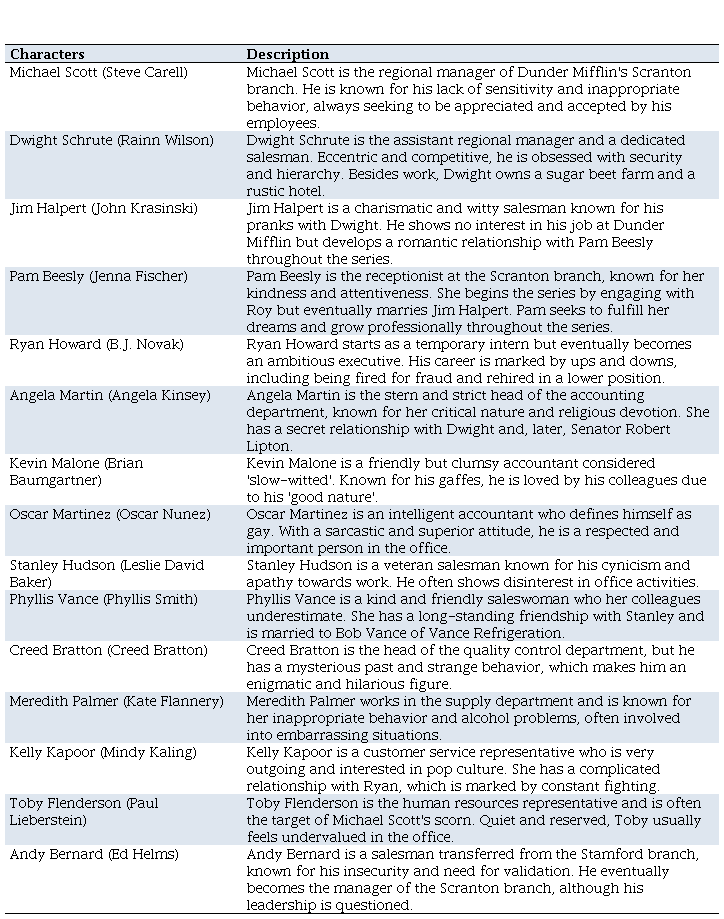
Initially, we present the characters and a description of their roles (Table 1) captured in the images-interactions of the scenes' continuous review, which allowed us to record the perceptions of the interpretations based on the reality presented in the series.
Characters and their features in the TV series "The Office."
Source: Survey data.
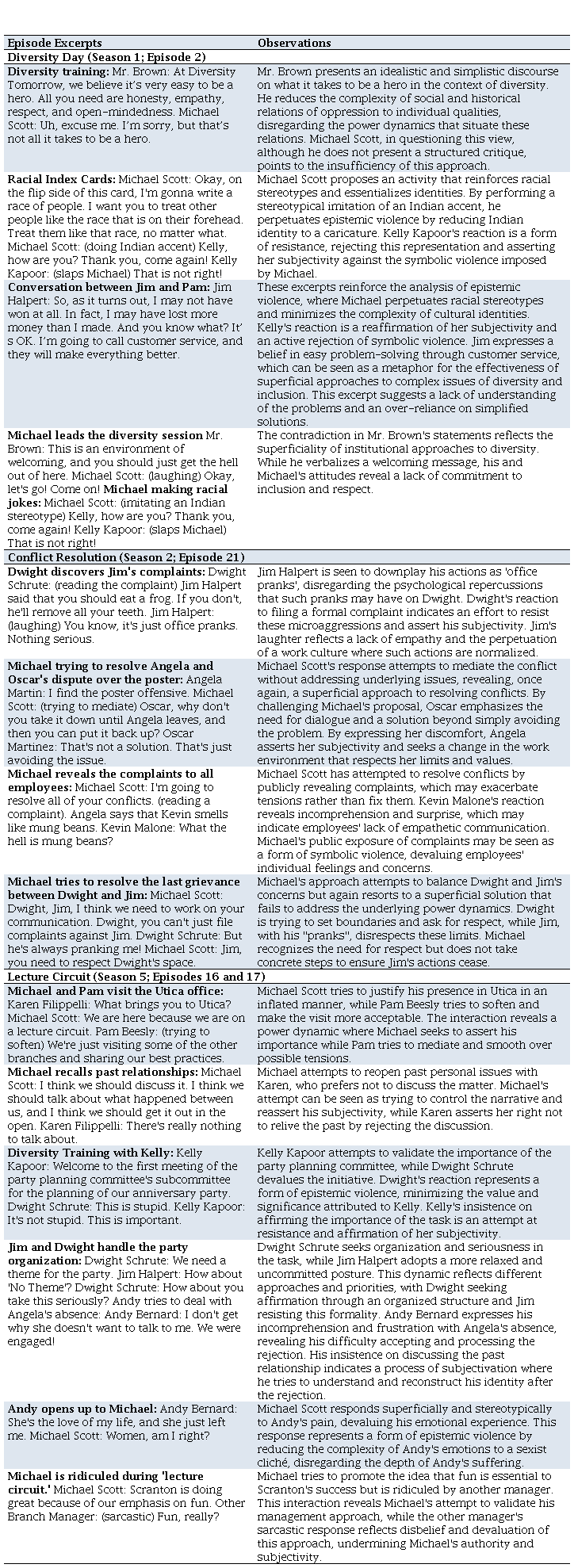
It can be seen that, through the 'structured micro-analysis' of individual scenes and sequences from the chosen seasons (Table 2), the series' plot highlights experiences of silencing and devaluation of knowledge when, for example, Toby Flenderson, a representative of the Human Resources area, is frequently silenced and devalued by Michael Scott. Michael constantly ignores or ridicules Toby's attempts to implement human resources policies that protect and benefit employees (Toby is in HR, which technically means he works for corporate, so he's really not a part of our family. Also, he's divorced, so he's really not a part of his family. - Michael Scott.)
Invalidation of Experiences and Identities: When Oscar Martinez, one of the accountants, frequently has his experiences and identity invalidated or misinterpreted by Michael (Oscar is the gay accountant. I would never use this word, but I have no problem with the word... He would. - Michael Scott); still, Stereotypes and Generalizations, referenced in the way Michael refers to Kelly Kapoor, based on stereotypes and generalizations about her ethnicity (Kelly is our Indian employee who works in customer service. She's been with us for a few years now. And she's... exotic. - Michael Scott), or when Pam Beesly, the receptionist, often has her opinions and contributions disregarded or undervalued by her male colleagues. Michael frequently delegates tasks to Pam without recognizing her potential or considering her professional aspirations (Pam, just cover for me. Don't tell anyone where I am. Just say I'm out sick or on vacation or something - Michael Scott).
Summary
Source: Survey data
In the episode "Diversity Day" (Season 1; Episode 2), it is noted that Michael Scott, the manager, organizes diversity training in which he focuses on addressing stereotypes rather than combating prejudice, as evidenced by his jokes about different ethnicities and cultures. The training, led by Mr. Brown, a diversity consultant, is subverted by Michael, who seeks control of the session and disrespects the consultant by insisting that he, Michael, should be conducting the training.
Michael then instructed employees to place racial identity cards on their foreheads and to treat each other according to the associated stereotypes, thus reinforcing the stereotypes rather than promoting understanding and respect for diversity. Kelly Kapoor's occurrence is a form of resistance, rejecting this representation and asserting her subjectivity against the symbolic violence imposed by Michael. These events align with Santos' (2016) idea of epistemicide, where local knowledge and cultures are denied and destroyed.
Subjectivation refers to the process by which individuals have experiences that situate their identities through discursive and social practices. Epistemic violence, as discussed by scholars such as Spivak (1988), refers to the imposition of knowledge and meanings that marginalize and silence the voices and experiences of subaltern groups. In the excerpt, this is exemplified by the activities proposed by Michael, which essentialize and stereotype racial identities, and by the superficiality of institutional approaches he represents. According to Cañas and Gallego (2016) and Dussel (2016), this simplification reflects the Eurocentric hegemony that neglects power dynamics and historical structures of oppression.
The characters who resist these practices, such as Kelly Kapoor, demonstrate a form of subjectivation that rejects epistemic violence and seeks to assert their own authentic identity. Her attitude toward Michael's imitation is a counter-narrative challenging the imposition of reductionist and stereotypical meanings. Therefore, the analysis suggests that the processes of subjectivation and epistemic violence are related, with discursive practices in the workplace situating identity trajectories and perpetuating exclusions and stereotypes, corroborating Furtado (2011) when mentioning that individual behaviors can affect collective relations, increasing violence in the workplace.
Subjectivation in the workplace is a process that occurs in everyday practices through daily interactions and institutional responses to conflicts. In this context, the characters try to assert their identities and boundaries in an environment that often devalues these attempts. Dwight Schrute is in a constant state of resistance, using institutional mechanisms (such as the complaint register) to ensure a respectful work environment. Jim Halpert and Michael Scott's lack of adequate response often devalues and ridicules his attempts. This devaluation process exemplifies epistemic violence, where Dwight's experience is minimized and disregarded.
Angela Martin also asserts her subjectivity by expressing discomfort with Oscar's poster. By suggesting a temporary and superficial solution, Michael Scott's response ignores the need for a resolution that respects Angela's concerns. By offering Michael the solution, Oscar expresses a deeper understanding of the need for dialogue and mutual respect. Kevin Malone is taken aback by Angela's permission, highlighting the workplace's lack of communication and empathy. Michael Scott's public disclosure of complaints exposes inconvenient difficulties and problems, exacerbating symbolic violence and disrespecting the individuals' subjectivity.
This situation illustrates Teo and Wendt's (2020) critique of epistemic violence that disregards and delegitimizes other valid forms of knowledge. This dynamic reflects a form of microaggression and perpetuation of a work culture where such actions are normalized. According to Barreto and Heloani (2015), intolerance manifests itself in acts that, when repeated, perpetuate psychological violence.
Jim Halpert represents the figure of a colleague who perpetuates microaggressions under the guise of "joking around," disregarding the impact of his actions on others. His lack of empathy and understanding of Dwight's needs is a form of epistemic violence, where he denies the validity of Dwight's experiences.
In the episode "Conflict Resolution" (Season 2; Episode 21), we observe a variety of conflicts between employees, ranging from trivial issues, such as disputes over personal belongings, to more significant disagreements about workplace behaviors and attitudes. This diversity of conflicts reflects the complexity of human interactions in the workplace and the need for differentiated approaches to resolution.
Michael Scott seeks to resolve all accumulated conflicts simultaneously, demonstrating a lack of understanding and skill in conflict mediation. His search for quick solutions to conflicts results in superficial resolutions that are far removed from the underlying problems, which often exacerbates tensions, contributes to providing an unsafe space for dialogue, and makes conflict resolution an uncomfortable experience for employees.
In the episode "Lecture Circuit" (Season 5, Episodes 16 and 17), Michael Scott goes on a lecture circuit to motivate and inspire salespeople at different branches of Dunder Mifflin. The idea is to promote the company and emphasize Michael's leadership skills and charisma, even using the lectures as a platform to promote his image. The presentations often center on his personal experiences, which reflects Michael's inability to understand the real purpose of the lectures.
As a result, employees' reactions range from apathy to embarrassment, highlighting the disconnection between Michael and his audience, which leads them to feel disrespected and undervalued, increasing frustration and discouragement among employees and undermining the initial purpose of the circuit. This ties in with Kwok's (2020) critique of epistemic injustices in the workplace, where higher hierarchical positions enjoy more significant interference. As such, the subjectivation processes in the work environment are shaped by the interactions among characters and by the institutional responses to conflicts and disagreements. In this context, the characters try to assert their identities and resist epistemic violence that devalues their experiences and perspectives.
Michael Scott constantly tries to assert his importance and explain his actions but is met with confrontation and mockery from his colleagues and other authority figures. His attempts to reopen past elaborations and promote his management approach reflect a search for validation and recognition of his subjectivity. Pam Beesly is a mediator trying to soften and make interactions more harmonious. Her approach attempts to create a more inclusive and respectful working environment. Kelly Kapoor tries to assert the importance of her initiatives and resist the devaluation of her contributions by colleagues like Dwight Schrute. Her insistence on trusting the importance of the party planning committee is a form of resistance to the epistemic violence that minimizes her role and initiatives.
Jim Halpert and Dwight Schrute present contrasting approaches to organization and seriousness in the workplace. While Dwight seeks structure and seriousness, Jim adopts a more relaxed stance, reflecting different forms of subjectivation and resistance. Andy Bernard struggles to understand and process Angela's exclusion, seeking validation and emotional support. Michael Scott's superficial response reflects a form of epistemic violence that deeply devalues her. In consequence, it can be seen that epistemic violence manifests itself when knowledge is used to discriminate and dehumanize, addressing certain groups as inferior and excluding them from moral considerations. This violence is intrinsically linked to othering, where differences in beliefs and customs define a group as 'Other', leading to marginalization and conflict (Bunch, 2015).
Hence, the subjectivation processes in this context are marked by proof of identity affirmation and resistance to epistemic violence that devalues individual experiences. Institutional and interpersonal responses to conflicts and tension have repercussions on forming these subjectivities and on the perpetuation or contestation of power structures. There is undoubtedly evidence of injustices of testimony and hermeneutics that impede epistemic agency, as the capacity and ability of workers at lower hierarchical levels to exercise control over their knowledge, to express their perspectives and opinions validly, and to actively contribute to decision-making and knowledge production processes in the work environment (Kwok, 2020).
5 FINAL CONSIDERATIONS
Epistemic violence in the workplace, as portrayed in "The Office", has a significant impact on multiple dimensions of employees' lives, resulting in the exclusion and isolation of individuals whose voices and knowledge are systematically disregarded. Characters such as Toby, Oscar, and Kelly often feel marginalized and devalued. For example, as an HR representative, Toby is constantly ridiculed and ignored by Michael Scott, which exemplifies epistemic exclusion. Oscar, as one of the few openly gay characters, also faces disregard for his opinions and experiences, resulting in social and professional isolation. Kelly, whose cultural background and communication style are often devalued, exemplifies how epistemic violence can create an environment where specific knowledge and perspectives are overlooked.
The systematic devaluation of certain voices perpetuates inequities and injustices in the workplace. The lack of recognition and respect for the knowledge and experiences of marginalized individuals leads to unfair decisions and the maintenance of oppressive power structures. In the series, this is evident in how the ideas of minority characters are often ignored or appropriated by their more privileged coworkers. The hierarchical structure at Dunder Mifflin, where decisions are usually made without considering the perspectives of less valued employees, reinforces the perpetuation of injustices and inequities.
They feel demotivated and less engaged when their voices and experiences are invalidated. This situation is evident in "The Office" through the discouragement of characters who are often unheard. Toby, for example, displays an apparent lack of motivation and engagement due to the constant disdain he faces. A competent and knowledgeable employee, Oscar also shows frustration and discouragement when his contributions are undervalued or ignored.
Subjectivation processes in this context are marked by attempts at resistance and identity affirmation that are often undermined by inadequate institutional responses and the perpetuation of a work culture that normalizes symbolic and epistemic violence. This dynamic suggests a critique of the common practice in many organizations, where management prefers quick fixes rather than investing time and resources to resolve conflicts in a substantive and lasting way.
One of the significant challenges in addressing epistemic violence in the work environment lies in identifying subtle forms of symbolic oppression, such as the marginalization of ideas, the silencing of minorities, and the systematic disregard of certain voices. Many of these practices are normalized in organizations, becoming invisible or, even worse, treated as part of the organizational culture, which makes them difficult to report and address. There is significant institutional resistance to change in environments where hierarchy and privilege are deeply rooted.
Thus, the culture of harassment, often masked by humor or power dynamics, contributes to perpetuating toxic and dehumanizing behaviors, as seen in "The Office", where disrespect towards marginalized employees is treated as a triviality. This resistance to change is accompanied by a lack of practical tools and methodologies to assess the profound impacts of these symbolic acts of violence on workers' well-being and productivity.
The study contributes to understanding the dynamics of exclusion and resistance, offering a critical perspective on the impact of power relations on individuals' subjectivation. It also highlights the role of organizations in constructing practices that value the diversity of voices and knowledge.
It is limited to the analysis based on TV series such as "The Office". Although it provides clear examples of organizational behaviors, it reflects a fictional scenario that may not capture the complexity and depth of fundamental dynamics in different work contexts. Thus, investigating the long-term psychological impacts of epistemic violence, including impaired mental health, demotivation and professional burnout, is a promising field, still little explored.
Furthermore, studies need to develop inclusive practices capable of restructuring organizational cultures to value and genuinely integrate the diversity of perspectives. Another relevant path would be to deepen the relationship between moral harassment and epistemicide, analyzing how the power and control dynamics contribute to delegitimizing knowledge and silencing voices, especially in contexts where the experiences of particular groups are systematically undervalued.
REFERENCES
Alatas, S. F. (2003). Academic dependency and the global division of labour in the social sciences. Current Sociology, 51(6), 599-613.
Alves, G. (2010). Tela Crítica – A Metodologia. Londrina: Praxis; Bauru: Canal 6.
Asamani, L. (2016). Organizational and individual consequences of workplace violence. Public Policy and Administration Research, 6(9). https://core.ac.uk/download/pdf/234669966.pdf
Baird, C., & Calvard, T. S. (2019). Epistemic vices in organizations: Knowledge, truth, and unethical conduct. Journal of Business Ethics, 160(1). https://doi.org/10.1007/s10551-018-3897-z
Barreto, M., & Heloani, R. (2015). Violência, saúde e trabalho: A intolerância e o assédio moral nas relações laborais. Serviço Social & Sociedade, 123, 544–561. https://doi.org/10.1590/0101-6628.036
Beigel, F. (2016). El nuevo carácter de la dependencia intelectual. Cuestiones de Sociología, 14
Bunch, A. (2015). Epistemic violence in the process of othering: Real-world applications and moving forward. Scholarly Undergraduate Research Journal at Clark, 1(1). https://commons.clarku.edu/surj/vol1/iss1/2/
Camargo, M. L., Almeida, N. S., & Goulart, E., Júnior. (2018). Considerações sobre o assédio moral como fator contribuinte para os episódios depressivos no trabalho: A violência velada e o adoecimento mental do trabalhador. Semina: Ciências Sociais e Humanas, 39(2), 129-146.
Cañas, F. C., & Gallego, J. D. M. (2016). La decolonización del saber epistémico en la universidad. Cuadernos de Filosofía Latinoamericana, 27(115), 285-302.
Dussel, E. (2016). Transmodernidade e interculturalidade: Interpretação a partir da filosofia da libertação. Revista Sociedade e Estado, 31(1), 31-45.
Flick, U. (2004). Uma introdução à pesquisa qualitativa. Porto Alegre: Bookman.
Fontes, L. O. (2022). Violência, trabalho e periferia: Conflitos morais e convívios nas fronteiras entre dois mundos. Cadernos de Campo, 35, e022035. https://doi.org/10.9771/ccrh.v35i0.35924
Furtado, O. (2011). Trabalho e Solidariedade. 1 Ed. Editora Cortez.
Gonzalez Rey, F. (2005). Pesquisa qualitativa e subjetividade: Os processos de construção da informação. Pioneira Thomson Learning.
Heath, C., Hindmarsh, J., & Luff, P. (2010). Video in qualitative research: Analysing social interaction in everyday life. Sage Publications.
International Labour Organization. (2022). Experiences of violence and harassment at work: A global first survey. ILO. Geneva, Switzerland. https://doi.org/10.54394/IOAX8567
Kwok, C. (2020). Epistemic injustice in workplace hierarchies: Power, knowledge and status. Philosophy & Social Criticism, 47(9). https://doi.org/10.1177/0191453720961523
Lander, E. (2005). Ciências sociais: Saberes coloniais e eurocêntricos. In E. Lander (Ed.), A colonialidade do saber: eurocentrismo e ciências sociais: Perspectivas latino-americanas. Buenos Aires: Clacso.
Lee, V. P., Hongling, L., & Mignolo, W. D. (2015). Global coloniality and the Asian century. Cultural Dynamics, 27(2), 165-190.
Lima, H. D. S. A. (2021). Violência simbólica e ambiente de trabalho: A face oculta da violência. RESC – Revista de Estudos SocioCulturais, 1(01).
Lira, G. F. C. et al. (2024). Construindo caminhos para um cuidado coletivo e ampliado: uma interface entre violência e saúde mental. In C. A. S. Garcia Junior & R. F. Ceccon (Eds.), Narrativas de violência e saúde mental: experiências e territórios. Editora Rede Unida. 19-36.
Loizos, P. (2004). Vídeo, filme e fotografias como documentos de pesquisa. In M. W. Bauer & G. Gaskell (Eds.), Pesquisa qualitativa com texto, imagem e som: Um manual prático. Petrópolis: Vozes.
Roderick, R. (2010). Examining causes and prevention of violence and aggression in the workplace. https://digitalcommons.uri.edu/cgi/viewcontent.cgi?article=1027&context=lrc_paper_series
Santos, B. S. (2016). Epistemologies of the South and the future. From the European South: A Transdisciplinary Journal of Postcolonial Humanities, (1), 17-29.
Santos, B. S., & Meneses, M. P. (2009). Introdução. In B. S. Santos & M. P. Meneses (Eds.), Epistemologias do Sul. Coimbra: Edições Almedina.
Silva, M. P., Bernardo, M. H., & Souza, H. A. (2016). Relação entre saúde mental e trabalho: A concepção de sindicalistas e possíveis formas de enfrentamento. Revista Brasileira de Saúde Ocupacional, 41. https://doi.org/10.1590/2317-6369000003416
Spink, P. (1996). A organização como fenômeno psicossocial: Notas para uma redefinição da psicologia organizacional e do trabalho. Revista Psicologia e Sociedade, 8(1), 174-192.
Spivak, G. C. (1988). Can the Subaltern Speak? In C. Nelson & L. Grossberg (Eds.), Marxism and the Interpretation of Culture (pp. 271-313), University of Illinois Press.
Teo, T., & Wendt, D. C. (2020). Some clarifications on critical and Indigenous psychologies. Theory & Psychology, 30(3), 371-376. https://doi.org/10.1177/0959354320920944
Vanoye, F., & Goliot-Lété, A. (2002). Ensaio sobre a análise fílmica (2nd ed.). Campinas: Papirus.
Información adicional
redalyc-journal-id: 5707
