Abstract:
Background: The impacts of companies on the environment have drawn society's attention, emphasizing the importance of corporate sustainability, which can directly influence business reputation. Within this context, the Brazilian Stock Exchange (B3), starting in 2012, began recommending that listed companies publish sustainability reports, showcasing their social and environmental actions.Purpose: The present research aims to analyze the relationship between corporate reputation and the quality level of sustainability reports provided by companies listed on the B3 Stock Exchange, classified under the Public Utility sector, during the period from 2012 to 2023.
Method: Regarding its methods, this research is classified as documentary, as it involved examining sustainability reports published by companies on their "investor relations" channels. As for its purpose, the study is classified as quantitative, as the results were derived from regression analyses using panel data. Furthermore, the sample consisted of 221 elements.
Results: The main results show that the statistical average of relevance surpasses the information credibility indicator, highlighting the importance of these reports for decision-making. Additionally, the independent variables used as proxies for Corporate Governance and Market Analysts demonstrated a significant influence on the relevance of the information. In contrast, only the "Market to Book" variable showed statistical significance in reflecting the credibility of the information.
Conclusions: It can be concluded that companies in the public utility sector can improve the quality of their sustainability reports, including by adopting international practices.
Keywords: sustainability, social responsibility, corporate reputation, public utility, ISI.
Resumo:
Contextualização: Os impactos das empresas no meio ambiente têm despertado a atenção da sociedade, reforçando a importância da sustentabilidade corporativa que pode influenciar diretamente à reputação empresarial. Neste escopo, a Bolsa de Valores Brasileira (B3), a partir de 2012, passou a recomendar que as empresas listadas publiquem relatórios de sustentabilidade, evidenciando suas ações socioambientais.Objetivo: A presente pesquisa tem como objetivo analisar a relação entre a reputação corporativa e o nível de qualidade dos relatórios de sustentabilidade disponibilizados pelas empresas listadas na Bolsa de Valores B3, classificadas no setor de Utilidade Pública, durante o período de 2012 a 2023.
Método: Quanto aos meios, a presente pesquisa se classifica como documental, visto que, foram observados os relatórios de sustentabilidade divulgados pelas empresas em seus canais de “relacionamento com os investidores”; quanto aos fins, a presente pesquisa pode é classificada como um estudo quantitativo, pois os resultados foram extraídos a partir da análise de regressões sob o uso de dados em painéis; no mais, a amostra foi composta por 221 elementos.
Resultados: Os principais resultados mostram que a média estatística da relevância supera o indicador de credibilidade da informação, o qual sustenta a importância desses relatórios para tomada de decisão. Além disso, as variáveis independentes usadas como proxies de Governança corporativa e Analistas de Mercado apresentaram influência significativa na relevância das informações, em contraponto, somente a variável “Market to book” possui significância estatística para refletir na credibilidade da informação.
Conclusões: Conclui-se que as empresas do setor de utilidade pública podem melhorar a qualidade dos relatórios de sustentabilidade, inclusive a partir da adoção de práticas internacionais.
Palavras-chave: sustentabilidade, responsabilidade social, reputação corporativa, utilidade pública, ISI.
Resumen:
Contextualización: Los impactos de las empresas en el medio ambiente han llamado la atención de la sociedad, destacando la importancia de la sostenibilidad corporativa, que puede influir directamente en la reputación empresarial. En este contexto, la Bolsa de Valores de Brasil (B3), a partir de 2012, comenzó a recomendar que las empresas cotizadas publiquen informes de sostenibilidad, mostrando sus acciones socioambientales.Objetivo: La presente investigación tiene como objetivo analizar la relación entre la reputación corporativa y el nivel de calidad de los informes de sostenibilidad proporcionados por las empresas cotizadas en la Bolsa de Valores B3, clasificadas en el sector de Utilidad Pública, durante el período de 2012 a 2023.
Método: En cuanto a los medios, la presente investigación se clasifica como documental, ya que se observaron los informes de sostenibilidad publicados por las empresas en sus canales de "relación con los inversores". En cuanto a los fines, esta investigación se clasifica como un estudio cuantitativo, dado que los resultados se obtuvieron mediante análisis de regresión utilizando datos en panel. Además, la muestra estuvo compuesta por 221 elementos.
Resultados: Los principales resultados muestran que el promedio estadístico de la relevancia supera el indicador de credibilidad de la información, lo que refuerza la importancia de estos informes para la toma de decisiones. Además, las variables independientes utilizadas como proxies de Gobernanza Corporativa y Analistas de Mercado presentaron una influencia significativa en la relevancia de la información. En contraste, solo la variable "Market to Book" mostró significancia estadística para reflejar la credibilidad de la información.
Conclusiones: Se puede concluir que las empresas del sector de servicios públicos pueden mejorar la calidad de sus informes de sostenibilidad, incluso adoptando prácticas internacionales.
Palabras clave: sostenibilidad, responsabilidad social, reputación corporativa, servicio público, ISI.
Carátula del artículo
Sustainability and corporate reputation reports: A look at B3’s public utility sector
Relatórios de sustentabilidade e reputação corporativa: Um olhar sobre o setor de utilidade pública da B3
Informes de sostenibilidad y reputación corporativa: Una mirada al sector de servicios públicos de B3
 Deylane Freitas Fontes Júnior deylanefreitas2@gmail.com
FACEMINAS, Brasil
Marcelly Lydyanne Alves da Silva marcelly3331@gmail.com
Federal University of Rio Grande do Norte (UFRN), Brasil
Walyson Tiago Dutra de Lira walysontiago5@gmail.com
Federal University of Rio Grande do Norte (UFRN), Brasil
Edivaldo do Nascimento Duda edivaldoduda091@gmail.com
Federal University of Paraíba (UFPB), Brasil
Antônio Martins do Nascimento Neto neetto.13@gmail.com
Federal University of Rio Grande do Norte (UFRN), Brasil
Contextus – Revista Contemporânea de Economia e Gestão, vol. 23, e94243, 2025
Universidade Federal do Ceará
Recepción: 30 Septiembre 2024
Aprobación: 07 Enero 2025
Publicación: 19 Marzo 2025
1 INTRODUCTION
The World Commission on Environment and Development released a document in 1987, Our Common Future, which presented the definition of sustainable development in a very explicit and coherent way. The notion of sustainable development is that attitude “that satisfies the needs of the present without compromising the ability of future generations to satisfy their own needs”, according to the World Commission on Environment and Development (WCED, 1987, p. 46). It highlights the actions carried out nowadays must pay attention to future consequences.
This contextualization of sustainable development is closely related to companies and due corporate social responsibility. As entities that share, in addition to physical space, environmental space and common interests with the community, it is important that they are concerned with the negative (and positive) impacts on the site (Habek, & Wolniak, 2016). According to Silva (2021), there is a need for companies to demonstrate representation in the environment in order to cause positive impacts.
This notion of sustainable development and, consequently, the socio-environmental impacts, can be evidenced through the sustainability reports released by the respective companies. For Alsayegh, Ditta, Mahmood and Kouser (2023), this report is a document that highlights companies' actions in environmental, social terms and governance aspects, in general, literature and market professionals call these actions by Environmental, Social and Governance (ESG).
Furthermore, it is noticeable companies often aim to ensure their continuity in the market through positive economic results, and can have attitudes based exclusively on maximizing business profit. Given the evolution of the market, competitive strategies and the level of consumer awareness, companies began to invest in sustainable practices with the aim of configuring an institutional image at the forefront of the business, known as corporate reputation (Duda, Silva, Lagioia, & Santos, 2022; Pereira, 2024).
The Accounting Pronouncements Committee classifies reputation as a non-monetary asset, identifiable, without physical substance, and capable of generating future economic benefits, so, reputation can be recognized as an asset of the intangible asset evidenced in the balance sheet of companies. This is the recognition of companies in the market, so they can allocate resources or contract obligations for the acquisition, maintenance and improvement of this intangible resource.
The disclosure of socio-environmental information in sustainability reports tends to influence the reputation of companies, according to a study by Amorim and Souza (2024), when analyzing the sustainability reports released by mining companies Cia Samarca S.A., after Mariana environmental disaster. Thus, companies can pay attention to environmental and social issues, including using sustainability reports to adapt the perceptions of interested parties (stakeholders) and reflect positively on their reputation and position in the market (Gualdi, 2024). Therefore, the present study seeks to answer the following problem: what is the relationship among the reputation of public utility companies listed on Stock Market (B3) and the quality level of sustainability reports?
The research has the general objective of analyzing the relationship between corporate reputation and the quality level of sustainability reports made available by companies listed on the B3 Stock Exchange, classified in the Public Utility sector. To this end, the time range from 2012 to 2023 was considered, as it encompasses the period in which B3 started to recommend the exposure of this type of report by listed companies.
This research is justified as it is made up of companies providing different types of services, such as energy, gas, sanitation, water and sewage, respectively. Such branches play a crucial role in the country's infrastructure, exerting a lot of influence on the national economy. Other studies such as Ribeiro, Alves, Taffarel, and Menon (2017) highlight the strong economic, environmental and social impact exerted by companies, requiring them to dedicate themselves to socio-environmental responsibility factors. In addition to it, Silva, Mazzioni, and Vargas (2020) highlight that such companies present good qualities in sustainability reports, especially in data transparency, internationalization of securities, company size and differentiated levels of corporate governance. Finally, according to Sousa (2022) who emphasizes the importance of studying the topic, as it provides useful information for potential users, in this case shareholders, to make assertive decisions about investments. For these reasons, the study is supported.
Another contribution of the study encourages the debate on business reputation and the influence of the information behavior of companies in the Public Utility sector through sustainability reports. By investigating this relationship in companies in that sector, the research contributes to the literature by exploring a potential market, expanding the scope of academic debate and offering relevant insights for managers, policymakers and investors interested in aligning corporate practices with sustainability.
In addition to it, this research lives up to B3's recommendation, therefore encompassing all data and reports available by companies in the Public Utility sector in order to facilitate longitudinal analysis, that is, over time, and allow for a more accurate assessment. trends and patterns. This being said, it provides a solid basis for comparisons with other sectors in future studies.
2 THEORETICAL FRAMEWORK
For better organization and fluidity of the research, this topic is subdivided into: brief contextualization of sustainability reports; discussion on the levels of corporate reputation and disclosure strategies, besides the presentation of previous studies that are similar to the theme of this research and are fundamental for discussing the results, a posteriori.
2.1 Sustainability reports
Sustainability reports seek to highlight the impacts of operational activities in organizations and companies on the economy, the environment and society (Stocker, Tontini, & Sarturi, 2020). So, they can be defined as documents published annually on a voluntary basis by the company, demonstrating to its stakeholders the degree of sustainability and the social impact of its activities (Silva, 2021). According to Petrescu et al. (2020), in a competitive market, transparent communication about sustainability stands out as a strategic element, strengthening the trust, credibility and commitment of investors and employees.
Faced with the need to act in the face of environmental and social challenges, the United Nations (UN) proposed, in September 2015, the Sustainable Development Goals (SDGs), which establish a Global Agenda until 2030 with goals and indicators to be achieved for sustainable development (Global Compact, 2022). Silva (2021) highlights that UN reinforced the importance of company participation, as they are linked to the environment and society around them, and because they are encouraged to act actively in this environment, complementing the State and non-governmental organizations actions.
In this context, the objectives of sustainability reports prepared by entities must be 17 UN SDGs, these objectives are goals such as eliminating poverty, valuing quality education, tackling climate change and promoting sustainable consumption patterns and production. They are a foundation for reports, guiding organizations in adapting their strategies and operations to global sustainability principles (Melo, & Barbosa, 2023). Thus, the authors Alsayegh et al. (2023) argue that sustainability reports are essential, as they demonstrate the Environmental, Social and Governance (ESG) practices used in organizations, in addition to the progress made to achieve the Sustainable Development Goals (SDGs).
However, with consumers' growing awareness of the socio-environmental impacts of organizations, there has been an increase in the search for products and services that reflect their environmental and social values. This has led many companies to get a sustainable image, often through greenwashing. This phenomenon creates a false impression of environmental commitment without the actual implementation of sustainable practices, representing a considerable threat to the integrity of sustainable development (Pereira, 2024).
Thus, there is a greater demand for the disclosure of socio-environmental information from large corporations, which are increasingly being pressured by recognized institutions to choose to adhere to sustainability reports, such as the guidelines prepared by the organization Global Reporting Initiative (GRI, 2024), in order to guarantee more accurate and realistic information, providing greater reliability to interested parties. In addition to strengthening stakeholder trust, these reports contribute to increasing transparency, improving corporate reputation and aligning business activities with best global sustainability practices (Silva, 2021).
The benefits generated by sustainability reports appear to be greater than the financial risks that may occur in their implementation (Petrescu et al., 2020). Among the benefits, we highlight the increase in transparency in operational activities related to corporate sustainability, the facilitation for investors to evaluate and direct their resources, and the boost given to the competitiveness of companies (Girón, Kazemikhasragh, Cicchiello, & Panetti, 2021). In this context, Petrescu et al. (2020) argue that the disclosure of environmental results is a distinctive factor in a highly competitive industry, thus increasing shareholder confidence and employee loyalty.
2.2 Level of corporate reputation and disclosure
According to Carmo (2021, p.23), the concept of reputation is “an object of interest for many companies, which seek a positive image among their stakeholders and the recognition that groups build through contact with the brand”. Corporate reputation is seen as a strategic resource that provides competitive advantages and improves company performance. It has also been the subject of debate in both academia and the business environment (Melo, Silva Rebouças, Nascimento, Maia, & Santos, 2022).
Duda et al. (2022) concluded that sustainability is extremely important for companies, not only because of their financial solvency, but also because of concerns about their reputation in society and their customers. According to the Accounting Pronouncements Committee (2010), the image of an institution is measured and recorded as an intangible asset, which makes it a relevant indicator for investors, especially those interested in socially responsible investments.
The term corporate reputation is related to a society perception, or more precisely, of the people and companies that influence or are impacted by the organization's actions, as emphasized by the authors Cruz and Lima (2010). This availability of information is manifested through the disclosure of corporate reports, which may include both information required by legal regulations and voluntary information, addressing quantitative and qualitative aspects, positive or not. Additionally, these reports cover a variety of types of information (Cruz, & Lima, 2010).
Ghuslan, Jaffar, Mohd Saleh, and Yaacob (2021) highlight corporate reputation is an essential asset for companies, as it promotes competitive advantages and sustainable performance. A solid reputation helps build trust, strengthen the brand image and attract investors and customers, fundamental factors for organizational longevity and success. Thus, understanding and managing the elements that influence reputation are crucial to ensuring a company's survival in a competitive market (Ghuslan et al., 2021).
In line with Almeida, Botelho and Calado (2024), a company's reputation arises as a result of various actions and perceptions on the part of society and its stakeholders. The organization does not have absolute control over the construction of its reputation, since it is influenced by several factors, some of which are beyond its reach of influence, increasing the complexity involved in the formation of business reputation.
The disclosure of sustainability practices, also known as disclosure, encompasses the presentation of financial, accounting, social and environmental data, reflecting the three pillars of sustainability and seeking to ensure organizational transparency. Correct evidence of this data allows for more efficient decision-making, minimizing risks of future losses (Três, Di Domenico, & Três, 2023).
Therefore, a higher level of disclosure brings several benefits, as it offers relevant and transparent information about business activities, promoting more efficient decision-making. Adequate evidence of this data is essential to strengthen investor confidence and increase the entity's credibility, in addition to contributing to sustainable development in the market, improving the quality of information for more assertive decision-making (Augusto, & Souza, 2021).
Disclosure communicates the social and environmental impacts of companies' economic actions to their stakeholders. As reporting becomes increasingly essential, it helps validate and record what companies practice in their sustainable activities. Sustainability reports, based on the Global Reporting Initiative (GRI) model, provide organizations with the ability to set goals, measure performance and manage changes to promote sustainability, transmitting transparent information about the environmental, social and economic effects of business operations (Yahiro , & Moura-Leite, 2020).
GRI is an international, non-profit and independent organization, which was created in 1997, with the aim of developing and disseminating global standards for the disclosure of sustainability reports (GRI, 2024). Its function is to assist governments and organizations in disclosing the economic, environmental and social impacts caused by their activities, thus enabling their sustainable growth through standardized reports (Vieira, Silva, Martini, & Mattos, 2020).
According to Mougenot and Doussoulin (2024), GRI is considered one of the most comprehensive and effective frameworks for incorporating corporate responsibility into organizational strategies, including being used as a global reference for preparing sustainability reports. These standards are based on the Triple Bottom Line model, which consists of three dimensions of organizational performance, namely social, economic and environmental, promoting a more transparent approach to sustainability and, consequently, business practices (Ferrarez et al., 2020). In short, the dissemination of environmental information is becoming increasingly widespread these days, reflecting a growing global concern with sustainable development and environmental conservation (Silva, 2021).
2.3 Previous studies
Figure 1 presents the main objectives and results of previous studies, which aims to provide an overview of the existing contributions in the literature. In general terms, this research aimed to explore the relationship among corporate reputation, disclosure and sustainability practices, as it seeks to understand how these topics influenced companies' performance.
Figure 1.
Presentation of previous research
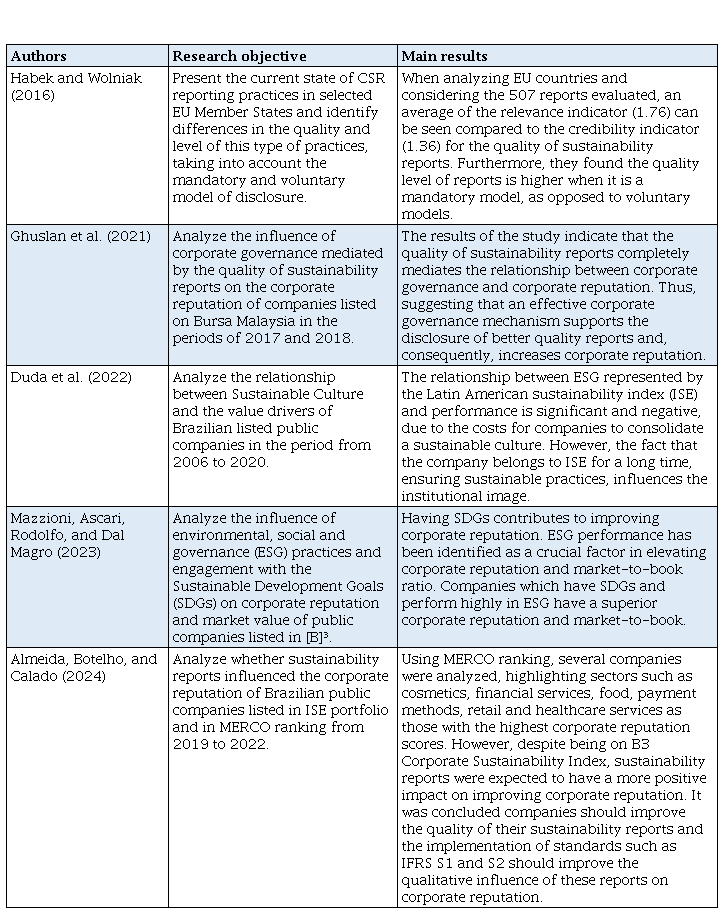 Source: Own elaboration.
This research differs from previous studies by focusing on the analysis of companies in the Public Utility sector listed on the Brazilian Stock Exchange – B3. Previous studies addressed different sectors and contexts, analyzing how various factors were reflected in the economic performance of companies. However, this study is focused on the relationship between the level of corporate reputation and how it influences the quality of sustainability reports of companies in the Public Utility sector from 2012 and 2023. Therefore, seeking to highlight how corporate reputation can assist in getting ESG practices and corporate transparency.
3 METHODOLOGY
In order to meet the proposed objective, this research is classified as descriptive, documentary and with a quantitative approach, as it seeks to describe and analyze the relationship among variables on corporate reputation and the quality of accounting information of public utility companies listed on B3, when disclosing their sustainability reports.
In relation to the classification of objectives, the research is classified as descriptive, as it aims to analyze, record, compare and interpret the variables based on statistical analysis from regression, without interference from the researcher (Nunes, Nascimento, & Alencar, 2016). As for the procedures, the research is documentary, as it collected data from sustainability reports, integrated or similar issued by companies in the public utility sector on B3 Stock Exchange from 2012 to 2023.
Furthermore, the research was developed to better approach the problem in a quantitative way, as it explored the data and numbers through statistical treatment (Moreira, & Caleffe, 2006). To this end, the research proceeded with the analysis of descriptive statistics (mean, mode, median and standard deviation) of the variables in question, in addition to statistical tests and regression on the data in panels based on fixed and random effects to better investigate the problem and meet the research objective.
3.1 Population and sample
The research population is made up of publicly traded companies in the Public Utility sector, listed in the company Brasil, Bolsa, Balcão (B3), which published their sustainability reports from 2012 to 2023. This delimitation resulted in a number of 221 elements analyzed. The period under analysis considered years after 2012, as it was from these years on that B3 began to recommend the insertion of item 7.8 – “Description of the company's relevant long-term relationships that do not appear elsewhere in this form” in the respective reference forms, highlighting the place where they published sustainability reports, integrated or similar. If not, companies should explain why they did not do so (B3, 2023).
About the composition of the sample, those companies with a lack of data for the calculation of all variables in a given period were excluded.
3.2 Research variables
To measure the quality of sustainability reports, a specific assessment tool adapted from the study by Hąbek and Wolniak (2016) was used, which analyzed the annual and integrated reports published by Member States of the European Union (EU), according to the relevance and credibility criteria. The evaluation checklist consists of 17 criteria grouped into two categories, with 11 criteria in the relevance category and 6 criteria in the information credibility category, as shown in Table 1.
Table 1
Structure of an assessment tool
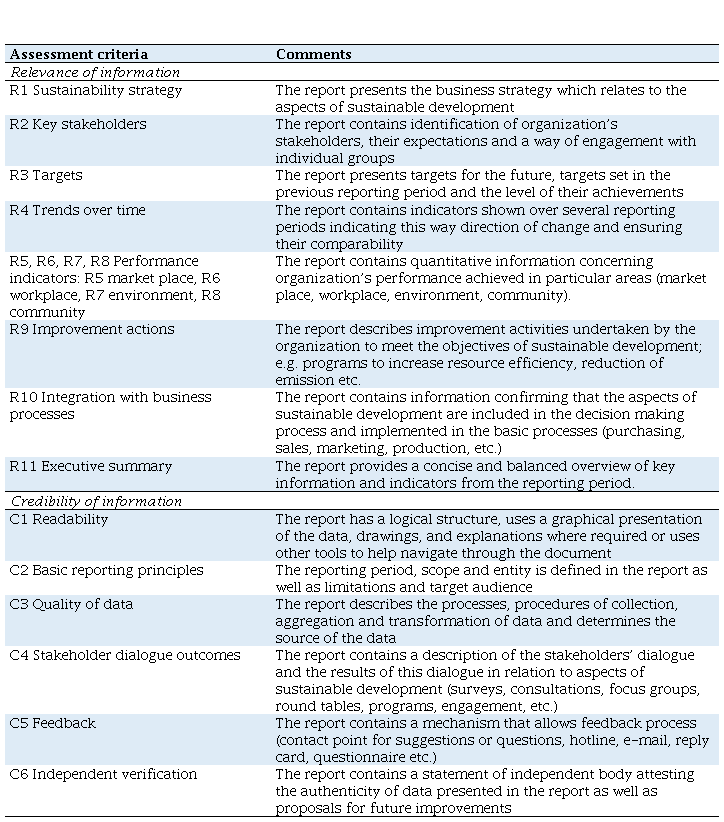 Source: Habek and Wolniak (2016).
For the purpose of processing the evaluation, a scale from 0 to 3 was applied, adapted from the work of Machado, Cruz, Takamatsu and Lima (2013), in which: (i) 0 (zero), when the quality criterion is not disclosed in the sustainability reports; (ii) 1(one) when disclosed in sustainability reports in narrative form; (iii) 2 (two) when disclosed in sustainability reports supported by numbers, cumulatively in narrative form; (iv) 3 (three) when disclosed in sustainability reports with the support of monetary value, cumulatively in narrative form and supported by numbers.
To evaluate and determine the relationship among the quality level of the sustainability reports examined and other variables, indicators related to reporting practices were aggregated. Therefore, the following are the two indicators that were analyzed: R – Information relevance indicator; C – Information credibility indicator.
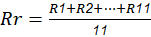
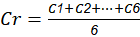
The indicators were specified using the arithmetic mean of the sub-indicators that constitute a given indicator (R and C). The relevance indicator is made up of 11 sub-indicators, while the credibility indicator is made up of six sub-indicators (see Table 1). In this way, individual indicators were calculated for each of the reports that were analyzed (indicators Rr and Cr), as follows.
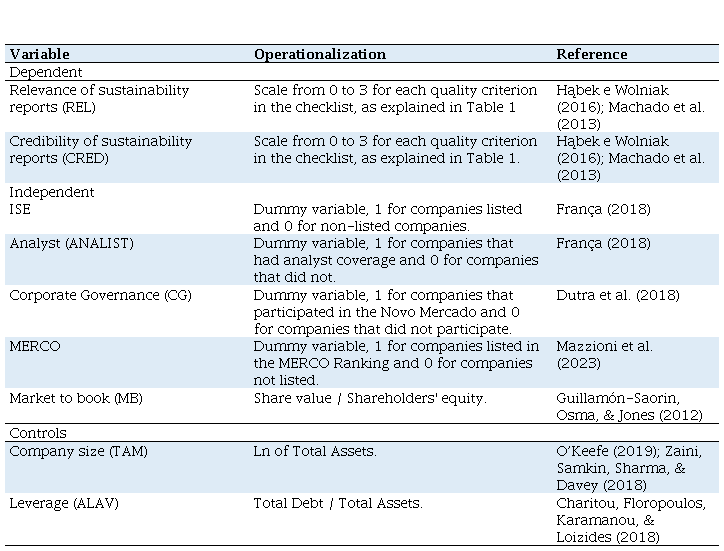
Corporate reputation can be measured using different methodologies. In order to achieve the study's objectives, we opted to observe it using the following metrics: (1) Company listed on the Corporate Sustainability Index (ISE); (2) Company covered by market analysts; (3) Company listed on B3's Novo Mercado; (4) Company cited in Merco index; (5) the company's market to book.
The corporate sustainability index was represented by a dummy variable, with 1 for listed companies and 0 for those not included in the index. This indicator was selected because companies can use the disclosure of social and environmental information as a form of social legitimization (Cho, Roberts, & Patten, 2010). As for analyst coverage, a second dummy variable was used, with 1 for companies that were monitored by a market analyst, and 0 when there was no coverage. This second variable was selected because these agents represent a kind of governance mechanism external to the entity (Martinez, 2007).
The third variable represents a dummy variable, with 1 when the company was classified in B3's “Novo Mercado” governance level, and 0 when it was not. The inclusion of this metric is justified because there is a positive correlation between participation in differentiated markets and obtaining better results (Dutra, Parente, Dutra, & Parente, 2018). Merco variable was represented by a dummy variable in which 1 represented the company in the corporate reputation ranking developed by Merco and 0 when it was not cited. Merco (Corporate Reputation Business Monitor) is a benchmark indicator used in Latin America to measure corporate reputation. While Market to book represents the creation of value by the entity on the part of shareholders, i.e. an expectation of market value.
The following variables were used to arrive at the research results, as shown in Table 2:
Table 2
Descriptions, calculation methods and theoretical bases of the respective dependent, independent and control variables of the research estimation model
 Source: Own elaboration.
3.3 Data collection
The variables related to the Quality of Sustainability Reports were obtained manually, directly from the documents issued by the companies themselves, such as the Annual Report, Reference Form, Integrated Report, Sustainability Report or Management Report, which are available on B3 websites and on the “Investor Relations” channels of the companies themselves.
The variables related to the Quality of Sustainability Reports were obtained manually, directly from the documents issued by the companies themselves, such as the Annual Report, Reference Form, Integrated Report, Sustainability Report or Management Report, which are available on the B3 websites and on the “Investor Relations” channels of the companies themselves.
3.4 Econometric models
The results were obtained using the following models, according to Equation 1, which deals with the Relevance model (REL); and Equation 2, which deals with the Credibility criterion (CRED):
REL𝑖𝑡 =𝛃0 + 𝛃1ISEit + 𝛃2ANALISTti + 𝛃3GCit + 𝛃4MERCOit + 𝛃5MTBit + 𝛃6TAMit + 𝛃7ALAVit + Ɛit (Equation 1)
Where: REL = Relevance of Sustainability reports; ISE = dummy variable, 1 for companies participating in the ISE, and 0 for non-participants; ANALIST = dummy variable, 1 for companies that have market analysts, and 0 for those that do not; GC = dummy variable, 1 for companies listed on the new market and 0 for non-listed companies; MERCO = dummy variable, 1 for companies cited by MERCO and 0 for non-cited companies; MTB = Market to Book of the company; Company size = Natural logarithm of total assets; LevarageV = Leverage of the company; i = company, t = period.
CRED𝑖𝑡 =𝛃0 + 𝛃1ISEit + 𝛃2ANALISTti + 𝛃3GCit + 𝛃4MERCOit + 𝛃5MTBit + 𝛃6TAMit + 𝛃7ALAVit + Ɛit (Equation 2)
Where: CRED = Credibility of Sustainability reports; ISE = dummy variable, 1 for companies participating in the ISE, and 0 for non-participants; ANALIST = dummy variable, 1 for companies that have market analysts, and 0 for those that do not; GC = dummy variable, 1 for companies listed on the new market and 0 for non-listed companies; MERCO = dummy variable, 1 for companies cited by MERCO and 0 for non-cited companies; MTB = Market to Book of the company; Company size = Natural logarithm of total assets; ALAV = Leverage of the company; i = company, t = period.
4 ANALYSIS AND DISCUSSION OF RESULTS
This section presents and discusses the results in line with previous research on the same subject. However, there are specific subsections for better organization of the ideas, starting with the descriptive statistics of the data, followed by two topics, which include the regression results for each dependent variable in the study (relevance and credibility).
4.1 Descriptive Statistics
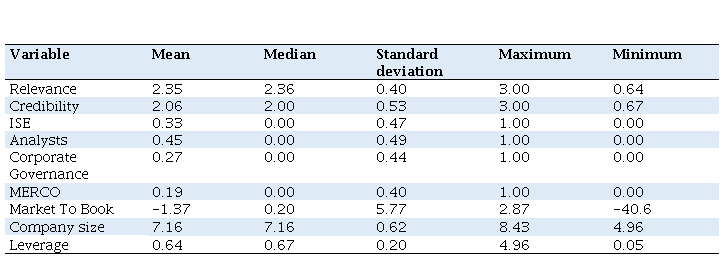
Initially, the descriptive statistics (mean, median, standard deviation, maximum and minimum intervals) of the quantitative variables are presented in order to represent and describe the behavior of the data set, as shown in Table 3.
Table 3
Descriptive Statistics
 Source: Own elaboration.
Table 3 shows an average of 2.35 for the “Relevance” variable, while the “Credibility” variable showed an average of 2.06. In this sense, the relevance of the information provided in the reports of the companies evaluated is at a higher level than its credibility, which may reflect on the ability of this information to influence corporate strategies aimed at sustainability and environmental impact. These results are very similar to the study by Habek and Wolniak (2016), as relevance showed an average of 1.76, while credibility showed an index of 1.36.
Another relevant piece of information from this study is the “Market to book” variable, which has the highest standard deviation in relation to the average, so in order to reduce the influence of outliers, “Market to book” underwent a process at 1% level. Furthermore, the negative average of this indicator indicates that most of the companies in the study are below market projections.
Previous studies, such as Mazzioni et al. (2023), have shown that companies with high performance in environmental, social and governance (ESG) practices tend to have a positive MTB, i.e. they are more credible. Therefore, the negative average BAT observed may indicate that the companies analyzed need to improve their sustainability practices in order to increase their market valuation.
4.2 Relevance of information
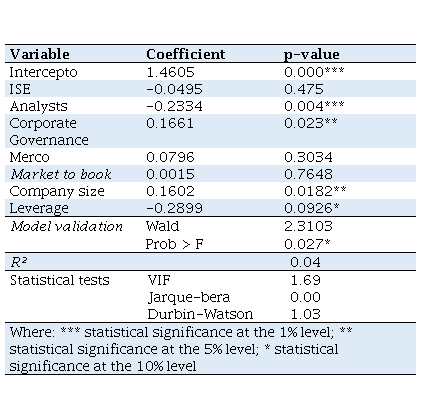
Hausman and Breush-Pagan LM statistical test showed that the fixed effects model provides a better statistical explanation for analyzing the relationship among the variables and the relevance of the information, as shown in Table 4. The analysis of the assumptions of autocorrelation (Durbin-Watson) and multicollinearity (VIF test - variance variance factor) indicate that there are no problems among the variables and are therefore suitable for carrying out the regression.
Table 4
Relevance of information
 Source: Own elaboration.
In Table 4, the variables “Corporate Governance” and “Analysts” are significant in explaining the behavior of the dependent variable (“Relevance”) at a level of up to 5%. Thus, one reason for this is the segmentation of companies in Novo Mercado, as this has a positive effect on the social and environmental information disclosed in the reports. This corresponds to the study by Ghuslan et al. (2021), as when evaluating companies listed on Malaysian Stock Market in 2017 and 2018, it was realized that a good level of corporate governance reproduces the disclosure of better quality sustainability reports and provides greater corporate reputation.
As for the analysts, this is indicated by a negative coefficient, which implies that when the company has analysts on its team, they do not necessarily reproduce relevant information and are used more as a disclosure strategy, i.e. to consolidate the company's reputation in the market. This competitive tactic used in companies ensure more readability and relevance of information by disclosing analyst coverage to ensure reputation similar to Pereira's (2024) study through the sustainable image known as greenwashing.
With regard to the control variables, the “Size” variable was statistically significant up to 2% with a positive coefficient, so the greater the volume of the company's assets, the more it tends to be relevant to the information disclosed in the reports. In turn, the “Leverage” variable only partially explained the behavior of the dependent variable, in a negative way, if a significance level of 10% is considered.
4.3 Credibility of information
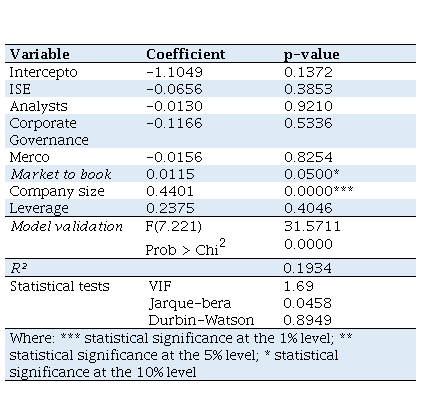
Next, Table 5 shows the regression data according to the dependent variable “Credibility” of the information. If the regression assumptions were met, it was found that the random effects model provides a better statistical explanation for analyzing the relationship among the variables (Hausman test and Breush-Pagan LM). The results of VIF and Durbin-Watson tests corroborate there are no problems of autocorrelation and multicollinearity among the variables and are therefore suitable for carrying out the regression.
Table 5
Credibility of information
 Source: Own elaboration.
The results in Table 5 show only the explanatory variable “Market to book” influences the credibility of the information disclosed in the reports. It shows a statistically significant relationship at the p-value level of 5% and with a positive coefficient, so it follows that the higher investors' expectations of companies, the more credible the information is likely to be. This variable explains the behavior of credibility at a level of 19.34%, as indicated by the explanatory power (R²). In addition to it, this relationship may indicate that the most highly valued companies tend to prioritize transparency of information and environmental impact in their reports.
Another relevant piece of information is the size of the organizations, since this control variable has the capacity to explain both the relevance and credibility of the information disclosed in sustainability reports. Table 5 shows a significantly perfect relationship between the size and credibility indicators.
The main results shown in the tables are somewhat in line with the findings of Duda et al. (2022), since when observing the relationship among the companies classified by Latin American Sustainability Indicator and the degree of performance, it can be seen that there was a significant relationship, albeit negative, but over time this provides greater reputation. Table 4 and 5 show this variable has no statistical significance with the relevance and credibility of sustainability reports. Finally, the research is similar to Almeida et al. (2024), as it was hoped that the issuing of sustainability reports would have a positive impact on companies' corporate reputation. However, there was no significant influence between Merco and the dependent variables (relevance and credibility of sustainability reports). Therefore, companies in the public utility sector need to improve the quality of their reports and even coincide with the adoption of International Sustainability Standards.
5 CONCLUSIONS
The aim of this research was to analyze the relationship between reputation and quality level of sustainability reports published by companies listed on B3, classified in the Public Utility sector. To measure the reputation of the companies, several variables were considered, such as: the sustainability indicator, Merco reputation indicator, the presence of analysts, the differentiated level of Corporate Governance, and the market assessment by the market to book. With regard to the quality of sustainability reports, a specific assessment tool was used to indicate the relevance and credibility of the reports, adapted from the study by Hąbek and Wolniak (2016). This objective was therefore met, as data was collected using the sustainability and/or integrated reports published by companies in this sector.
In addition to it, from 2012 to 2023 was considered, as this covers the period when B3 began recommending that listed companies display this type of report. With the manual data collection procedure using the reports, the statistical average for relevance was 2.35, while the average for the credibility variable was 2.06. Thus, the relevance of the information provided in company reports for decision-making by stakeholders is at a higher level than its credibility.
So, it can be inferred that the independent variables “Corporate Governance” and “Analyst”, as well as the control indicators, especially the variable “Size”, are statistically significant in explaining the relevance of the information transmitted by the reports, with an explanatory power (R²) of 4%. With regard to the credibility of the information, only the independent variable “Market to book” and the independent variable “Size” had a statistical influence on explaining the quality of the information, with an explanatory power of approximately 20%.
Another pertinent piece of information in the study was the positioning of companies based on their level of corporate reputation, which did not even show statistical interference among Merco and the variables. Therefore, as the main suggestion of this study, it is worth highlighting that entities in the Public Utility sector can improve the quality of their sustainability reports, including international standards.
The research includes sustainability reports issued by companies in the Public Utility sector listed on B3, from 2012 to 2023. However, even given the length of time and the number of reports analyzed, the study can be considered somewhat limited, since it only covered one segment of companies.
Therefore, it is not considered to be an inexhaustible source, and a suggestion for future research is to analyze the relationship among reputation and the quality of reports involving other sectors, and even other variables, in order to compare them with this study. Research could also be carried out on companies listed on international stock exchanges. Therefore, we could explore how the environmental impact declared in sustainability reports influences the perception of stakeholders and investors. It would also be pertinent to study the effect of different sustainability frameworks, such as GRI standards or ESG criteria, on the quality and relevance of the information presented in the reports. Finally, future studies could expand the time sample to include periods of regulatory transition or relevant economic events, analyzing how these changes impact the reputation and quality of the reports.
REFERENCES
Almeida, J. S., Botelho, D. R., & Calado, J. E. S. (2024, junho). Influência da qualidade dos relatórios de sustentabilidade na reputação corporativa de companhias abertas brasileiras. In Anais do Congresso UFSC de Controladoria e Finanças, Florianópolis, SC, Brasil, 14.
Alsayegh, M. F., Ditta, A., Mahmood, Z., & Kouser, R. (2023). The role of sustainability reporting and governance in achieving sustainable development goals: an international investigation. Sustainability, 15(4), 3531. https://doi.org/ 10.3390/su15043531.
Amorim, F., & Souza, M. T. S. D. (2024). Estratégias de legitimação de eventos negativos: rompimento de barragem de mineração e disclosure. Revista Contabilidade & Finanças, 35, e1739.
Augusto, J. A., & Souza, M. M. (2021). Características associadas ao nível de evidenciação das receitas de contratos com clientes das companhias de capital aberto brasileiras. Revista Ambiente Contábil, 13(1), 114-133. https://doi.org/10.21680/2176-9036.2021v13n1ID19409
Carmo, A. C. D. (2021). O website como canal de comunicação de sustentabilidade e a sua associação na reputação e valor organizacional: o caso Delta Cafés (Doctoral dissertation)., Instituto Politécnico de Lisboa, Escola Superior de Comunicação Social.
Charitou, A., Floropoulos, N., Karamanou, I., & Loizides, G. (2018). Non-GAAP earnings disclosures on the face of the income statement by UK firms: the effect on market liquidity. The International Journal of Accounting, 53(3), 183-202.
Cho, C. H., Roberts, R. W., & Patten, D. M. (2010). The language of US corporate environmental disclosure. Accounting, Organizations and Society, 35(4), 431-443.
Cruz, C. V. O. A., & Lima, G. A. S. F. (2010). Reputação corporativa e nível de disclosure das empresas de capital aberto no Brasil. Revista Universo Contábil, 6(1), 85-101.
Duda, E. N., Silva, D. J. C., Lagioia, U. C. T., & Santos, M. A. (2022). Sustainable Culture Rings With Good Performance? A Study of Companies Listed in the Business Sustainability Index (Ise). Revista de Gestão Social e Ambiental, 16(2), e02987. https://doi.org/10.24857/rgsa.v16n2-013
Dutra, R. S., Parente, P. H. N., Dutra, G. B. M., & Parente, L. O. D. S. S. (2018). Governança corporativa e desempenho empresarial: uma análise sob o enfoque da reputação corporativa das empresas brasileiras. RAGC, 6(26).
Ferrarez, R. P. F., Vargas, R. V., Alvarenga, J. C., Chinelli, C. K., Almeida Costa, M., Oliveira, B. L., ... & Soares, C. A. P. (2020). Sustainability indicators to assess infrastructure projects: Sector disclosure to interlock with the global reporting initiative. Engineering Journal, 24(6), 43-61.
França, R. D. (2018). Ensaios sobre tax avoidance, reputação corporativa e governança no Brasil (Tese de doutorado). Universidade de Brasília, Doutorado em Ciências Contábeis.
Ghuslan, M. I., Jaffar, R., Mohd Saleh, N., & Yaacob, M. H. (2021). Corporate governance and corporate reputation: The role of environmental and social reporting quality. Sustainability, 13(18), 10452.
Girón, A., Kazemikhasragh, A., Cicchiello, A. F., & Panetti, E. (2021). Sustainability reporting and firms’ economic performance: Evidence from Asia and Africa. Journal of the Knowledge Economy, 12(4), 1741-1759.
Guillamon-Saorin, E., Osma, B. G., & Jones, M. J. (2012). Opportunistic disclosure in press release headlines. Accounting and Business Research, 42(2), 143-168.
Hąbek, P., & Wolniak, R. (2016). Assessing the quality of corporate social responsibility reports: the case of reporting practices in selected European Union member states. Quality & Quantity, 50, 399-420. https://doi.org/10.1007/s11135-014-0155-z.
Machado, E. A., Cruz, A. P. C., Takamatsu, R. T., & Lima, G. A. S. F. (2013). Evidências de disclosure de valor recuperável de ativos em firmas listadas no mercado acionário brasileiro. Revista Universo Contábil, 9(1), 86-103.
Martinez, A. L. (2007). Analisando os analistas: estudo empírico das projeções de lucros e das recomendações dos analistas do mercado de capitais para as empresas brasileiras de capital aberto (Doctoral dissertation). FGV, São Paulo.
Mazzioni, S., Ascari, C., Rodolfo, N. M., & Dal Magro, C. B. (2023). Reflexos das práticas ESG e da adesão aos ODS na reputação corporativa e no valor de mercado. Revista Gestão Organizacional, 16(3), 59-77.
Melo, G. C. V., Silva Rebouças, L., Nascimento, Í. C. S., Maia, A. J. R., & Santos, A. R. S. (2022). Reputação corporativa negativa e desempenho empresarial: Análise em empresas do setor serviços listadas na B3. REA-Revista Eletrônica de Administração, 21(2), 268-287.
Melo, L. S. A., & Barbosa, M. D. F. N. (2023). Análise dos ODS divulgados nos relatórios de sustentabilidade das empresas com alto potencial poluidor, integrantes do setor de Petróleo, Gás e Biocombustível da B3. REUNIR - Revista de Administração Contabilidade e Sustentabilidade, 13(1), 77-94.
Moreira, H., & Caleffe, L. (2006). Metodologia da pesquisa para o professor pesquisador. Rio de Janeiro: ILJ, 17, 1.
Mougenot, B., & Doussoulin, J. P. (2024). A bibliometric analysis of the Global Reporting Initiative (GRI): global trends in developed and developing countries. Environment, Development and Sustainability, 26(3), 6543-6560.
Nunes, G. C., Nascimento, M. C. D., & Alencar, M. A. C. (2016). Pesquisa científica: conceitos básicos. Revista de Psicologia, 10(29), 144-151.
O'Keefe, P. A. (2019). The reporting of non-GAAP profit figures in Australia: an impression management perspective (Doctoral dissertation). University Of Tasmania.
Pereira, D. (2024). Sustentabilidade nas empresas: desvendando o greenwashing. The Trends Hub, 4. https://doi.org/ 10.34630/tth.vi4.5692.
Petrescu, A. G., Bilcan, F. R., Petrescu, M., Holban Oncioiu, I., Türkeș, M. C., & Căpuşneanu, S. (2020). Assessing the benefits of the sustainability reporting practices in the top Romanian companies. Sustainability, 12(8), 3470.
Ribeiro, F., Alves, T. A., Taffarel, M., & Menon, G. (2017). Responsabilidade social corporativa e o desempenho financeiro no setor de energia elétrica: Um estudo com modelo de dados em painéis. Gestão & Regionalidade, 33(99). https://doi.org/10.13037/gr.vol33n99.3987
Silva, L. H. V. D. (2021). Aplicação e impactos dos Objetivos de Desenvolvimento Sustentável em grandes empresas privadas do setor industrial no Brasil (Dissertação de Mestrado). Pontifícia Universidade Católica de Campinas, Campinas.
Silva, N. P., Mazzioni, S., & Vargas, L. A. (2020). Qualidade da informação contábil: uma análise das empresas de utilidade pública listadas na B3. Contabilometria, 7(1), 61-76.
Sousa, J. M. B. D. (2022). Análise comparativa do desempenho econômico e financeiro das empresas brasileiras do setor de utilidade pública (Master's thesis), Universidade Federal do Rio Grande do Norte.
Vieira, I. L., Silva, E. R., Martini, L. C., Jr, & Mattos, U. A. O. (2020). Pontos positivos e negativos dos relatórios de sustentabilidade no modelo global reporting initiative: revisão da literatura nacional e internacional. Revista Gestão Industrial, 16(2), 21-46. http://dx.doi.org/10.3895/gi.v16n2.10549
Yahiro, A. A., & Moura-Leite, R. C. (2020). A evidenciação da responsabilidade social da empresa no ramo têxtil: uma revisão sistemática. FACEF Pesquisa-Desenvolvimento e Gestão, 23(3).
Zaini, S. M., Samkin, G., Sharma, U., & Davey, H. (2018). Voluntary disclosure in emerging countries: a literature review. Journal of Accounting in Emerging Economies, 8(1), 29-6.