1 INTRODUCTION
Entrepreneurship is a vast and diverse field of research (Acs & Audretsch, 2003) that holds an essential position in technological change and economic growth (Acs & Varga, 2005). Regarding entrepreneurship in the digital universe, research focuses more on digital technologies (Kollman, 2006; Paul et al., 2023; Anim-Yeboah et al., 2020; Nambisan, 2017; Steininger, 2019). Digital entrepreneurship (DE) is defined based on several concerns (a) the creation of new ideas or businesses (Kollmann, 2006), (b) the creation of digital products and platforms (Nzembayie et al., 2019), (c) digital ways of doing business (Hull et al., 2007), 2007), (d) the use of digital media and other information and communication technologies (Davidson & Vaast, 2010), (e) digital infrastructure and entrepreneurs (Sussan & Acs, 2017), and (f) the intersection between digital technologies and entrepreneurship (Nambisan, 2017). These concerns suggest a lack of consensus in defining entrepreneurship (Lamine et al., 2023).
Although there are systematic reviews of academic production on digital entrepreneurship (Bailetti, 2012; Kraus et al., 2018; 2021; Zaheer, Breyer & Dumay, 2019; Anim-Yeboah et al., 2020; Fernandes et al., 2022), the focus of these reviews remains restricted to bibliometric analysis (Zhai et al., 2023; Dana et al., 2023), proposals for research topics, such as academic digital entrepreneurship (Secundo, Rippa & Cerchione, 2020), innovation and the entrepreneurial ecosystem (Satalkina & Steiner, 2020; Guimarães et al., 2023), or calls for research agendas (Fernandes & Ferreira, 2022; Agostini, Galati & Gastaldi, 2020; Vial, 2019). We did not find a systematic review of academic production that provides an integrated understanding of existing research to consolidate the academic field and guidelines for future research.
The field of research remains fragmented (Dana et al., 2023; Secundo, Rippa & Cerchione, 2020). A theoretical shortage is evident in the reviews identified, especially in structured and current theoretical bases (Anim-Yeboah et al., 2020). The studies that address the multidisciplinarity of the field focus on areas such as information systems (Nambisan, 2017; Nadkarni & Prügl, 2021), information architecture (Yoo, Henfridsson & Lyytien, 2010), markets, management (Hsieh & Wu, 2019), and economics (Acs & Varga, 2005). We, therefore, see the need to integrate existing studies in other areas of knowledge (for example, sociology, anthropology, and organizational studies) to help the field of research consolidate and develop.
This article aims to integrate and discuss knowledge about entrepreneurship in the digital world in an interdisciplinary way. Thus, we followed Breslin and Gatrell (2023) to conduct a systematic review based on a theorization process. We adopted the following procedures to contribute to the theorization process of this systematic review: (a) We identified conceptual gaps, (b) we organized and categorized the selected research, (c) we problematized the academic productions, and (d) we proposed the productions between the fields for new conceptualizations.
The results of this article can be divided into different parts. Firstly, we present a consolidated view of the production of entrepreneurship and the digital universe, which is structured around the following issues: (a) approaches to entrepreneurship, (b) approaches to the digital universe, (c) impacts of the digital universe on entrepreneurship, (d) types of organizational contexts. Secondly, we identified shortcomings and challenges in academic production. Thirdly, anchored in the theory of several fields of knowledge, we suggested the socioconstructionist dynamics of the digital universe as a perspective for theoretical renewal in entrepreneurship studies. Specifically, we suggested three new themes for future research: (a) the socio-practical perspective of entrepreneurship, (b) the socio-constructionist perspective of digital media, and (c) creative economy organizations.
2 METHODOLOGY
The research methodology is based on a systematic and narrative review of academic production (Elsbach & Van Knippenberg, 2020; Gough, Oliver, & Thomas, 2012; Hodgkinson & Ford, 2014; Patriotta, 2020), which focuses on the search for transparency in the selection process, the reflexive interpretation of the results, the generation of integrating categories and the proposition of perspectives that guide future research. The systematic review of academic production is supported by Breslin and Gatrell (2023), who argue that conducting reviews of the academic output and facilitating the identification and classification of published studies also makes us analyze and challenge existing paradigms and propose new conceptual and theoretical perspectives.
The review was conducted in a three-stage process. The first stage (mapping) was based on a search for articles in different national and international databases. We consulted academic article databases: Sage Publication Journals, Academy of Management, SPELL, Emerald, JSTOR, SciELO, Routledge, Periódicos Capes, Wiley Online Library, and Web of Science. In these databases, we used different combinations of searches between the terms ‘entrepreneurship’, ‘entrepreneur’, ‘entrepreneurship’, ‘entrepreneurs’, ‘digital’, and ‘digital transformation’. The search period was defined as from 2000 to 2024. We did not restrict the search to any specific field of study, which allowed us to identify publications dedicated to DE in several fields (e.g., arts, humanities, entrepreneurship and innovation, education and careers, management and business). As a result of this stage, excluding duplicates, 506 relevant articles were mapped in all the databases.
In the second stage (refinement and expansion), we eliminated duplicates. We selected only those publications that related directly to digital entrepreneurship, excluding research focused on parallel and indirect themes, such as the pandemic, health, or research with a narrow geographical scope. We then analyzed the selected study, considering consistency, relevance, and coherence. In other words, we checked whether each article was based on consistent, relevant, and coherent research on DE. The result of this analysis was a selection of 38 relevant, consistent, and cohesive articles. Given the small number of articles on digital entrepreneurship, it was necessary to take a qualitative approach. Thus, we started making connections that would lead us to new insights and broader perspectives to seek out new paths and domains of knowledge (Breslin & Gatrell, 2023).
We then analyzed the references cited by each of these articles to find other productions that had not been mapped in the first stage, which allowed us to expand the selection of academic output to include different types of production, such as books, book chapters, theses, and dissertations. The sources found were analyzed for consistency, relevance, and coherence. The review process ended when no new and relevant references emerged. At the end of this stage, we selected a total of 94 works.
The third stage was dedicated to the thematic analysis of the works selected in the previous phase. In the first analysis, we sought to identify central themes that could generate explanations, integrations, and problematizations to explain and guide future research. The themes identified were: (a) approaches to entrepreneurship, (b) approaches to digital, (c) impacts of digital on entrepreneurship, (d) types of organizations, (e) shortcomings and challenges of academic research, and (f) socio-practical perspective of entrepreneurship, (g) socio-constructionist perspective of digital media, and (h) context of organizations in the creative economy. All the material was analyzed again based on these themes to generate categories that integrate and explain academic production. The resulting categories in each theme are presented in the following sections of this article. In the third analysis of all the material and the results of the categories, we could identify gaps in current research and draw up a reflection on potential perspectives to guide future research.
3 TRADITIONS OF ACADEMIC PRODUCTION: ENTREPRENEURSHIP IN THE DIGITAL UNIVERSE
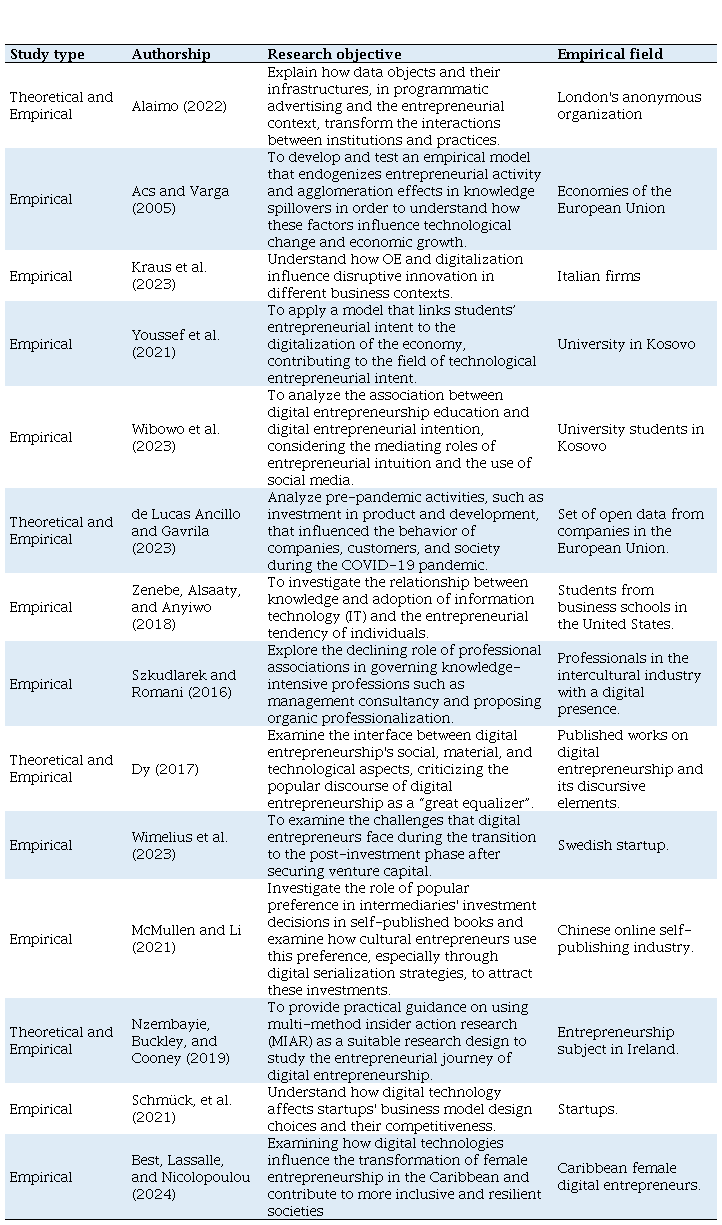
The analysis of the studies found in the research on entrepreneurship and the digital universe can be structured as follows. Twenty studies focus on research reviews concerned with research agendas and suggestions for themes, and 28 studies are divided into empirical research and theoretical-conceptual studies. We identified and analyzed 11 empirical studies and 17 theoretical-conceptual studies. Table 1 shows a breakdown of the empirical research.
Many studies have been limited to digital entrepreneurship focused on technology and information systems (Nambisan, 2017; Lamine et al., 2023; Beckman et al., 2012). Some researchers restrict the focus of their studies to questions about economic growth (Acs & Varga, 2005), the entrepreneurial ecosystem (Guimarães et al., 2023), the integration of information systems and technologies (Steininger, 2019), the digital transformation of businesses (Sedera, Tan, & Xu, 2022), innovation (Agostini, Galati, & Gastaldi, 2020; Leick & Aldogan Eklund, 2021; Kraus et al, 2023), entrepreneurial intention (Youssef et al., 2021; Wibowo et al., 2023), and digital platforms (Srinivasan & Venkatraman, 2017; Zenebe, Alsaaty & Anyiwo, 2018; Nzembayie, Buckley & Cooney, 2019; Sahut, Iandoli & Teulon, 2021; Taylor-Wesselink & Teulon, 2022). Research also addresses issues of interdisciplinarity (Zaheer, Breyer & Dumay, 2019) and critical analysis (Dy, 2017; Dy, Marlow & Martin, 2017; Dy, 2022).
Studies with more applied themes were also identified in the research, such as the issue of the impacts of digital entrepreneurship, the COVID-19 scenario (de Lucas Ancillo & Gavrila, 2023), the effect of the digital aspect on social entrepreneurship (Khanzada et al., 2023; Kosa & Dhliwayo, 2024), family businesses (Basly & Hammouda, 2020), gender (Alhajri & Aloud, 2024; Best, Lassalle & Nicolopoulou, 2024), institutional regulation (Szkudlarek & Romani, 2016), contexts, and cultural rules (Silva; Fernandes & Paiva, 2020; Da Fonseca & Campos, were also identified.
Most theoretical and empirical work takes a positivist approach to understanding digital entrepreneurship (Giones & Brem, 2017), including its definition as a field of knowledge (Bailetti, 2012; Nambisan, 2017) and its intersection with innovation (Beckman et al., 2012), which indicates the need for a more practice-oriented approach (Lamine, 2023).
Some of the empirical studies use quantitative methodologies (Acs & Varga, 2005; Youssef et al., 2021; Wibowo et al., 2023; de Lucas Ancillo & Gavrila, 2023; Zenebe, Alsaaty & Anyiwo, 2018; Kraus et al, 2023), others qualitative (Dy, 2017; Szkudlarek & Romani, 2016; Wimelius et al., 2023; McMullen & Li, 2021; Nzembayie, Buckley & Cooney, 2019; Alaimo, 2022; Best, Lassalle & Nicolopoulou, 2024), and another employs a mixed methodology (Schmück et al., 2021). The case study is one of existing research’s most widely used methodological approaches (Alaimo, 2022).
Table 1
Type, goal, and field of empirical production
 Source: Elaborated by the authors.
We identified 20 reviews of academic production published between 2016 and 2024. Most of them conducted bibliometric analyses of the field (Kraus et al., 2018, 2019; Guimarães et al., 2023; Machado, Martens & Kniess, 2023; Paul et al., 2023; Zhai et al., 2023; Dana et al., 2023). Only three reviews performed a content analysis: one to determine the types of approaches to digital from the concept of ecosystem and platforms (Fernandes et al., 2022), another on academic entrepreneurship (Secundo, Rippa & Cerchione., 2020), and the third from a critical perspective (Zaheer, Breyer, & Dumay, 2019). However, all the reviews of academic production analyzed do not show a more in-depth or integrated contribution to entrepreneurship in the digital universe. We could not find a publication that integrates the multidisciplinarity of disciplines, theories, contexts, and organizations.
3.1 Entrepreneurship approaches
To analyze the conceptions of entrepreneurship that underpin the selected academic production, we searched for studies on entrepreneurship for references to develop a categorization of the conception of entrepreneurship based on Bruyat and Julien (2001); Karatas-Ozkan et al. (2014); Hlady-Rispal and Jouison-Laffitte (2014) and Rajagopal (2021). The categorization understands entrepreneurship from the following perspectives:
● Positivist: The positivist conception seeks to position itself in the field of study neutrally and objectively. It uses the rationality of the natural sciences to observe and understand its objects of study based on the assumption that all objects and entities exist regardless of any human perception in their search. This approach seeks to explain the events researched causally, i.e., there is an objective meaning to all reality awaiting discovery by the researcher. These discoveries are feasible under the positivist approach as long as the studies include events that can be observed and measured, i.e., can be verified (Alvarez, Barney & Young, 2010; Gartner & Birley, 2002).
● Post-positivist: Post-positivist conceptions present greater reflexivity by attempting to understand the events presented in the studies subjectively and sometimes critically. Researchers do not attempt to impose their previous knowledge on the situation researched and emphasizes the subjective, social, political, and symbolic meanings of the actions and events of their objects of study. The analysis of post-positivist conceptions also starts from people’s actions to construct and reconstruct reality, considering social and cultural dimensions (Karatas-Ozkan et al., 2014; Blundel, 2007; Lindgreen & Packendorff, 2009).
We can subdivide the post-positivist approaches to entrepreneurship (Blundel, 2007; Sklaveniti & Steyaert, 2021; Thompson, Verduijn & Gartner, 2020) into the following strands:
● Critical realism: It seeks to critically present explanations through causalities, addressing perspectives and conditions that influence entrepreneurship (Blundel, 2007).
● Practice: where the understanding of entrepreneurship is linked to doing (Sklaveniti & Steyaert, 2021); it involves contemporary theories of practice and entrepreneurship (Thompson, Verduijn & Gartner, 2020).
● Interpretationist/constructivist: It seeks to establish a dialog between entrepreneurship and value creation by considering the different social realities and their interactions (Lindgreen & Packendorff, 2009), also considering the environment and other fields of knowledge (Bruyat & Julien, 2001; Hlady-Rispal & Jouison-Laffitte, 2014).
When we analyze studies on entrepreneurship, the positivist conception predominates in research (Gartner & Birley, 2002). Such studies seek to explain how entrepreneurship interacts with several businesses in repeatedly and more neutrally. They are based on the existence of measurable facts for this interaction, looking for regularities and cause-and-effect relationships between the underlying elements. The themes include analysis of the supply of demand and consumption (Rajagopal, 2021), focusing on themes such as business opportunities in development and economic changes (Alvarez, Barney & Young 2010). The post-positivist conception develops in entrepreneurship by seeking to understand it as a complex and dynamic process (Karatas-Ozkan et al., 2014). Thus, the research is not formed in advance with categories; these emerge or change from the fieldwork through the perspectives of the contexts researched and what is most significant in people’s perspectives, investigating, for example, the relationship between the contextual and procedural issues of entrepreneurship (Blundel, 2007) or addressing new theoretical and methodological fields (Lindgreen & Packendorff, 2009).
Most of the research analyzed on digital entrepreneurship adopts a positivist conception. It seeks to explain the relationship between entrepreneurship and digital neutrally and impartially by focusing on the economic opportunities of entrepreneurship (Acs & Varga, 2005; Bailetti, 2012; Beckman et al., 2012; Youssef et al., 2021), consumption (Da Fonseca & Campos, 2021), and the application of business models (Hull et al., 2007). The studies analyzed also seek to understand the cause of digital entrepreneurship through the influence of existing technologies and their use (Nambisan, 2017; Nambisan; Wright & Feldman, 2019) or through the innovation environment (Agostini, Galati, & Gastaldi, 2020).
The studies analyzed also identified research on entrepreneurship in the digital universe that addresses post-positivist conceptions, such as critical approaches to analyzing entrepreneurship and the digital world (Dy, 2017; Dy Marlow & Martin, 2017; Dy, 2022) through reflective practice in the production of knowledge about digital entrepreneurship and its digital artifacts (Nzembayie, Buckley, & Cooney, 2019), and digital transformation in the practices of entrepreneurship (Alaimo, 2021), but these studies using post-positivist conceptions are few and fragmented.
The analysis of the conceptions of entrepreneurship in the research reviewed reveals a predominance of the positivist approach, which seeks neutral and measurable explanations of the relationship between entrepreneurship and the digital world. However, post-positivist conceptions, although still scarce, offer a more complex and dynamic vision, considering social, cultural, and contextual factors.
3.2 Approaches to Digital
The most recent studies on digital that underpin this research focus on understanding and theorizing about digital entrepreneurship and the digital transformation in entrepreneurship. Our focus is to present what has been identified in the selected and analyzed research, understanding the link between entrepreneurship and digital. In order to analyze the conceptions of the digital that underpin the selected academic production, we looked for references to draw up a categorization of the several approaches to the digital, and we suggested integrating the conceptions based on the areas of knowledge of technology, anthropology, sociology and communication (Orton-Johnson & Prior, 2013; Lupton, 2014; Bailey et al., 2019; Ingvarsson & Ingvarsson, 2020). The categorization understands digital from the following conceptions:
● Positivist: The positivist conception of digital issues analyzes and positions itself in its studies to measure the reality in the field, seeking to explain it, for example, through the use of digital technologies. Researchers conduct their study by observing the field objectively, not being part of it. Their works are based on strictly objective criteria, including the presentation and analysis of metrics, data, and the quantification of results. Furthermore, the analysis of the interaction with human vs. digital relations adopts a more functional perspective, assigning specific roles and focusing on the digital to report observations made without interference (everything has already been established). Researchers are not inserted into the field being studied. Their studies are based on categories, constructs, and hypotheses applied to an existing reality (Bailey et al., 2019; Brynjolfsson & McAfee, 2014).
● Post-positivist: The post-positivist conception from the digital perspective seeks to understand social actions and analyze new forms of collaboration between the human and the digital. The digital ceases to be a system with defined and rigid phases and processes. It is instead seen as interactional, influencing, and suffering influences from the media in which it is positioned. Through specific practices, the post-positivist conception of the digital seeks to integrate technological possibilities, symbolic entities, and social and interpretive processes (Plesner & Phillips, 2018). The studies then reflect on existing practices and how technology reconfigures social practice. The researcher assumes in his studies that his understanding of the event of the field does not occur on the facts themselves, but is based on the interpretations that individuals make when participating in a given event. The research subject needs to be involved in order to understand. The post-positivist perspective considers that there is no possibility of facts existing in a pure form, as it is necessary to consider the influences of culture, relationships, and social theories through practices, articulations, and social constructions (Lupton, 2014; Orton-Johnson & Prior, 2013; Hjarvard, 2012; Kallinikos, Leonardi & Nardi, 2012).
Post-positivist conceptions of the digital (Lupton, 2014; Orton-Johnson & Prior, 2013; Hjarvard, 2013) are subdivided into the following strands:
● Affordances: The affordances perspective seeks to analyze the dynamic interaction of the agent with their environment (Gibson, 1982). By situating this perspective in the digital universe, we can analyze how the users/agents place themselves when interacting with the available technology. It aims to understand how technology shapes or influences the work processes and interactions of the members, considering the information, opportunities, and possibilities that the environment provides and the perception of individuals in their contexts (Leonardi, Huysman & Steinfield, 2013; Leonardi & Vaast, 2017).
● Practice: The digital in practice perspective focuses on understanding the implications of using digital media in several areas such as culture, economics, education, and health. Investigating these practices focuses on themes such as individuality, identity, corporeality, power relations and social inequalities, social networks, social structures, social institutions, and social theories (Lupton, 2014).
● Socioconstructionist: The socioconstructionist perspective refers to how reality is researched through the interaction between individuals and their social construction concerning digital/social media use. Initially, the context in which the objects or relationships will be analyzed is defined. This understanding is linked to human practices and is shared in social contexts, allowing for a more precise explanation of the coordination of cultures and societies and technological innovations. Thus, socioconstructionism focuses on the diversity of research in fields of knowledge (Lindgreen & Packendorff, 2009; Hjarvard, 2013; Couldry & Hepp, 2016; Couldry & Kallinikos, 2017).
The research analyzed in the digital universe approach also predominates positivist studies. Their research focuses on opportunities or the creation of existing businesses promoted by innovations in science and technology (Kollmann, 2006; Beckman et al., 2012) or by using digital media and information and communication technologies (Davidson & Vaast, 2010). They analyze how technology-based companies and startups do business (Hull et al., 2007), seek to define their digital enterprise through infrastructure (Nambisan 2017), their business models (Kraus et al., 2018) with the support of information systems (Nambisan et al., 2019). The intersection of digital and entrepreneurship is also objectively analyzed through the analysis of innovation ecosystems (Sussan & Acs, 2017; Huang et al., 2020), market analyses (Fernandes et al., 2022), and analyses of the economic role of entrepreneurship in the digital universe (Acs & Vargas, 2005).
Some studies with post-positivist conceptions in the digital universe can found. Although scarce, they are methodologically more diverse, dynamic, and challenging (Burgess, Marwick & Poell, 2018). Post-positivist design studies focus on understanding non-linearity in creating digital products and platforms (Nzembayie et al., 2019) and how digital technologies facilitate entrepreneurial transformation (Sahut et al., 2019) through practice, when analyzing the support of digital technologies for conducting entrepreneurial actions (Champenois, Lefebvre & Ronteau, 2020) and reviews of studies that indicate more holistic views and approaches to entrepreneurship and digital (Secundo, Rippa, & Cerchione, 2020; Li, 2017). However, the production of studies based on the post-positivist conception is still fragmented and incipient.
The studies analyzed on digital entrepreneurship are dominated by the positivist conception, focusing on business opportunities and technological innovation. However, post-positivist approaches, although less present, bring a more dynamic and complex vision, exploring the interaction between digital and the social. These approaches offer new perspectives for understanding how digital technology transforms entrepreneurship. Although these approaches are scarce, they are methodologically diverse and promise to expand the field of research in the future.
3.3 Impact of the digital universe on entrepreneurship
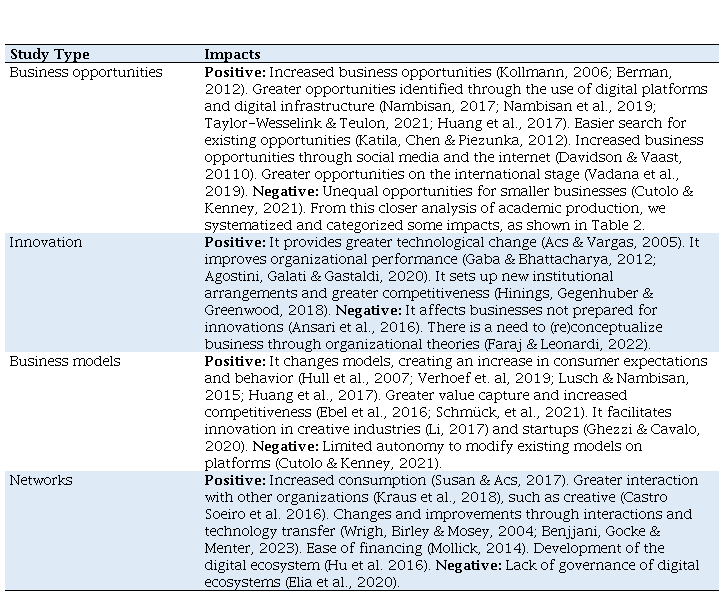
Some impact categories emerged when we took a closer look at the selected material, even though no more in-depth and systematic studies were identified regarding the impacts of the digital universe on entrepreneurship. Based on these categories, we systematized and categorized some positive and negative impacts of the digital dimension on entrepreneurship. These categories allowed us to describe the different ways in which digital affects the underpinning entrepreneurship processes: (a) business opportunities, (b) innovation, (c) business models, and (d) networks.
The first consists of business opportunities. The studies analyzed identified that business opportunities are related to the transformation of customer value propositions brought about by digital. Business opportunities are created by digital technologies (Kollmann, 2006; Berman, 2012; Martínez-López & Casillas, 2013), by digital platforms expanding the digitization of products and services in all industries (Nambisan, 2017; Nambisan et al., 2019; Taylor-Wesselink & Teulon, 2021), by analyzing digital infrastructure (Huang et al., 2017), through social media and the internet (Davidson & Vaast, 2010), through new methodologies such as design thinking (Micheli et al., 2019), through tools such as big data and artificial intelligence (Mueller-Saegebrecht & Lippert, 2024), and by looking for opportunities that already exist (Katila, Chen & Piezunka, 2012) and going international (Vadana et al., 2019). On the other hand, digital can also cause an imbalance in business opportunities. For example, the relationship between the impact of digital and business size has been investigated (Cutolo & Kenney, 2021).
The second impact refers to innovation. In the selection of studies analyzed, innovation then occurs through technological changes (Acs & Vargas, 2005; Brem & Viardot, 2017), to improve performance in organizations (Gaba & Bhattacharya, 2012), to improve business (Agostini, Galati & Gastaldi, 2020), and to provide changes through new institutional arrangements (Hinings, Gegenhuber & Greenwood, 2018). Conducting disruptive innovations, however, can overly affect entrepreneurial systems (Ansari et al., 2016). It may also be necessary to (re)conceptualize the innovation process from the perspective of organizational theories (Faraj & Leonardi, 2022).
The third impact is on business models, with studies focusing on changes to existing entrepreneurial business models impacted by digital. This is due to digital transformation (Hull et al., 2007; Verhoef et al., 2019), digital technology such as digital platforms and innovation (Lusch & Nambisan, 2015; Huang et al., 2017; Facin et al., 2016; Magnusson and Pasche, 2014; Constantinides et al. 2018). These changes also impact analytical tools (Ebel et al., 2016), value creation, and capture (Sahut, Iandoli & Teulon, 2021; Schmück et al., 2021). The impact of business models can also facilitate innovation in the creative industries (Li, 2017) and digital startups (Sanasi, Ghezzi & Cavalo, 2023). The impact can be harmful due to entrepreneurs’ little autonomy and influence when using business models and digital platforms (Cutolo & Kenney, 2021).
The fourth impact is networks, which can occur through digital consumption (Susan & Acs, 2017), changes in processes, infrastructure, and interactions (Bejjani; Gocke & Menter, 2023), technology transfers (Wrigh, Birley & Mosey, 2004), and financing systems (Mollick, 2014) at the intersection with other industries, such as music and games (Castro Soeiro, Santos & Alves, 2016). It is necessary to understand that although digital impacts on networks, it is crucial for digital entrepreneurs (Kraus et al., 2018) and that interactions with more consolidated institutions, such as industries, impact the digital ecosystem (Hu et al., 2016). Some studies suggest that a more significant role in governance is needed in digital ecosystems (Elia et al., 2020).
From this closer analysis of academic production, it was possible to systematize and categorize a set of impacts, as shown in Table 2.
Table 2
Positive and negative impacts of digital on entrepreneurship
 Source: Elaborated by the authors.
The categories developed allowed us to describe how digital impacts the processes that support entrepreneurship: (a) business opportunities: the studies analyzed identified that business opportunities are related to the transformation of customer value propositions implied by digital; (b) innovation: the impacts of innovation are related through technological changes, new ways of doing business and institutional rearrangements; (c) business models: the studies focus on changes to existing entrepreneurial business models impacted by digital and (d) networks: networks have the interaction of entrepreneurship, its stakeholders and entrepreneurial ecosystems.
3.4 Type of organizational contexts
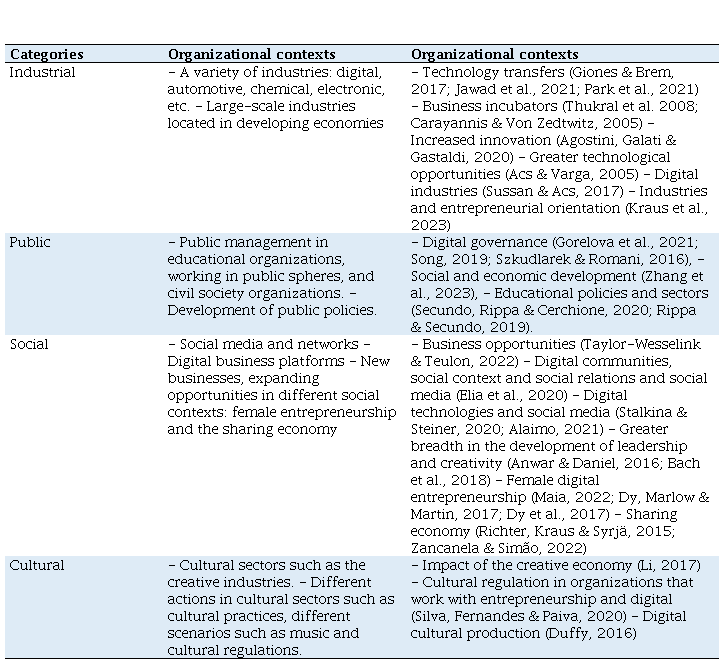
We also analyzed the academic output to understand the different organizational contexts in which digital entrepreneurship is researched. Some organizational context categories emerged during the analysis: (a) industrial; (b) public; (c) social and (d) cultural. The studies analyzed are still fragmented and scarce in the selected period, as shown in Table 3.
Table 3
Organizational contexts of digital entrepreneurship
 Source: Elaborated by the authors.
The industrial comprises studies that analyze business opportunities in industries, with a focus on entrepreneurship in the digital universe (Jawad et al., 2021; Park et al., 2021) and large corporations (Nadkarni & Prügl, 2021) with their updating through innovation systems (Agostini, Galati & Gastaldi, 2020). The study objects focus on digital industries (Sussan & Acs, 2017), the exploitation of technological opportunities (Acs & Varga, 2005), the entrepreneurial orientation of these industries (Kraus et al., 2023), and the search by large corporations for emerging digital markets (Thukral et al., 2008). The focus is also on technology-based companies with technology transfers (Giones & Brem, 2017) and business incubators (Carayannis & Von Zedtwitz, 2005). An example when we talk about industrial context and the search for more holistic and comprehensive studies of digital entrepreneurship is the study by Jawad et al. (2021), which analyzes digital entrepreneurship and its influence on the business landscape in developing economies such as China, India, and Brazil.
The public context within entrepreneurship in the digital universe focuses on organizations operating in public spheres or in the interest of society (public institutions, state, education, politics, and regulations). Through digital entrepreneurship and digital governance (Gorelova et al., 2021), in acting and modifying regulations and laws (Song, 2019), research addresses institutional regulations (Szkudlarek & Romani, 2016), and fostering social and economic development (Zhang et al., 2023). The public context still appears in conceptions, relevance, and practices (Tranfield et al., 2003), in educational policies and sectors (Secundo, Rippa & Cerchione, 2020), and in the development of technologies within universities (Rippa & Secundo, 2019). We highlight the study by Zhang et al. (2023), which analyzes digital influence on entrepreneurial initiatives in 101 nations.
The social context concentrates research on studies that relate social contexts and the social interactions of entrepreneurs and the digital environment, such as platforms, digital media, and social networks. Research focuses on interaction on digital platforms to pursue business opportunities (Taylor-Wesselink & Teulon, 2022) such as networking in digital communities (Elia et al., 2020) or modifying social relationships through digital technologies (Stalkina & Steiner, 2020). It also includes topics on social interactions through the intersection of themes such as leadership and digital creativity (Anwar & Daniel, 2016; Bach et al., 2018). When addressing digital media, the studies analyzed address digital media acting in the social context by transforming the fields of entrepreneurship studies (Alaimo, 2021) or being analyzed through socio-material practices of entrepreneurship in the digital economy (Davidson & Vaast, 2010). Some topics use social contexts, such as women’s digital entrepreneurship (Maia, 2022; Dy, Marlow & Martin, 2017; Martinez Dy et al., 2017) or the sharing economy (Richter, Kraus & Syrjä, 2015; Zancanela & Simão, 2022). An example of the social context is the study by Taylor-Wesselink & Teulon (2022), which highlights how digital platforms are adopted to interact by different types of entrepreneurs at different stages of development.
The cultural context includes studies that relate to the field of the creative economy, addressing issues such as cultural practices and culture’s developing scenarios. The few studies identified focus on analyzing business models impacting the creative economy (Li, 2017), a perspective of cultural regulation in creative economy organizations that work with entrepreneurship and digital (Silva, Fernandes & Paiva, 2020). One study analyzes the value and emotion of entrepreneurial activities in digital cultural production (Duffy, 2016). The studies analyzed are fragmented and scarce over the selected period. Li’s study (2017) looks at digital technologies that facilitate business model innovations in the creative industries, proposing a more holistic view of these business models precisely because they are used by different sectors of the economy, such as the creative sector.
3.5 Gaps and challenges of academic research
The analysis of the selected academic output on entrepreneurship in the digital universe has several delineations. The first delineation refers to the approaches in entrepreneurship and the digital universe. In both perspectives, we identified a predominance of studies that are interested in measuring and analyzing entrepreneurship and entrepreneurship in the digital universe as purely economic businesses and activities that seek to conduct their studies more rationally and, therefore, take a positivist approach. Few and scattered studies are dedicated to research that focuses on understanding the system of social interactions with the conduct of research through practices and reflexivity and are therefore allocated to the perspectives of post-positivist approaches. Post-positive perspectives provide more significant heterogeneity when studying the events that permeate entrepreneurship by broadening their dimensions of analysis and considering social and cultural dimensions (Karatas-Ozkan et al., 2014; Blundel, 2007; Lindgreen & Packendorff, 2009).
The second outline relates to the impacts of digital presented in the selected studies. The analysis shows that the studies also show impacts focused on innovation as a theme that drives new opportunities and business forms and models, showing a predominance of studies with a positivist approach. Some studies address other forms of digital impact, such as networks, but these are also scarce and fragmented. We could not identify any studies about the impact of digital technologies on dynamics that construct or are constructed by the social aspect. Post-positivist conceptions of the digital indicate that perspectives need to encompass understanding digital-mediated social actions and relationships, considering social and cultural issues, and conducting these analyses through social practices and constructions (Lupton, 2014; Orton-Johnson & Prior, 2013; Hjarvard, 2012).
The third delineation is related to the organizational contexts identified and categorized in the studies analyzed. The industrial contexts delimited into industries, companies, and large corporations, are concentrated in more significant numbers in the studies analyzed. Although the public and social contexts are more diverse, they are related and selected with a focus on analyzing environments for economic and business development. The studies that differ within organizational contexts are still scattered, and few studies are available when we attempt to analyze production within the cultural context and the creative economy.
Based on the outlines identified in research on entrepreneurship and the digital universe, in this section, we propose three challenges for the renewal of academic research to guide future studies:
● Socio-practical perspective on entrepreneurship: We argue that studies on entrepreneurship can benefit from a more in-depth reflection on its practices. This deepening can occur in practices that fit into activities based on several interconnected elements (Gartner et al., 2016). Proposing this perspective is related to the need to produce studies with new strands for entrepreneurship. By conducting studies from this perspective, there is the possibility of greater observation of practices in real-time more heterogeneously, considering social and cultural dimensions. This perspective is promising for studying the interrelationships between active individuals, more collective elements, stabilized forms, and their interaction (Champenois, Lefebvre & Ronteau, 2020). The socio-practical perspective then provides greater reflexivity and a deepening of the cases and contexts analyzed, many elements of social activities, and several interconnected elements in dynamic fields practiced by human actions (Gartner et al., 2016; Thompson, Verduijn & Gartner 2020).
● Socio-constructionist perspective of the digital universe: To guide future research, this proposal seeks to understand how social interactions are built through digital media for entrepreneurship. The socioconstructionist perspective works with interaction, the collective and political construction of knowledge through human mediation. The socioconstructionist perspective provides knowledge about interaction processes. It describes complexities in the social world, where interaction patterns and practices are sustained by digital social media, which are mediated and transformed at the same time as they are transformed by human interactions (Lindgreen & Packendorff, 2009; Hjarvard, 2012; Couldry & Hepp, 2013, 2016; Hepp, 2018). When we talk about actions in the digital universe, these relationships are conceived as complex sets of technology, human beings, symbols, discourses, and economic structures, sets that emerge in continuous practices and specific situations and that depend on our interaction in order to exist (Plesner & Phillips, 2018).
● Creative economy organizations: This proposition involves exploring specific contexts that can bring new insights to our understanding of entrepreneurship in the digital universe. Thus, specifically, we suggest that one context may be especially promising for this discussion, which is creative economy organizations. To include creative economy organizations in the research contexts of entrepreneurship in the digital universe becomes strategic and relevant for the renewal of research, as they are organizations that produce goods and services with cultural and artistic values, symbolic, with relevant economic development, which encompass diverse knowledge themes due to their dynamism (Cave, 2001; Jones, Lorezen & Sapsed, 2015; Doyle, 2016; Khaire, 2017).
4 RENEWAL OF ACADEMIC PRODUCTION: NEW RESEARCH HORIZONS
To integrate academic production focused on entrepreneurship in the digital universe, we propose approaches from different fields of knowledge as a source of theoretical renewal. We will explore the perspectives of entrepreneurship and the digital world from sociology, anthropology, and organizational studies, the socio-practical approach to entrepreneurship, the socio-constructionist approach to digital media, and the new research horizons into creative economy organizations.
4.1Socio-practical perspective of entrepreneurship
The socio-practical perspective of entrepreneurship is advantageous for advancing the field of knowledge for several reasons, including (a) a more refined understanding of the field of knowledge by englobing such as cultural, social, political, and institutional dimensions with contextual and procedural narratives (Corradi, Gherardi & Verzelloni, 2010; Marins & Davel, 2019), (b) broadening the dimensions of analysis of stakeholders and contexts and (c) real-time understanding of those involved in entrepreneurial activity. Understanding the socio-practical perspective of entrepreneurship in the context of research in the digital universe becomes strategic and relevant for future research since practice-based studies (PBS) in entrepreneurship are constantly developing (Gartner et al., 2016), even though there is little research (Marins & Davel, 2019).
The socio-practical perspective of entrepreneurship considers practices as the fundamental unit of analysis. Entrepreneurship as a practice is an ongoing activity of engaging in practices, which allows for the empirical study – observing and explaining practices – in real-time of professionals involved in entrepreneurial activity (Champenois, Lefebvre & Ronteau, 2020; Thompson, Verduijn & Gartner 2020; Gherardi, 2022). From this perspective, entrepreneurship should not be observed or theorized similarly in all situations (Thompson, Verduijn & Gartner 2020). The methodologies applied to this perspective allow for a broader understanding of entrepreneurship under new concepts (Chalmers & Shaw, 2017). Using the socio-practical perspective allows us to legitimize newcomers to the field and identify qualities necessary for entrepreneurial practices (De Clerq & Voronov, 2009; Gartner et al., 2016).
Applying the socio-practical perspective of entrepreneurship is related to doing (Sklaveniti & Steyaert, 2021). Integrating this perspective of entrepreneurship into the digital universe, doing becomes possible to understand social environments with more than one meaning and interpretation (Johannisson, 2011). This allows for a better understanding of the "how" in human actions; practical theory divides several elements of social activities with several interconnected elements (Gartner et al., 2016). The socio-practical perspective becomes promising and relevant by providing new avenues for research by contributing to understanding aspects of conception, differentiation, classification, framing, evaluation, identity, choice, definition, and forms of interpretation and understanding of social environments and entrepreneurship in the digital universe.
Entrepreneurship from a socio-practical perspective studies are found in different theoretical fields of knowledge such as sociology, philosophy, anthropology (De Clerq & Voronov, 2009; Sklaveniti & Steyaert, 2021), organizational studies (Gherardi, 2012; Nicolini 2011), and in several empirical fields such as sustainable development (Shove, 2014), digital media (Couldry, 2004), and entrepreneurship (Johannisson, 2011; Watson 2013; Chalmers & Shaw, 2015; Gartner et al., 2016; Champenois, Lefebvre & Ronteau, 2020; De Clerq & Voronov, 2009; Thompson et al., 2022). Studying entrepreneurship from a socio-practical perspective stimulates an understanding of the visions of entrepreneurship in the digital universe, an alternative to the excessive economic focus of the studies identified. Entrepreneurship as a practice can be applied as observational fieldwork of a particular situation over time and with greater involvement of the researcher in the place where the practices occur (Thompson, Verduijn & Gartner 2020).
The socio-practical perspective of entrepreneurship promotes advances by allowing a more profound and more practical analysis of activities in the digital universe. It broadens understanding by integrating cultural, social, and institutional dimensions and enabling the real-time study of entrepreneurs’ actions. This approach highlights how practices are shaped by context and interaction, offering new research opportunities. Thus, the socio-practical perspective becomes essential for a more complete and dynamic view of digital entrepreneurship.
4.2Socioconstructionist perspective of digital media
The socioconstructionist perspective of digital/social media has become a promising concept to open new research paths. It proposes higher quality research, as it includes new or neglected events and angles in the study fields. The social socioconstructionist perspective, therefore, addresses pluralism in research on entrepreneurship; it recognizes different meanings of entrepreneurship, provides knowledge about interaction processes, and describes complexities (Lindgreen & Packendorff, 2009). Its advancement in the field of knowledge occurs for several reasons: (a) the construction of social and cultural dimensions to the practice of entrepreneurship in the digital universe; (b) the understanding of the interaction of the digital – of digital media – in transforming and being transformed in digital entrepreneurship, (c) the importance of how the digital connects entrepreneurs and the social world. It becomes relevant because digital/social media are increasingly inseparable from social interactions in the most diverse fields, including organizational fields (Hjarvard, 2012; Couldry & Hepp, 2013; 2016; Burgess, Marwick & Poell, 2018). The social media’s scope is built around the convergence of content sharing, public communication, and interpersonal connection shaped by technological mastery (Burgess, Marwick & Poell, 2018).
The socioconstructionist perspective postulates that individuals are active in building knowledge and do so through practical understandings, language, and common factors, considering their historical and sociocultural dimensions (Schwandt, 2014). When we demarcate the construction of knowledge in a digital universe, we need to emphasize that contemporary society is increasingly dependent on the media and its communication logic, which influence the construction of this new sociocultural reality (Hjarvard, 2012; Couldry & Hepp, 2013; 2016). We see that they are mediated by several social processes when also demarcating new technologies' effects on the social world and how people use them and modify their ways of working and interacting (Kallinikos, Leonardi & Nardi, 2012).
The socioconstructionist perspective as a renewal of digital research is based on understanding how individual practices and interactions occur and construct knowledge in the social world. It is based on specific assumptions related to ontology, epistemology, and ideology. In other words, the environment in which the objects or relationships will be studied is first established. The socioconstructionist perspective also implies understanding that entrepreneurship, and here also entrepreneurship in the digital universe, develops and is constructed in the social interaction between individuals, and research should improve our understanding of these interactions (Lindgreen & Packendorff, 2009). The social world presented is the scenario in which social media support interaction patterns and practices with their infrastructures and resources; communication is necessary for constructing the social world (Couldry & Hepp, 2016). These media are mediated, and the digital is found in the daily life of social domains, saturating them while transforming and being transformed in this relationship with the social world (Hepp, 2019).
The concept of mediatization was helpful in understanding how social media spread, intertwine, and influence other social fields or institutions (Hajvard, 2013). Mediatization is the relationship between the transformation of media and communication through technology, on the one hand, and culture and society, on the other (Couldry & Hepp, 2013; Hajvard, 2013). This relationship occurs procedurally but cannot be understood as linear (Hepp, 2019; Couldry, 2012). We can call these mediated communication infrastructures and resources digital media. When positioning digital media in his studies, Couldry (2012) understands it as a complex phase since it acts through the Internet as a network of networks by connecting all types of information to an innumerable number of individuals, greatly expanding communication between these individuals and the world.
These communication practices are fundamental to how the social world is constructed. Social constructionism is an approach that understands the world as fundamentally intertwined with the media. Social media have changed the references of human interaction practices. Thus, the social world is constructed by us (humans), but this construction process is currently conducted through digital communication technologies (Couldry & Hepp, 2016). When we relate this perspective to organizations, we infer that digital transformation uses technology to reinvent an organization’s core business (Rogers, 2016). When considering this reinvention, it is necessary to situate it in a space. This space is provided/situated by digital media and contributes to the social world’s construction and sociocultural reality (Couldry & Hepp, 2016).
Applying the socioconstructionist digital media perspective seeks to establish dialogues with different social realities. With entrepreneurship, this perspective seeks to understand and relate the construction of value creation from social interactions (Lindgreen & Packendorff, 2009) through digital media. The socioconstructionist perspective becomes promising and relevant by contributing to understanding this construction through the interactions and practices of entrepreneurship in the digital universe. Future research on entrepreneurship in the digital universe can be stimulated in different ways by the socioconstructionist perspective of digital media: (a) understanding aspects of the mediatization of daily activities, (b) exploring data on what is said by publications in the digital media used, (c) analyzing communication and positioning in digital media based on the social context, the interaction with the public, the type of media used and the choices of words, images, sounds, and their meanings.
In future empirical research, analyses can better investigate how innovations conducted through digital media support entrepreneurship in the digital universe. One possibility in methodological terms is to conduct empirical studies using digital ethnography. This methodological approach allows a deeper understanding of the culture through the media or digital practices (Varis, 2015; Pink et al., 2016). It also provides a deeper understanding of the topic and the possibility of analyzing it from multiple dimensions.
The socioconstructionist perspective on digital media offers a promising approach to expanding research on entrepreneurship in the digital universe. It recognizes the importance of social and cultural interactions mediated by digital media, helping to understand how media transform and are transformed by this environment. Through methodologies such as digital ethnography, one can investigate how digital practices and innovations support entrepreneurship in greater depth. This perspective broadens the field of study by integrating social, technological, and cultural dimensions, enriching the understanding of digital entrepreneurship and its interactions.
4.3 New contexts and organizations of the creative economy
Including organizations in the creative economy in research contexts on entrepreneurship in the digital universe becomes strategic and relevant for the renewal of research. Few studies on entrepreneurship in the digital universe cover creative economy themes. The creative economy or creative or cultural industry consists of organizations that produce goods and services with cultural and artistic values (Caves, 2002) that are more symbolic than material (Khaire, 2017). These values alter cultural perspectives and generate economic development (Jones, Lorezen & Sapsed, 2015). The advantages of the advancement of this field of knowledge are due to several reasons, which include (a) understanding ways of constructing, transmitting, and preserving values of these organizations for entrepreneurship in the digital universe, (b) understanding ways of addressing cultural, social, political, economic and artistic impacts through digital means and (c) highlighting the creation and implementation of cultural inventions and innovations.
Their fields of activity include arts, music, fashion, gastronomy, and cultural heritage, among others (Jones et al., 2016; Khaire, 2017). Studies of creative economy organizations cover several themes, including innovation and technology (Jones et al., 2016; Cunningham & Potts, 2015; Doyle, 2016); entrepreneurship (Townley & Gulledge, 2015; Hausmann & Heinze, 2016; Stefanovic, 2018; Purnomo, 2023); cultural changes (Khaire, 2015); creative economy and creative/cultural policies (Howkins, 2002; Gibson & Kong, 2005; Garnham, 2005; Gertler, 2010); culture of organizations focused on gastronomy (Fantinel & Cavedon, 2010; Svejenova, Mazza, & Planellas, 2007); aesthetics (Marins & Davel, 2019); creativity (Drake, 2003); tourism (Richards, 2020; Larsen & Mossberg, 2007).
The growing research on entrepreneurship and creative economy organizations is linked to a mutual influence through continuous innovations and technological changes (Doyle, 2016; Khaire, 2017). The creative industries as we know them today derive from technological changes, including the Internet and digitalization of the late 20th and early 21st centuries (Cunningham, 2002). Understanding the nature of change in the creative industries is fundamental to understanding their potential for development and transformation (Jones, Lorezen & Sapsed, 2015).
The interaction between business and culture’s common point is the innovation processes that foster changes by producing cultural goods that originate as something different and, with the acceptance of the market, become an accessible product or service accepted by consumers (Khaire, 2017). This acceptance can be achieved by building stories, using rhetoric to convince and create cultural adherence, legitimizing these stories, and achieving the success of their ventures (Davel & Cora, 2016).
Studies on the entrepreneurship of creative economy organizations in recent decades have addressed themes such as interaction with symbolic and economic values (Davel & Cora, 2016), innovation (Hausmann & Heinze, 2016; Toghraee & Monjezi, 2017), exploration of opportunities (Scott, 2012), social institutions (Kolsteeg, 2013), cultural and artistic entrepreneurship (Marins & Davel, 2020), cultural and social values (Banks, Gill & Taylor, 2014; Klamer, 2011), entrepreneurship and haute cuisine (Svejenova, Mazza, & Planellas, 2007), and entrepreneurial artistic production (Purnomo, 2023). Studies on the creative economy also seek to define which industries should be seen as primarily creative, varying whether they include the arts, cultural heritage, gastronomy, fashion, music, and information technology as part of the creative industries (Jones, Lorezen & Sapsed, 2015). Thus, themes related to digital media and entrepreneurship in creative economy organizations have become increasingly relevant (Doyle, 2016). When analyzing creative economy organizations and their relationship with the digital, their understanding must involve new approaches relating culture to the digital environment and the humanities (O'Gorman, 2006).
Digital media are involved in the creative production and transmission of stories, messages, and ideas, often to large audiences, as social media permeate contemporary culture and society to such an extent that social media can no longer be conceived as separate from cultural and social institutions (Hajvard, 2013). These activities involve significant sociocultural ramifications for citizens and society (Doyle, 2016). For example, in gastronomic organizations, chefs engage in creativity, exert symbolic value, and are increasingly creative in their work (Svejenova, Slavich, & AbdelGawad, 2015). Haute cuisine meals are experiences enjoyed not so much for their functional value as food but rather for their aesthetic, emotional, and intellectual value (Svejenova, Slavich, & AbdelGawad, 2015).
The conception of entrepreneurship research in the digital universe in empirical contexts of organizations in the creative economy becomes relevant when seeking to establish important information, data, and dialogues with different organizational realities. The perspective also becomes promising when contributing to understanding themes such as creativity, symbolic, aesthetic, and emotional values, the transmission of stories, and the valorization of culture occurs through digital media and from the socio-practical and socio-constructionist perspectives.
Researching entrepreneurship in the digital universe in the context of creative economy organizations provides greater depth and diversification of the organizations underlying this organizational context. Empirically, research can draw on organizations that work with fashion, theater, music, and gastronomy, and analyze them through narratives in an attempt to understand how innovations produced through digital media support entrepreneurship in the context of the creative economy in the digital universe. Thus, including creative economy organizations in research on digital entrepreneurship is essential to renew and expand this field. These organizations, which value goods and services with cultural and symbolic meanings, generate innovations that significantly impact the digital environment. By integrating technology and culture, they promote social and economic changes that expand the frontiers of entrepreneurship. Thus, studying the relationship between digital media and creative industries allows for a deeper understanding of topics such as innovation and the transmission of cultural value, revealing new research opportunities. This approach contributes to a better understanding of cultural and economic transformations in the digital environment.
 Francine Fernanda Ferreira Garbelotti francinegarbelotti@gmail.com

