Abstract:
Background: Public administration has undergone numerous transformations over the past decades. Work engagement has emerged as a central phenomenon to understand the outcomes of public servants and mechanisms for better delivery of public services to citizens.Purpose: The present research tested the impact of identification with the organizational purpose on the work engagement of Federal Senate employees in Brazil.
Method: A sample of 282 participants responded to the questionnaire composed of closed-ended items. Confirmatory factor analysis and structural equation modeling were conducted.
Results: It was found that identification with the organizational purpose strongly and positively influenced employee engagement. Organizational purpose proved to be an important antecedent, constituting, therefore, a central phenomenon for understanding and discussing work engagement in the public sector.
Conclusions: The present study advances by stimulating the debate on the topic in the Brazilian public service, filling theoretical and empirical gaps in the field, and opening up possibilities for future investigations.
Keywords:corporate purposecorporate purpose,job demands–resourcesjob demands–resources,public servants’ engagementpublic servants’ engagement,public service motivationpublic service motivation,Federal SenateFederal Senate.
Resumo:
Contextualização: A administração pública tem passado por inúmeras transformações ao longo das últimas décadas. O engajamento no trabalho se consolida como fenômeno central para compreender resultados dos servidores e mecanismos para melhor prestação de serviços públicos aos cidadãos.Objetivo: Esta pesquisa testou o impacto da identificação com o propósito organizacional no engajamento no trabalho de servidores do Senado Federal do Brasil.
Método: Uma amostra de 282 participantes respondeu ao questionário composto por medidas de itens fechados. Análise fatorial confirmatória e modelagem por equações estruturais foram conduzidas.
Resultados: Verificou-se que a identificação com o propósito organizacional exerceu uma influência positiva e forte no engajamento dos servidores. O propósito organizacional se revelou como um importante antecedente, constituindo-se, portanto, como um fenômeno central para a compreensão e discussão do engajamento no trabalho no setor público.
Conclusões: Este estudo avança ao estimular o debate sobre o tema no serviço público brasileiro, contribuindo para preencher lacunas teórico-empíricas existentes no campo e lançando possibilidades de investigações futuras.
Palavras-chave: propósito corporativo, demandas-recursos de trabalho, engajamento de servidores públicos, motivação para o serviço público, Senado Federal.
Resumen:
Contextualización: La administración pública ha experimentado numerosas transformaciones a lo largo de las últimas décadas. El compromiso en el trabajo se consolida como un fenómeno central para comprender los resultados de los servidores y los mecanismos para mejorar la prestación de servicios públicos a los ciudadanos.Objetivo: La presente investigación evaluó el impacto de la identificación con el propósito organizacional en el compromiso laboral de los servidores del Senado Federal de Brasil.
Método: Una muestra de 282 participantes respondió al cuestionario compuesto por medidas de ítems cerrados. Se llevaron a cabo análisis factorial confirmatorio y modelado de ecuaciones estructurales.
Resultados: Se comprobó que la identificación con el propósito organizacional ejerció una influencia positiva y fuerte en el compromiso de los servidores. El propósito organizacional resultó ser un antecedente importante, constituyendo, por tanto, un fenómeno central para comprender y discutir el engagement en el trabajo en el sector público.
Conclusiones: El presente estudio avanza al estimular el debate sobre el tema en el servicio público brasileño, contribuyendo con lagunas teórico-empíricas existentes en el campo y abriendo posibilidades para investigaciones futuras.
Palabras clave: ropósito, propósito corporativo, demandas-recursos de trabajo, compromiso de los servidores públicos, motivación para el servicio público, Senado Federal.
Carátula del artículo
Work engagement and identification with organizational purpose: A study at the Federal Senate
Engajamento no trabalho e identificação com o propósito organizacional: Um estudo no Senado Federal
Compromiso laboral e identificación con el propósito organizacional: Un estudio en el Senado Federal
 Flávia Fernanda Ribeiro e Silva flaviafe@senado.leg.br
Federal Senate, Brasil
Tatiane Paschoal paschoal@unb.br
University of Brasilia (UnB), Brasil
Franscisco Antônio Coelho Júnior acoelho@unb.br
University of Brasilia (UnB), Brasil
Contextus – Revista Contemporânea de Economia e Gestão, vol. 22, e92710, 2024
Universidade Federal do Ceará
Received: 31 December 2023
Accepted: 14 February 2024
Published: 26 March 2024
1 INTRODUCTION
In countries across different continents, there are strong social pressures and legal requirements to improve the quality of public goods and services. Public administration has undergone numerous transformations over the last few decades and adopted new management perspectives emphasizing results, governance, and sustainability (Bergue, 2010; Secchi, 2009). The history of transformations and the current emphasis on effectiveness and excellence show that the quality of public service depends, among other factors, on the ability of governments to attract, hire, and maintain competent professionals who are motivated by their activities (Christensen, Paarlberg & Perry, 2017; Zahari & Kaliannan, 2022). The public service is commonly considered bureaucratic, slow, inefficient, and with traces of patrimonialism (da Cunha Rezende, 2009; Ribeiro & Mancebo, 2013). Public servants, in turn, are generally portrayed as disengaged and unmotivated. According to Vieira et al. (2011), the lack of incentives for good performance can discourage employees from carrying out their work with quality and speed. Furthermore, according to Ribeiro and Mancebo (2013), faced with the often prejudiced gaze of society, civil servants can find themselves between two paradoxical feelings: embarrassed by the lack of social recognition for their work and proud of achieving public office.
In this context, work engagement is consolidated as a central phenomenon for understanding the behaviors and results of employees and mechanisms for better provision of public services to citizens. Work engagement is defined as a positive and rewarding mental state, characterized by vigor, dedication, and concentration, related to work activity, of a motivational nature, reflected in the desire to truly contribute to organizational success (Schaufeli et al., 2002). Employees engaged with their work present high feelings of inspiration, well-being, and genuine pleasure with their work activities (Magnan et al., 2016).
Work engagement has many possible antecedents (Bakker, 2014; Kossyva et al., 2023; Zahari & Kaliannan, 2022). However, scientific research on work engagement rarely addresses the phenomenon in the public sector and its respective peculiarities (Fletcher et al., 2020; Zahari & Kaliannan, 2022). This lack of contextualization compromises the application of theoretical models of engagement to people management practices in public organizations, creating a gap between what the scientific literature points out and what can be applied and practiced in the sector. It is essential to consider the context when approaching and developing people management practices in general (Fonseca, Meneses, Silva, & Campos, 2013; Fletcher et al., 2020; Klein & Mascarenhas, 2016; Zahari & Kaliannan, 2022). Interestingly, the relationships between engagement and other work behaviors and attitudes appear to be stronger for public servants than for private sector workers (Borst et al., 2019). These findings further instigate discussion about the antecedents of engagement and their different explanatory weights.
Camões et al. (2023) found that the engagement levels of Brazilian public servants can vary throughout their careers, mainly due to the resources and demands present in the organizational environment at different times. It is worth noting that the perception that results directly contribute to bringing improvements to society stands out as a relevant variable to understand employee engagement and motivation and their respective relationships with variables in the organizational context (Camões et al., 2023; Christensen et al., 2017; Perry, Hondeghem, & Wise, 2010). Identification with the organizational purpose and the perception that it is effective in achieving a greater good nurture intrinsic motivation (Tuin et al., 2020). The systematic review by Fletcher et al. (2020) found that identification with public service values can influence work engagement and help explain it, therefore being a variable deserving special attention to advance knowledge in the field.
The Federal Senate is a privileged place for investigating and discussing work engagement, as it stands out in the federal public sector as a unique body in the Legislative Branch, with well-defined constitutional attributions, with remuneration for permanent employees above the average of other bodies, with a reduced number of career civil servants compared to politically appointed civil servants, and subject to political influence. Considering this complex body full of particularities in the Brazilian public sector, the objective of the present study was to empirically test the relationship between work engagement and identification with the organizational purpose. More specifically, the study sought to: a) describe the levels of work engagement of permanent employees of the Federal Senate; b) verify the adjustment of the work engagement measurement model in the Federal Senate; c) test a structural model of the relationship between identification with organizational purpose and work engagement.
Regarding academic contributions, it is worth highlighting that, if on the international scene studies on work engagement in the public service are still incipient, in Brazil, the gaps are even more evident and indicate a vast set of possibilities for research and interventions. The present study offers information about public servants in the Upper Chamber, analyzing, for example, the adequacy of the Brazilian version of the engagement instrument in the sector, comparing the average engagement score with the scores of the Brazilian population, empirically testing the relationship between variables that still lack systematization in the scientific literature, opening paths for understanding the antecedents of work engagement of Brazilian public servants and pointing out perspectives for future studies. As for managerial applications, this study presents an unprecedented diagnosis of the levels of engagement of employees of the Agency in question and their identification with the organizational purpose. This information offers input for managers to evaluate and plan people management practices that potentially promote employee engagement and identification with the work and the organization.
2 THEORETICAL FRAMEWORK
According to Schaufeli (2013), the first academic article on work engagement was published by William Kahn in 1990 in the Academy of Management Journal. However, it took a decade for the topic to be revisited by other academic researchers, driven by the positive psychology movement, which emerged at the turn of the century, emphasizing the growing importance of human capital and the psychological involvement of professionals in public and private organizations.
Regarding the definition of work engagement, Schaufeli et al. (2002) define it as a positive and rewarding mental state characterized by vigor, dedication, and concentration related to work activity, of a motivational nature, and reflected in the desire to truly contribute to organizational success. In operational terms, the authors mentioned above propose three dimensions: vigor, expressed in high levels of energy and mental resilience at work, as the individual's willingness to invest effort in tasks and persistence in the face of difficulties; dedication to work, expressed in the sense of meaning, enthusiasm, inspiration, pride, and challenge; concentration, expressed as a state of full concentration and absorption in work, where time passes quickly and there is difficulty in separating the individual from work. It is a positive state more related to how people carry out their work than to goals, tasks, or types of organization.
The theoretical model widely adopted to explain and study work engagement, which supported the present study, is the Job Demands-Resources Model (JD-R). The JD-R assumes that all work environment variables can be characterized as work demands or work resources. Therefore, they positively or negatively affect work engagement (Schaufeli, 2013; Schaufeli & Taris, 2014). Resources are essential for engagement, standing out as predictors with greater weight in explanatory models, with two distinguishable types (Schaufeli & Taris, 2014; Schaufeli, 2017): (1) work resources, which consist of those aspects of work necessary to achieve goals, reduce demands, or stimulate personal growth and development (for example, feedback on performance, control of work, social support from colleagues); (2) personal resources, which consist of aspects of the individual associated with resilience and refer to the ability to control and positively influence the environment (for example, self-efficacy, optimism, and emotional stability). According to the model, resources energize workers, encourage persistence, and focus their efforts. In this sense, the JD-R model assumes that work engagement produces positive results, such as better performance at work, in addition to being a mediator of the relationship between work resources, personal resources, and positive results (Schaufeli, 2017; Schaufeli & Taris, 2014).
Based on the JD-R model, several studies have revealed that organizational practices, such as good communication about the organization's objectives, fair selection processes, understanding the organization's goals, and support from management, along with work attributes such as autonomy, empowerment, and flexibility, are significantly related to work engagement. Engagement, in turn, can mediate the relationship between organizational practices and organizational performance. These findings are consistent throughout the international literature on engagement (Bakker, 2014; Fletcher et al., 2020; Schneider et al., 2018; Tuin et al., 2020).
Recently, Tuin et al. (2020) conducted a study in a private organization examining the association between identification with the organizational purpose, employee motivation, and work engagement. They tested the hypothesis that a broad purpose, focusing on different stakeholders, the workers’ well-being, and social concern, leads to increased motivation and engagement. Identification with purpose was assessed through respondents' identification with the mission and vision of the organization. According to these authors, an attractive organizational purpose that serves a broader interest in pursuing a greater good can make professionals identify with this purpose and nurture intrinsic motivation. The results revealed a direct positive association between identification with purpose and worker motivation and engagement. This topic has proven to be very promising in the field of engagement and has potential applications in considering organizations' strategic planning and their organizational practices.
In the public sector, the nature of the work, its social relevance, and the organization's mission play a significant role in understanding employee engagement. Communication and feedback processes are necessary to nurture motivation for public service, emphasizing how organizational values and goals coincide with those of employees and how each employee's work contributes to the achievement of the organizational mission (Moynihan & Pandey, 2007). Wright (2007) conducted a study in an American state public organization and concluded that the mission of the public organization has a more significant effect than extrinsic incentives on motivation for public service. To increase motivation, managers must explain what needs to be done and demonstrate how tasks contribute to achieving the institutional mission. When public service motivation is nurtured, work engagement is positively affected and associated with job performance (Borst, Kruyen, & Lako, 2019). Recent findings suggest that financial rewards do not explain work engagement and other work resources have explanatory power over the phenomenon (Kulikowski & Sedlak, 2020).
In the Dutch public service context, Borst et al. (2019) studied the antecedents of employee engagement and its effects on organizational commitment and intentions to stay or leave. The results indicated that satisfaction with work-related resources, such as autonomy, support from colleagues, and work content, led to greater engagement than resources related to the organization, such as support from managers, development opportunities, and performance measures. Work-related resources increase intrinsic motivation because they fulfill needs for autonomy, relationships, and competence. Therefore, according to the authors, people managers in the public service must focus mainly on autonomy, cooperation with colleagues, and the content of the position if they want to improve their results. Borst et al. (2019) also concluded that public service motivation is a personal resource that positively affects engagement.
The study conducted by Andrade (2020) suggests that the articulation between public servants' personal and organizational values influences work engagement, a relationship mediated by job satisfaction. In Brazil, the study by Camões et al. (2023) on the work engagement cycles of federal public servants suggests that the perception that the work performed generates positive results for the organization and society is related to greater engagement and helps to understand its connection with productivity. Work seen as bureaucratic and extremely standardized tends to be an obstacle to engagement. The employee's identification with the organization, its values, and its social role could help explain variations in engagement when considering public service (Borst et al., 2019). It is known that work engagement is a dynamic phenomenon that can suffer intrapersonal variations. Moments of greater engagement in the public sector are associated with the perception of significant work for the public servant, expressed, for example, through relevant projects with important social results (Camões et al., 2023).
Organizational purpose involves the mission and vision of the organization. Organizational literature demonstrates that a broad purpose is generally based on the contributions of the business beyond the financial results and interests of its shareholders (Tuin et al., 2020). The purpose must go beyond its formal registration and be actively propagated. It is understood that a purpose is strong and influences the identification and motivation of workers to the extent that they believe in it (Tuin et al., 2020). A compelling purpose inspires the organization with value, making its workers identify with it and find meaning in their work. In a recent literature review, Zahari and Kaliannan (2022) identified that organizational practices and interventions are the variables that received less attention in empirical and explanatory studies. The question of purpose depends, at least in part, on the most central people management practices in organizations, focused on organizational communication, employee involvement, training, and professional development, for example (Demo, Costa & Koura, 2023). There is, therefore, an interface between the motivational aspects inherent to identifying with an organizational purpose and the people management practices that support it.
In the case of the Federal Senate, a public organization with attributions and responsibilities defined by the Federal Constitution of 1998, whose ultimate purpose is to contribute to social well-being and the democratic rule of law, the aspects foreseen by Tuin et al. (2020) on broad purpose and promoting engagement at work are present. Would this, therefore, be a variable that would help explain employee engagement? Based on the theoretical model and studies presented, this research hypothesizes that, in the Federal Senate, identification with the organization's purpose – vision, mission, and contribution to parliamentarians and society – positively influences employee engagement.
3 METHODOLOGY
3.1 Participants
The research instrument was sent to 1,964 active civil servants. The target audience was composed of 1,965 active permanent employees, one of whom was excluded because they did not have an institutional email registered in the Agency's Human Resources System. A total of 286 responses were obtained, of which 282 were valid after preparing the database, meaning approximately 14.5% of permanent employees responded to the instrument. Considering the size of the research population, the study's final sample, and a 95% confidence interval, the margin of error is 5%.
3.2 Instrument
Work engagement was assessed using the Utrecht Work Engagement Scale - UWES-17 (Schaufeli et al., 2006), validated in Brazil by Vazquez et al. (2015). There are 17 items that must be answered according to a seven-point scale (0 = never to 6 = always). Examples of items include: "At my work, I feel that I am full of energy"; "I consider my work to be full of meaning and purpose"; "Time flies while I'm working." According to the theoretical-methodological model, items can be grouped into a single dimension or into three dimensions. In the case of a single dimension, a summarized version of the instrument with only nine items can also be adopted (Ferreira et al., 2016; Vazquez et al., 2015). Considering the need to explore the construct of engagement and its operationalization in the Brazilian public service, the complete questionnaire was applied, and the model that best suited the sample addressed in the present research was verified, whether the single-factor, the summarized single-factor, or the three-factor model.
To measure identification with the organizational purpose, seven items were created based on the instrument developed by van Tuin et al. (2020), adapted to the mission and vision of the Federal Senate (Cronbach's alpha = 0.91). Respondents should evaluate how much each item represented their work experiences in the organization, according to a seven-point response scale (0 = not at all to 6 = very much). The items were: "The mission and vision of the Federal Senate inspire me"; "I feel that I contribute to the mission and vision of the Federal Senate with my daily work"; "The Federal Senate is recognized for its excellence in the exercise of governance and public management"; "The Senate strives to promote the strengthening of the democratic model"; "The Senate strives to promote social justice and the quality of life of the Brazilian people"; "We, as employees of the Federal Senate, deliver value to Brazilian society"; "We, as employees of the Federal Senate, deliver value to Senators."
At the end of the questionnaire, items were added about the socio-professional profile of the employees to characterize the sample, such as gender, age, education, time working in the Agency, and assignment in the administrative or legislative area.
3.3 Procedure
Firstly, the research project was presented to the managers responsible for approving and authorizing data collection at the organization, along with potential publications of an academic and scientific nature, identifying the name of the organization. An invitation to participate in the research was sent to the institutional email of 1,964 active Federal Senate employees, directing them to the Google Forms platform. The home page contained information about the objectives and nature of the research, the researchers' contact details, and the ethical precautions taken, such as the non-identification of respondents, the voluntary nature of participation in the research, and the opportunity to stop completing the questionnaire at any time. The independent and academic nature of the study, not linked to the Agency's actions, was also highlighted. After reading the information about the research, the server could agree or not with voluntary participation. If the participant selected the "agree" option, they were directed to the instrument items.
3.4 Data analysis
Preliminary analyses were conducted on missing data using the expected maximization technique and on outliers in the database using the Mahalanobis distance (Field, 2018; Tabachnick & Fidell, 2019). Regarding the criteria of singularity, multicollinearity, linearity, homoscedasticity, and normality, all were met. Next, confirmatory factor analysis was used to evaluate the fit of the work engagement measurement model. To specify and estimate the model of linear relationships between the variables of the hypothesized structural model, path analysis was applied through structural equation modeling, with maximum likelihood testing. Descriptive statistical analyses were also conducted. To describe the participants' engagement levels and compare the results with other samples and populations, the average score on the engagement items was calculated according to guidelines from Schaufeli et al. (2006) and Vazquez et al. (2015). Engagement levels can range from 0 to 6, so the higher the average score, the greater the work engagement. As a parameter, the results found by Vazquez et al. (2015) for Brazilian workers, whose average on a scale from 0 to 6 was 4.4 (SD = 1.2).
4 ANALYSIS AND DISCUSSION OF RESULTS
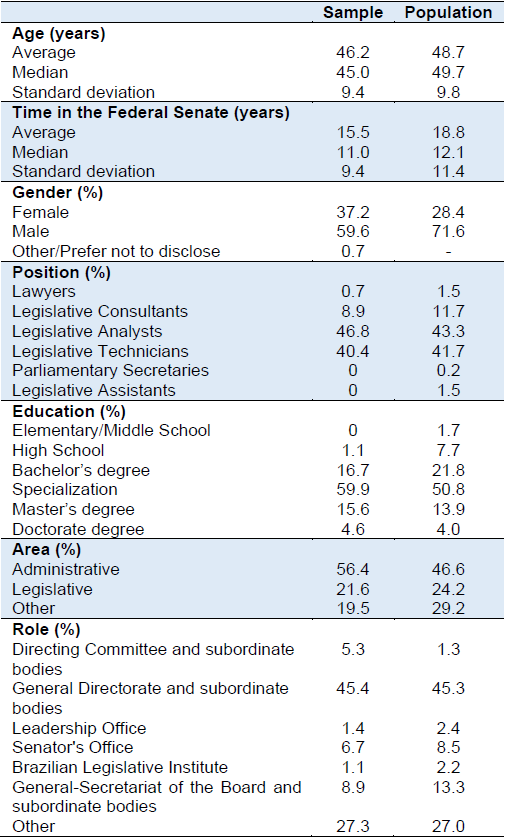
Regarding preliminary analyses, 18 missing values were identified among the different items of the questionnaire. The missing data were characterized as completely random (Little’s MCAR test: chi-square = 212.85; DF = 272; p = 0.997) and, therefore, were replaced using the Expected Maximization technique. Table 1 presents data regarding the sample profile and makes a comparison with the study population. It can be stated that, although not stratified, the sample encompassed the various categories relating to the professional profile existing in the organization.
Table 1
Comparison of sociodemographic data of the sample and permanent employees.
 Source: Elaborated by the authors.
As for the descriptive results, the level of work engagement obtained an average score of 4.2 (SD = 1.2; Median = 4.52; Mode = 4.65; Variance = 1.33), and the level of identification with the organizational purpose was 4.1 (SD = 1.3; Median = 4.42; Mode = 4.57; Variance = 1.70). Although it was not the primary objective of the study and was only conducted for exploratory and control purposes, the levels of engagement and identification with the purpose were compared between men and women, between employees in the administrative and legislative areas (t-test), by age and time in the Federal Senate (Pearson bivariate correlation). No significant differences were found.
Confirmatory factor analysis (CFA) was applied using structural equation modeling, a likelihood estimation method (Hair et al., 2009), to verify the adjustment of work engagement models. The model fit indices were verified by CMIN/df, where CMIN is the χ2 statistic, and df are the model's degrees of freedom, residual fit indices by SRMR (standardized root mean square residual) and RMSEA (root mean square of approximation), and the comparative indices CFI (comparative fit index) and TLI (Tucker-Lewis index). The instrument adjustment indicators in the single-factor and summary single-factor model are described in Table 2.
Table 2
Instrument adjustment indicators for the single-factor and summarized single-factor instruments
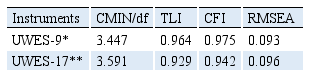 Source: Elaborated by the authors. * High covariance between items: 1 and 4; 10 and 11.
** High covariance between items: 1 and 4; 2 and 10; 15 and 17. Items 6, 11, and 12 were excluded.
The three-factor structure was not sustainable and did not achieve good rates for the sample investigated. The single-factor structure, in turn, achieved satisfactory indices, revealing good adjustment. The UWES-17 and UWES-9 structures were tested in one and three dimensions, which suggested that the one-factor model is the most appropriate in both cases. In the case of the summarized model with nine items, in addition to requiring less response time from the respondent, it is parsimonious, presented high covariance between a smaller number of items, did not require the exclusion of items, and achieved good fit indicators. The structural model, therefore, was tested based on the single-factor, summarized structure of work engagement.
The hypothesis postulated that identification with the organizational purpose, expressed through its mission and vision, positively influences the engagement of permanent employees. This hypothesis was supported (b= 0.70 and r2 = 0.56), and a strong relationship between these variables could be observed. Figure 1 presents the structural model found.
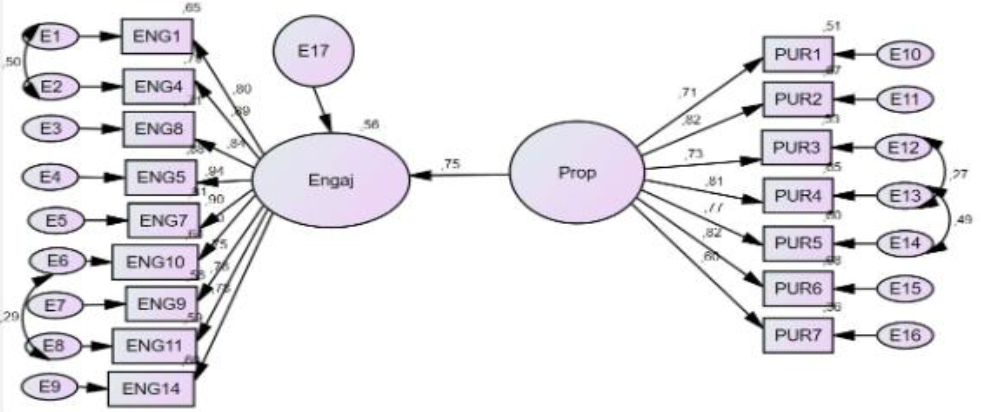 Figure 1.
Purpose to Engagement Model and Coefficients.
Source: Elaborated by the authors.
The instrument adjustment indicators for the structural model found are described in Table 3.
Table 3
Structural Equation Modeling adjustment indicators for the structural model
 Source: Elaborated by the authors.
Regarding the descriptive results, the average engagement score measured for permanent employees of the Federal Senate was 4.2 (SD = 1.2). Although slightly lower than that found by Vazquez et al. (2015) for Brazilian workers (M = 4.4; SD = 1.2), it is very close to the Brazilian average score and above the midpoint of the response scale.
Concerning the engagement experienced by civil servants, the descriptive results referring to the scores are in line with the commonly shared view of public servants as disengaged and unmotivated (Ribeiro & Mancebo, 2013), revealing that participants in the present study report experiencing frequent engagement at work and do not differ from Brazilian workers in other sectors and organizations in the country. When compared to the findings of the study conducted by Borst et al. (2019) involving thousands of public servants from the Netherlands, the participants in the present study presented an average score slightly higher than the average score of 3.90 found by the authors mentioned above. It can be assumed that the condition of the Brazilian labor market, often marked by high unemployment rates and informal situations, improves public servants' perception of their own work. At the same time, the Federal Senate plays a central, relevant, and direct role in the functioning of Brazilian society, exercising legislative, supervisory, and control powers. The mission of the Senate and, therefore, of its employees, naturally encompasses significant work for the employee, permeated by projects with important social results. According to a study by Camões et al. (2023), work perceived in this way tends to influence engagement in the public sector positively.
Still on average scores, while Vazquez et al. (2015) found a higher level of engagement among older workers with longer years of service, the present research did not detect significant differences by age group or length of service at the Agency. No significant differences were found in identification with the purpose and level of engagement between employees in the administrative and legislative areas, which suggests that these individual and socio-professional variables do not play an important role in predicting the phenomenon.
In terms of prediction, identification with the organizational purpose was presented as a strong antecedent of work engagement, explaining more than 50% of the variance in engagement and meeting suggestions and findings from previous studies (Moynihan & Pandey, 2007; van Tuin et al., 2020; Wright, 2007). Borst et al. (2019) emphasize that, in the public sector, one of the main work demands, considering the JD-R model, which has been consistently ignored, is the bureaucracy that permeates work processes. When employees encounter an excess of rules, regulations, and procedures that may seem meaningless, they tend to become alienated, less creative, and less productive (Borst et al., 2019). Engagement levels, therefore, could be compromised. The findings of the present study dialogue with previous discussions and gaps and highlight the importance of the organizational purpose and the employee's identification with it as a fundamental resource for addressing work engagement.
Regarding the conceptual and operational aspects of work engagement, it was found that the single-factor structure in the summarized version of the UWES-9 instrument was better suited to the sample, in line with the results of Ferreira et al. (2016) and Vazquez et al. (2015), contributing to the understanding that the UWES-9 in the single-factor summary version has shown good psychometric properties in Brazilian samples and is even more suitable for diagnoses and research in the investigated body and, possibly, in the public sector in general.
5 CONCLUSIONS
This work aimed to describe the levels of work engagement among permanent employees of the Federal Senate, verify the adequacy of the work engagement measurement model in the Federal Senate, and test a structural model examining the relationship between identification with the organizational purpose and work engagement. The objectives were successfully achieved, providing the investigated body with a comprehensive overview of employee engagement levels and identification with the organizational purpose. Additionally, it stimulated discussions on the topic within the public service, filling existing gaps in the field and paving the way for future investigations. Organizational purpose emerged as a significant antecedent, underscoring its centrality in understanding and addressing work engagement in the public sector.
The study delineated key work resources for engagement, well-documented in the literature, offering valuable insights for managers. Practices promoting greater autonomy, support for task content, cooperation among colleagues, and mutual support are effective strategies for fostering engagement. However, in the public sector, such practices may encounter legal and regulatory challenges inherent to the nature of civil service work, posing additional complexities. This study discusses potential pathways and practices to enhance work engagement, such as stimulating intrinsic motivation by clearly articulating tasks' alignment with institutional goals and providing comprehensive training to ensure employees understand their roles and contributions to strategic objectives. Encouraging collaboration among departments with complementary functions through working groups can foster mutual support and cooperation, aligning individual tasks with broader organizational objectives.
Given the identified gaps and results, a research agenda can be outlined for the field of people management and organizational behavior, particularly in the Brazilian public sector. One important aspect pertains to adopting a dialectical perspective on burnout and engagement, as suggested by Schaufeli and De Witte (2017). While previous research has often focused exclusively on either engagement or burnout within the JD-R model framework, future studies could explore the interrelationship between these phenomena. Studies can investigate the role of identification with the organizational purpose in mitigating the impact of work demands on employees and preventing experiences of stress and burnout, which warrants further exploration.
In theoretical-methodological terms, it is understood that engagement is a multifaceted and dynamic phenomenon. Bakker (2014) contends that daily fluctuations in work engagement stem from changes in personal and work-related resources. While consistent predictors can be identified over the long term, such as identification with the organizational purpose, investigating these daily variations is crucial for offering practical guidance to managers and employees. These inquiries lack sufficient data and discourse but gain relevance, particularly in light of the new work paradigms adopted by many organizations. Could information and communication technologies influence daily fluctuations in work engagement and employees' identification with the organization? Over time, would there be a net increase or decrease in employee engagement levels?
Work engagement remains a pertinent and timely subject in people management and organizational behavior, especially given the recent challenges and demands faced in the public service sector. The investment and consolidation of scientific insights into the engagement of public servants can furnish a sustainable foundation for medium- and long-term initiatives within organizations in this sector. Such efforts are essential for enhancing the quality and efficacy of services delivered to citizens.
REFERENCES
Bergue, S. T. (2010). Gestão de pessoas em organizações públicas. Caxias do Sul, RS: Educs.
Borst, R. T., Kruyen, P. M., & Lako, C. J. (2019). Exploring the job demands-resources model of work engagement in government: Bringing in a psychological perspective. Review of Public Personnel Administration, 39(3), 372-397. https://doi.org/10.1177/0734371X17729870
Camões, M. R. S., Gomes, A. O., Rizardi, B., & Lemos, J. (2023). Os ciclos de engajamento no trabalho de servidores públicos federais. Revista de Administração Pública, 57(4), e2023-0061. https://doi.org/10.1590/0034-761220230061
Christensen, R. K., Paarlberg, L., & Perry, J. L. (2017). Public service motivation research: Lessons for practice. Public Administration Review, 77(4), 529-542. https://doi.org/10.1111/puar.12796
Demo, G., Costa, A. C., & Coura, K. V. (2023). Human Resources Management Practices in the public service: Proposal of a measurement model. Rausp Management Journal, in press.
Ferreira, M. C., Valentini, F., Damásio, B. F., Mourão, L., Porto, J. B., Silva, R. C. C., & Pereira, M. M. (2016). Evidências adicionais de validade da UWES-9 em amostras brasileiras. Estudos de Psicologia, 21(4), 435-445. https://doi.org/10.5935/1678-4669.20160042
Field, A. (2018). Descobrindo a estatística usando o SPSS. Porto Alegre: Artmed.
Fletcher, L., Bailey, C., Alfes, K., & Madden, A. (2020). Mind the context gap: A critical review of engagement within the public sector and an agenda for future research. International Journal of Human Resource Management, 31(1), 6-46. https://doi.org/10.1080/09585192.2019.1674358
Fonseca, D. R., Meneses, P. P. M., Silva, A. I. S., Filho, & Campos, N. G. (2013). Autonomia para gestão estratégica de pessoas no setor público federal: Perspectivas de análise e agenda de pesquisa. Revista de Administração Pública, 47(6), 1451-1475. https://doi.org/10.1590/S0034-76122013000600006
Hair, J. F., Black, W. C., Babin, B. J., Anderson, R. E., & Tatham, R. L. (2009). Análise multivariada de dados. Bookman Editora.
Klein, F. A., & Mascarenhas, A. O. (2016). Motivação, satisfação profissional e evasão no serviço público: O caso da carreira de especialistas em Políticas Públicas e Gestão Governamental. Revista de Administração Pública, 50(1), 17-39. https://doi.org/10.1590/0034-7612146562
Kossyva, D., Theriou, G., Aggelidis, V., & Sarigiannidis, L. (2023). Definitions and antecedents of engagement: A systematic literature review. Management Research Review, 46(5), 719-738. https://doi.org/10.1108/MRR-01-2021-0043
Kulikowski, K., & Sedlak, P. (2020). Can you buy work engagement? The relationship between pay, fringe benefits, financial bonuses and work engagement. Current Psychology, 39, 343-353. https://doi.org/10.1007/s12144-017-9768-4
Magnan, E. D. S., Vazquez, A. C. S., Pacico, J. C., & Hutz, C. S. (2016). Normatização da versão brasileira da escala utrecht de engajamento no trabalho. Avaliação Psicológica, 15(2), 133-140. https://doi.org/10.15689/ap.2016.1502.01
Moynihan, D. P., & Pandey, S. K. (2007). Finding workable levers over work motivation: Comparing job satisfaction, job involvement, and organizational commitment. Administration & Society, 39(7), 803-832. https://doi.org/10.1177/0095399707305546
Perry, J. L., Hondeghem, A., & Wise, L. R. (2010). Revisiting the motivational bases of public service: Twenty years of research and an Agenda for the future. Public Administration Review, 70(5), 681-690. https://doi.org/10.1111/j.1540-6210.2010.02196.x
Schaufeli, W. B & Taris, W. T. (2014). A Critical review of the Job Demands-Resources model: Implications for improving work and health. In G. F. Bauer & O. Hämmig (Orgs.), Bridging Occupational, Organizational and Public Health: A Transdisciplinary Approach (pp. 43-66). NY: Springer.
Schaufeli, W. B. (2013). Employee engagement in theory and practice. In C. Truss, R. Delbridge, K. Alfes, A. Shantz, & E. Soane (Eds.), Employee Engagement in Theory and Practice (pp. 1-321). https://doi.org/10.4324/9780203076965
Schaufeli, W. B. et al. (2002). The measurement of engagement and burnout: A two sample confirmatory factor analytic approach. Journal of Happiness Studies, 3, 71-92.
Schaufeli, W. B., Bakker, A. B., & Salanova, M. (2006). The measurement of work engagement with a short questionnaire: A cross-national study. Educational and Psychological Measurement, 66(4), 701-716. https://doi.org/10.1177/0013164405282471
Schneider, B., Yost, A. B., Kropp, A., Kind, C., & Lam, H. (2018). Workforce engagement: What it is, what drives it, and why it matters for organizational performance. Journal of Organizational Behavior, 39(4), 462-480. https://doi.org/10.1002/job.2244
Tabachnick, B. G., & Fidell, L. S. (2019). Using multivariate statistics. New York: Harper & Row Collins College Publishers.
Tuin, L., Schaufeli, W. B., Van den Broeck, A., & van Rhenen, W. (2020). A corporate purpose as an antecedent to employee motivation and work engagement. Frontiers in Psychology, 11. https://doi.org/10.3389/fpsyg.2020.572343
Vazquez, A. C. S., Magnan, E. S., Pacico, J. C., Hutz, C. S., & Schaufeli, W. B. (2015). Adaptation and validation of the brazilian version of the utrecht work engagement scale. Psico-USF, 20(2), 207-217. https://doi.org/10.1590/1413-82712015200202
Vieira, C. B., Vilas Boas, A. A., Andrade, R. O. B., & Oliveira, E. R. (2011). Motivação na Administração Pública: Considerações teóricas sobre a aplicabilidade dos pressupostos das teorias motivacionais na esfera pública. Revista ADMpg Gestão Estratégica, 4(1), 1-18.
Zahari, N., & Kaliannan, M. (2022). Antecedents of work engagement in the public sector: A systematic literature review. Review of Public Personnel Administration. https://doi.org/10.1177/0734371X221106792

